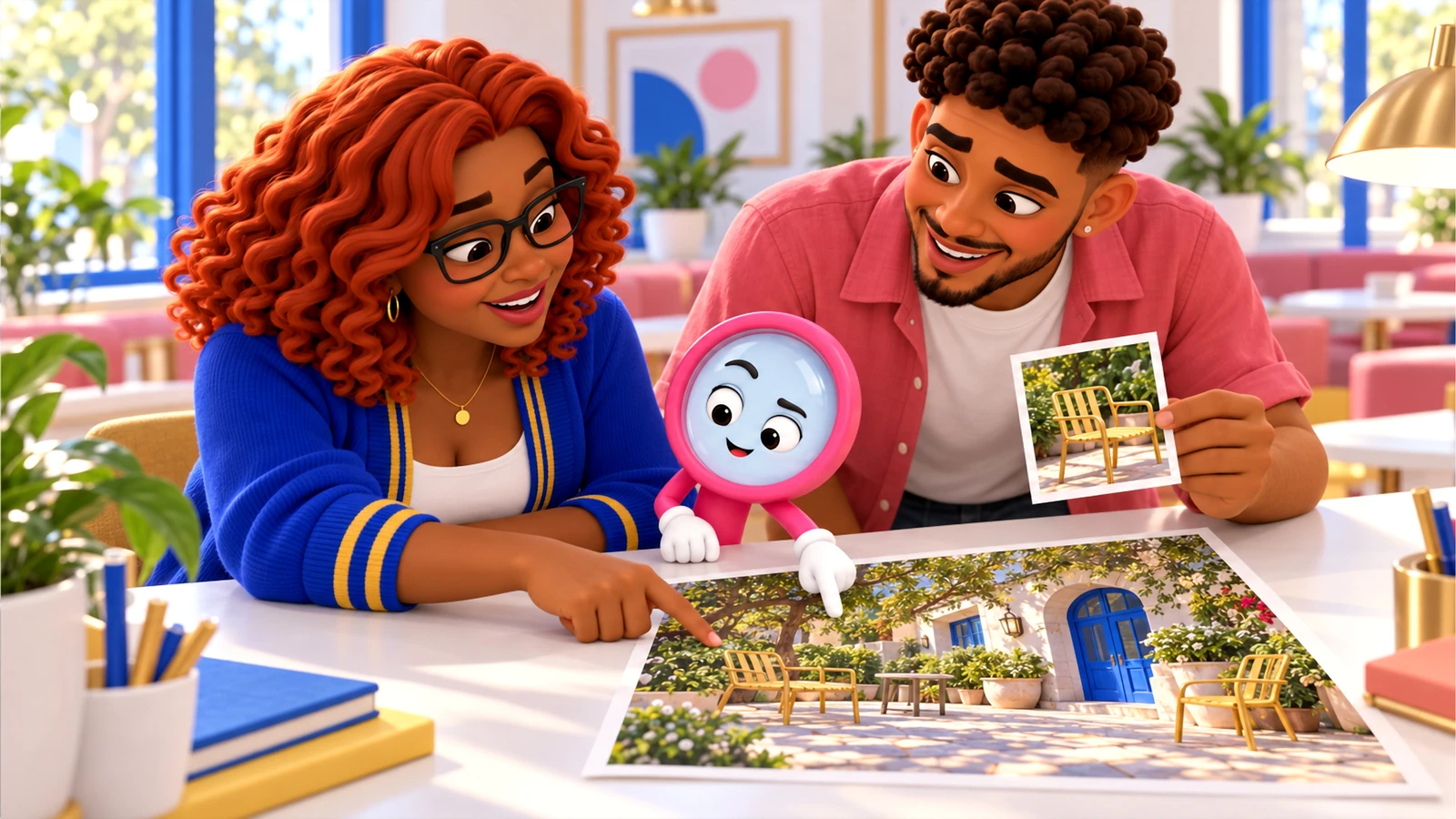
A convincing image is a starting point.
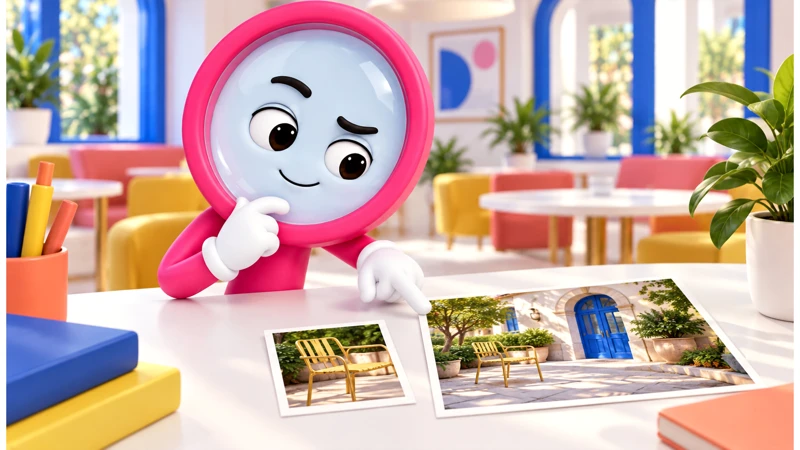
Gia and Mateo compare a cropped courtyard picture with the full photograph while Lupa points to the missing context.
I want to know what happened, not just whether the image looks convincing.
Adobe: AI-generated image examples
Adobe publishes clearly labeled images made with Firefly, including photorealistic examples. Use those actual examples to examine how plausible an invented scene can look; do not relabel them as news or claim they are currently viral.
Open the original referenceTwo prints. One caption that is spreading fast.
The image can start a question. It cannot answer all of it.
Hear what matters to each person. Choose a question. Notice what their answer adds, then check it against the case materials.
Sami
23, photographer checking where a file came from
“People are zooming into a hand. I want to know who first shared this and what the caption claims happened.”
Ask Sami
Is a strange detail proof it is generated?
Sami “It is a reason to look closer. It is not a universal test. A convincing detail does not prove the image is real either.”
What to check nextTrace the source and seek independent evidence of the claimed event.
What would useful provenance tell you?
Sami “Where the material came from and what is known about its handling. It might help, but I still need to understand what it establishes.”
What to check nextRead what the provenance record or tool actually says, including its limits.
Jordy
20, deciding whether the image belongs in a recap
“I want a clear answer before posting. “We cannot verify it yet” feels less satisfying, but it might be the honest one.”
Ask Jordy
What can you say without a verdict?
Jordy “What we checked, what we found and what we still cannot establish. The audience deserves that instead of my confidence level dressed up as fact.”
What to check nextWrite a verification note with supported findings and open questions.
Could we use it to teach the question?
Jordy “If its status is clear and we are not presenting it as proof of a real event. The example should not become the next misleading post.”
What to check nextLabel a practice example and preserve that context wherever it is shared.
Two people to hear from. Start with either one.
Put their perspectives together
Verification is a chain of checks. The useful response explains that chain and its limits, including when the available information does not settle the claim.
A person’s account explains their perspective. It still needs checking where it makes a factual claim.
Bring a companion into this.
Six ways to get unstuck
DudaFind the question
What new source or provenance information would change your assessment?
Try your first takePautaCheck who decides
Which separate legal question would require facts and authority beyond whether the image is synthetic?
Open the source fileLupaFollow the evidence
Trace the original context and corroborating sources. Distinguish provenance from proof of the depicted event.
Check the originalOndaConsider the people
Who could be harmed by a false identification, and what does a responsible update owe them?
Consider another viewNexoLook at the bigger picture
If a platform proposes mandatory labels, what problem does that address and what could remain unverified?
Read the explanationVozMake a next move
Prepare an evidence note about an image whose origin is uncertain. Explain what you can verify, what remains unknown and what would justify revising the note.
Build your responseFollow the question.
NIST’s synthetic-content report discusses provenance, watermarking, labeling, and detection, including their limitations. A detector output or an odd-looking hand is a clue, not a complete account of where an image came from. For a claim about a real event, look for the original publication, its date and context, available provenance information, and independent evidence of the event. ‘Unverified’ can be the most accurate conclusion.
Convincing pixels are not a source.
An image can look polished and still be generated, altered, old or presented with the wrong caption. An unusual hand is a clue to investigate, not a reliable universal test. A natural-looking hand is not proof of authenticity either.
NIST’s synthetic-content report examines technical approaches and their limits. Provenance, labels and detection tools answer different questions and can leave gaps. Start with the earliest available source, what is known about the file and independent evidence of the event. If you cannot verify the claim, describe that uncertainty rather than confidently declaring the image real or fake. You can use a labeled generated example to practice without sharing it as a real event.
- Provenance
- Information about where material came from and how it was handled.
- Corroboration
- Independent support for a claim.
- Uncertainty
- What the available information does not settle.
Una imagen puede verse impecable y aun así ser generada, alterada, antigua o tener un texto equivocado. Una mano extraña es una pista para investigar, no una prueba universal. Una mano que se ve normal tampoco demuestra autenticidad.
El informe de NIST examina métodos técnicos y sus límites. La procedencia, las etiquetas y las herramientas de detección responden preguntas diferentes y pueden dejar vacíos. Busca la fuente más temprana disponible, la información del archivo y evidencia independiente del suceso. Si no puedes verificar la afirmación, explica la incertidumbre en vez de asegurar que la imagen es real o falsa. Puedes practicar con un ejemplo generado y etiquetado sin presentarlo como un hecho.
- Procedencia
- Información sobre el origen y manejo de un material.
- Corroboración
- Respaldo independiente de una afirmación.
- Incertidumbre
- Lo que la información disponible no permite resolver.
A group chat shares a realistic image claiming a campus building flooded today. No original source is linked. What is the strongest response?
Choose an approach. You can explore every response.
Your turn. Make it useful.
Prepare an evidence note about an image whose origin is uncertain. Explain what you can verify, what remains unknown and what would justify revising the note.
Before you call it done: Have you avoided treating appearance or a missing provenance record as conclusive proof?
How the seven fields work together here
These questions shape the same assignment. Work through them in plain language; you don’t need seven separate essays.
- Public relations
- Who could be harmed by a false identification, and what does a responsible update owe them? The idea behind this
- Communication strategy
- How can your caption communicate uncertainty without making the image feel verified? The idea behind this
- Law and legal concepts
- Which separate legal question would require facts and authority beyond whether the image is synthetic? The idea behind this
- Policy and policy studies
- If a platform proposes mandatory labels, what problem does that address and what could remain unverified? The idea behind this
- Education and learning
- What new source or provenance information would change your assessment? The idea behind this
- Journalism and reporting
- Trace the original context and corroborating sources. Distinguish provenance from proof of the depicted event. The idea behind this
- Creativity
- Prototype two uncertainty notices. Ask readers what each lets them conclude and revise any misleading wording. The idea behind this
The research behind this case
These are our teaching applications of the ideas below. For the rule or factual claim itself, use this case’s source file.
Verification, context and accountability
Society of Professional Journalists, 2014. Professional ethics code.
Check information, preserve relevant context, consider harm and correct errors openly.
Keep in mind: Professional ethical guidance is not a statute or a guarantee that a claim is true.
Read the original sourceFraming
Robert M. Entman, 1993. Research article.
What a message selects and emphasizes can shape how a problem, its causes and possible responses are understood.
Keep in mind: Identifying a frame does not establish a speaker’s intent or prove how every audience member will respond.
Read the original sourceMake it specific.
Create an image-check card: claim, earliest source found, date/location evidence, provenance clues, corroboration, and confidence stated in plain language.
Write a verification note, not a verdict from vibes.
- Record the claim, earliest source you can locate and any provenance information.
- Look for independent evidence of the event; describe what a tool actually measured.
- Write what is supported, what remains uncertain and whether you would share it as evidence.
How you might tell a friend
I can’t verify the event from this image alone. I’m checking its source and independent records before sharing the claim.
Una forma de decirlo en español
No puedo verificar el suceso solo con esta imagen. Voy a revisar su fuente y registros independientes antes de compartir la afirmación.
Use your own voice. Keep the meaning, the evidence and the limits.
Where this example applies
The flooding example is invented. Do not fabricate an actual viral incident or imply NIST certifies a consumer detector as perfectly reliable.
The cultural reference starts a question. The other sources support the explanation.
Open the source file.
1Adobe: AI-generated image examples
Actual labeled primary examples produced with Adobe Firefly.
NIST: Synthetic Content Transparency
Provenance, labels, watermarking, detection, and technical limitations.
Sources checked September 23, 2026. General education; no independent expert review is claimed. Source standards