




Back to cases
Case 10Learning & support4 min

A city you can actually reach

Miles can swing over a barrier. Most people need a usable route.

In the conversationMariSamiOndaOnda
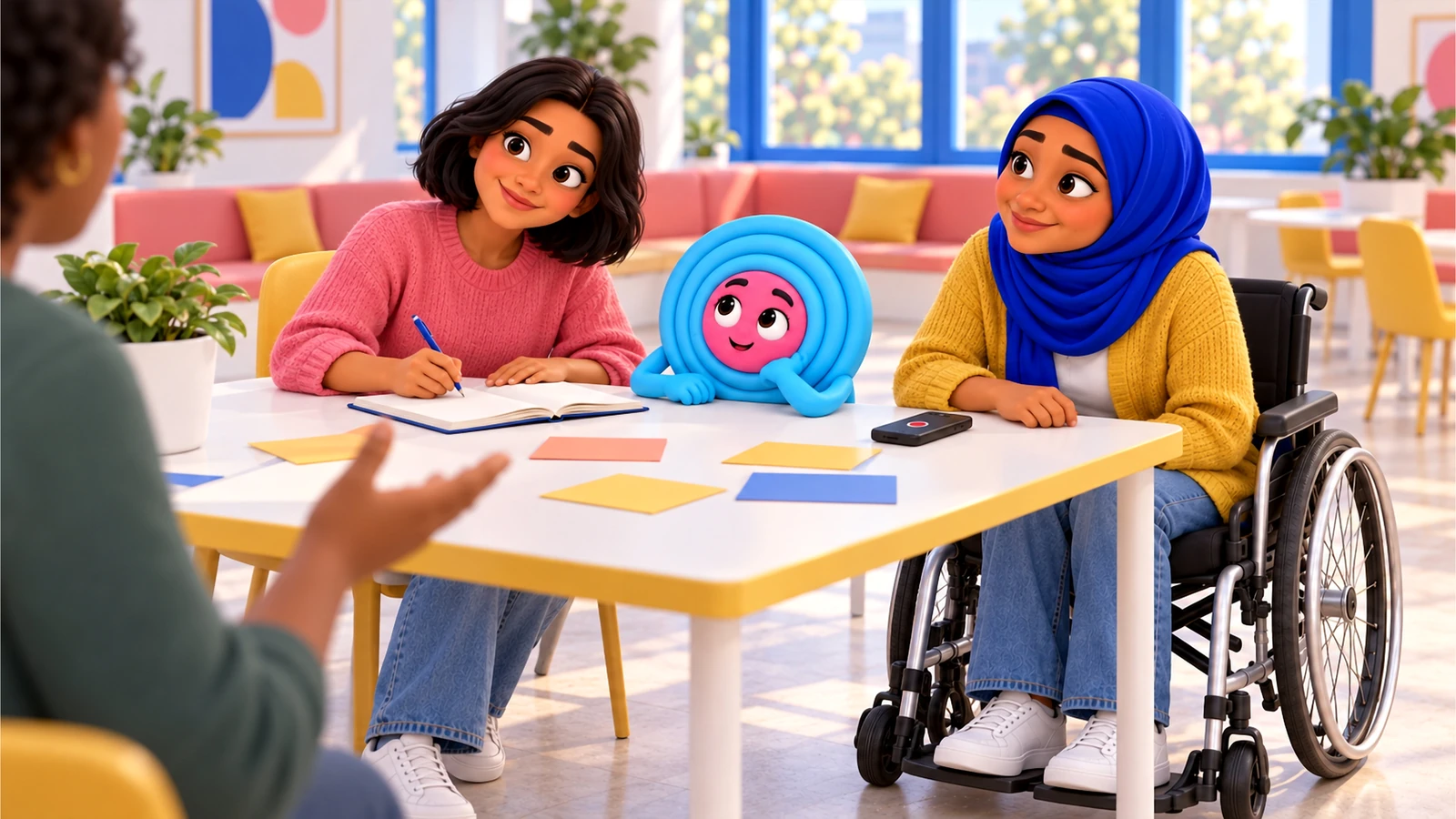
Mari, Sami and Onda listen and compare priorities at an accessible table in the Common Room.

The civic idea

Legal concepts

Getting to school, a library or a city program depends on sidewalks, ramps, buses and information, and when one piece fails, someone’s day falls apart. Knowing which law applies and which office to ask turns frustration into a request that can get a route fixed.

  • JurisdictionWhich laws and which government bodies apply to a place or program.
  • Claim vs. evidenceA claim says something is true; evidence is the record that supports or challenges it.
  • Program accessUnder ADA Title II, a government program as a whole must be accessible, even if not every older facility is.

SamiI don’t need a viral video, Mateo. I need to know if there’s a route that gets me to the bus in twelve minutes.

Take it off the pageFind your city’s ADA contact.

The route changed.

Mari, Sami and Onda listen and compare priorities at an accessible table in the Common Room.

Sami is with you

I want the whole route to work, not just the doorway.

The original reference

Sony: Into the Spider-Verse

Sony’s Spider-Verse introduces Brooklyn teenager Miles Morales. Use its city setting as an imaginative prompt: what makes a city usable when you cannot leap over its obstacles? This is our analogy, not an accessibility storyline claimed for the film.

Open the original reference

The usual route is blocked before the bus stop.

“Just go around” skips somebody’s actual journey.

Hear what matters to each person. Choose a question. Notice what their answer adds, then check it against the case materials.

Two people to hear from. Start with either one.

Put their perspectives together

Treat access as a journey and the person as a decision-maker. A clear observation is more useful than speaking for everyone who might encounter the same barrier.

A person’s account explains their perspective. It still needs checking where it makes a factual claim.

Follow the explanation

Bring a companion into this.

Six ways to get unstuck
DudaFind the question

Revise your access description after checking a part of the route you initially overlooked.

Try your first take
PautaCheck who decides

Which ADA source applies to the setting? Do not turn a photograph into a finding of legal compliance.

Open the source file
LupaFollow the evidence

Distinguish an observed measurement, a user report and an unverified assumption.

Check the original
OndaConsider the people

Whose experience would help test the route, and how can they contribute without being asked to represent everyone?

Consider another view
NexoLook at the bigger picture

What does “install a ramp” define as the problem, and which barriers could remain?

Read the explanation
VozMake a next move

Create an access brief for an invented trip through a public space. Show the whole route, the facts you have and the questions a responsible person still needs to answer.

Build your response

Follow the question.

The Justice Department explains that ADA Title II requires state and local government programs and services to be accessible to people with disabilities. Access can involve physical routes, communication, and changes to policies. Existing facilities and new construction do not have identical requirements. An observation of a barrier is a starting point for finding the responsible agency and asking how access is provided, not a complete legal finding.

Try the situation

“There’s a ramp” is not the end of the access question.

Think through the whole visit: finding the information, getting there, entering, taking part and leaving. A usable doorway does not solve an inaccessible registration form or a meeting people cannot hear.

The DOJ source explains obligations for state and local governments under ADA Title II. Program access and the rules for particular facilities are not identical questions. A photo of one entrance cannot settle compliance. In your own observation, record what happened, where and during which activity. Ask the person affected what they want changed instead of turning their experience into a public story without permission.

Program access
Whether a government service or program is accessible under the applicable requirements.
Barrier
Something that blocks or limits participation.
Effective communication
Communication that works for the people taking part, within the applicable requirements.

Piensa en toda la visita: encontrar la información, llegar, entrar, participar y salir. Una entrada accesible no resuelve un formulario que no se puede usar o una reunión que no se puede escuchar.

La fuente del Departamento de Justicia explica obligaciones de gobiernos estatales y locales bajo el Título II de la ADA. El acceso al programa y las reglas para instalaciones específicas no son la misma pregunta. Una foto de una entrada no determina el cumplimiento. Registra qué ocurrió, dónde y durante qué actividad. Pregunta a la persona afectada qué quiere cambiar antes de compartir públicamente su experiencia.

Acceso al programa
Accesibilidad de un servicio o programa según los requisitos aplicables.
Barrera
Algo que impide o limita participar.
Comunicación efectiva
Comunicación que funciona para quienes participan, según los requisitos aplicables.
An invented situation to think through

Your group is mapping the route to a city-run youth workshop. The obvious entrance has stairs. What belongs in your report?

Choose an approach. You can explore every response.

Your turn. Make it useful.

Create an access brief for an invented trip through a public space. Show the whole route, the facts you have and the questions a responsible person still needs to answer.

Before you call it done: Does a route marked usable actually include arrival, entry, movement and the activity itself?

How the seven fields work together here

These questions shape the same assignment. Work through them in plain language; you don’t need seven separate essays.

Public relations
Whose experience would help test the route, and how can they contribute without being asked to represent everyone? The idea behind this
Communication strategy
What would someone need to know before starting the trip, rather than only after arriving? The idea behind this
Law and legal concepts
Which ADA source applies to the setting? Do not turn a photograph into a finding of legal compliance. The idea behind this
Policy and policy studies
What does “install a ramp” define as the problem, and which barriers could remain? The idea behind this
Education and learning
Revise your access description after checking a part of the route you initially overlooked. The idea behind this
Journalism and reporting
Distinguish an observed measurement, a user report and an unverified assumption. The idea behind this
Creativity
Prototype a route guide in two forms. Ask whether the same information is usable without relying on color or an image alone. The idea behind this
The research behind this case

These are our teaching applications of the ideas below. For the rule or factual claim itself, use this case’s source file.

Universal Design for Learning Guidelines 3.0

CAST, 2024. Research-informed design guidance.

Provide options for engaging with material, understanding it and expressing learning while keeping the learning goal clear.

Keep in mind: Options should address actual barriers. Offering a choice of formats alone does not make an experience accessible.

Read the original source

What’s the problem represented to be?

Carol Bacchi. Author’s explanation of a policy-analysis approach.

Examine the view of the problem built into a proposed solution, including its assumptions and omissions. Question your own proposal, too.

Keep in mind: Our entry questions adapt part of WPR. They are not the complete approach or a substitute for evidence about an option’s effects.

Read the original source
Take this assignment to the making studio

Put your reasoning into words.

You can have a view and still have questions. Build a short take you can explain.

This stays in your browser and is not saved or submitted. Keep personal information out.

Voz asks what comes next

Make it specific.

Create a one-page route audit with an observed barrier, location, a question for the responsible agency, and a possible improvement. Label it a student observation, not a compliance inspection.

Check the sources

Make an observation someone can act on.

  1. Walk through a visit with consent, or review the public participation information.
  2. Describe one barrier without diagnosing anyone or declaring a legal violation.
  3. Ask the responsible office about the available access process and follow-up.

How you might tell a friend

The entrance is only one part of the visit. Can people find the information and participate once they arrive?
Una forma de decirlo en español

La entrada es solo una parte de la visita. ¿La gente puede encontrar la información y participar al llegar?

Use your own voice. Keep the meaning, the evidence and the limits.

Where this example applies

Fictional movie-to-civics analogy. Do not promise that every old building needs the same retrofit or every curb must have a ramp regardless of circumstances.

Lupa keeps the sources close

The cultural reference starts a question. The other sources support the explanation.

Open the source file.

1

Sony: Into the Spider-Verse

Official cultural source; Brooklyn teenager Miles Morales.

2

DOJ: ADA and City Governments

Title II program access, physical/communication access, and distinctions for existing facilities.

Sources checked September 23, 2026. General education; no independent expert review is claimed. Source standards

Another angle?

Find another case
Bring this case to your course

English language arts and writing are the main fit. Civics, journalism, communications and sociology courses can add their disciplinary sources. These are selected practice targets; your submitted work shows what you can do.

Common Core targets and evidence

Grade 6

a labeled fictional route map with evidence, barriers and questions at every stage; a revised written product; and a teacher observation or transcript of collaborative discussion.

  • RI.6.1 Cite a relevant source passage and distinguish what it states from an inference. Apply this to arrival, entry, movement and participation across an entire route.
  • W.6.2 Explain the distinctions among arrival, entry, movement and participation across an entire route in a labeled fictional route map with evidence, barriers and questions at every stage.
  • W.6.5 Submit a first draft and revision; identify a factual, reasoning or audience change prompted by feedback.
  • SL.6.1.c Ask a specific question, respond with detail and paraphrase another perspective.
  • SL.6.1.d Ask a specific question, respond with detail and paraphrase another perspective.
Grade 7

a labeled fictional route map with evidence, barriers and questions at every stage; a revised written product; and a teacher observation or transcript of collaborative discussion.

  • RI.7.1 Cite several relevant source details and explain how they support the distinction. Apply this to arrival, entry, movement and participation across an entire route.
  • W.7.2 Explain the distinctions among arrival, entry, movement and participation across an entire route in a labeled fictional route map with evidence, barriers and questions at every stage.
  • W.7.5 Submit a first draft and revision; identify a factual, reasoning or audience change prompted by feedback.
  • SL.7.1.c Ask for elaboration and record whether new information changes your view.
  • SL.7.1.d Ask for elaboration and record whether new information changes your view.
Grade 8

a labeled fictional route map with evidence, barriers and questions at every stage; a revised written product; and a teacher observation or transcript of collaborative discussion.

  • RI.8.1 Select the strongest evidence and explain why it is stronger than an alternative detail. Apply this to arrival, entry, movement and participation across an entire route.
  • W.8.2 Explain the distinctions among arrival, entry, movement and participation across an entire route in a labeled fictional route map with evidence, barriers and questions at every stage.
  • W.8.5 Submit a first draft and revision; identify a factual, reasoning or audience change prompted by feedback.
  • SL.8.1.c Connect ideas from several speakers and qualify or justify your view with evidence.
  • SL.8.1.d Connect ideas from several speakers and qualify or justify your view with evidence.
Grade 9–10

a labeled fictional route map with evidence, barriers and questions at every stage; a revised written product; and a teacher observation or transcript of collaborative discussion.

  • RI.9-10.1 Use strong, thorough evidence and distinguish direct source support from a disputed inference. Apply this to arrival, entry, movement and participation across an entire route.
  • W.9-10.2 Explain the distinctions among arrival, entry, movement and participation across an entire route in a labeled fictional route map with evidence, barriers and questions at every stage.
  • W.9-10.5 Submit a first draft and revision; identify a factual, reasoning or audience change prompted by feedback.
  • SL.9-10.1.c Invite a peer, verify or challenge a conclusion, and summarize agreement and disagreement.
  • SL.9-10.1.d Invite a peer, verify or challenge a conclusion, and summarize agreement and disagreement.
Grade 11–12

a labeled fictional route map with evidence, barriers and questions at every stage; a revised written product; and a teacher observation or transcript of collaborative discussion.

  • RI.11-12.1 Use strong, thorough evidence and explicitly identify an uncertainty that the source leaves unresolved. Apply this to arrival, entry, movement and participation across an entire route.
  • W.11-12.2 Explain the distinctions among arrival, entry, movement and participation across an entire route in a labeled fictional route map with evidence, barriers and questions at every stage.
  • W.11-12.5 Submit a first draft and revision; identify a factual, reasoning or audience change prompted by feedback.
  • SL.11-12.1.c Synthesize positions, resolve a contradiction where possible and name additional information needed.
  • SL.11-12.1.d Synthesize positions, resolve a contradiction where possible and name additional information needed.

Course variations

Pre-AP English 1 and English 2 practice

English 1: Closely annotate two pivotal wording or design choices in the case records about arrival, entry, movement and participation across an entire route; write one analytical paragraph explaining how those choices affect meaning, then revise the case product. English 2: Compare three relevant records, develop a cohesive multi-paragraph analysis or supported recommendation, address a competing interpretation and explain one revision.

Turn in: English 1: annotated excerpt + analytical paragraph + revised product. English 2: source comparison + sustained analysis/argument + revision memo.

  • Specific details support the explanation of arrival, entry, movement and participation across an entire route.
  • Commentary connects wording or design to meaning, rather than only naming features.
  • The argument/analysis has a precise focus and relevant evidence.
  • English 2 integrates sources and addresses a plausible competing view.
Official course framework
AP English Language practice

Recommend a route or design change using the full access chain, fair alternatives and limits of available information. Build a defensible thesis from the case records and appropriate primary-source material; explain how each source supports the reasoning, qualify a claim and revise the argument for the case’s named audience.

Turn in: Source-supported argument + fair counterclaim + audience-specific revision and commentary

  • A defensible thesis takes a clear, qualified position.
  • Evidence and commentary accurately handle arrival, entry, movement and participation across an entire route.
  • The strongest plausible counterclaim receives fair treatment.
  • Organization and language suit the intended reader; qualification reflects an actual evidentiary limit.

Selected course-skill practice; not an official AP task, exam simulation or score prediction.

Official course framework
IB MYP Language and Literature practice

Compare two case texts about arrival, entry, movement and participation across an entire route, supporting an interpretation of a creator’s choices. Organize the findings with references, create the case’s reader-facing product, then explain how a draft changed for its audience.

Turn in: Supported text comparison + referenced plan + original revised product + audience reflection

  • A: A supported comparison explains a textual choice connected to arrival, entry, movement and participation across an entire route.
  • B: Ideas and references are organized so the reader can follow the reasoning.
  • C: The original product makes intentional choices for a specified audience and shows development from draft to revision.
  • D: Vocabulary, register and expression communicate accurately in the chosen context.

Teacher selects the actual MYP year descriptors. These local indicators do not assign official achievement levels.

Official course framework
IB DP Language A: Language and Literature practice

How do a map or public-space access notice’s symbols, omissions and wording shape who appears able to participate? Choose a substantive nonliterary case text and write a guided textual analysis: develop an interpretation, analyze specific authorial choices and evaluate how they shape meaning. Keep a public-policy recommendation separate from the textual analysis.

Turn in: Focused guided textual analysis of one substantial nonliterary text, with precise textual/visual references

  • A: A reasoned interpretation is grounded in relevant references.
  • B: Analysis evaluates how particular language, structure or visual choices shape meaning.
  • C: A focused line of argument connects paragraphs.
  • D: Clear, precise analytical language suits the task.

Paper 1 skill practice only. Not an assessed individual oral, HL essay or Paper 2; those have additional work/body-of-work requirements.

Official course framework
Honors extension — locally defined

Test two complete routes against explicit access requirements, document a failure point and identify evidence required before claiming usability. Independently locate an appropriate corroborating source, document its limits and defend which new evidence would change your conclusion.

Turn in: Independent inquiry/decision memo + rival explanation or option + limitations/revision-trigger note

  • Independent evidence is traceable and relevant.
  • The analysis accurately handles arrival, entry, movement and participation across an entire route.
  • A serious competing interpretation or option is tested fairly.
  • The conclusion names a material limit and a concrete condition for revision.

No national Honors code or certification is asserted. Add the school’s actual course expectations.

Set the criteria with your local course teacher.

Keep the first draft, source notes, a discussion record and your revision. A solo response does not demonstrate a collaborative discussion standard. AP, Pre-AP and IB routes are independently designed practice, not official program assessments. Honors expectations are set locally.

See the complete curriculum crosswalk