


Pause the track.
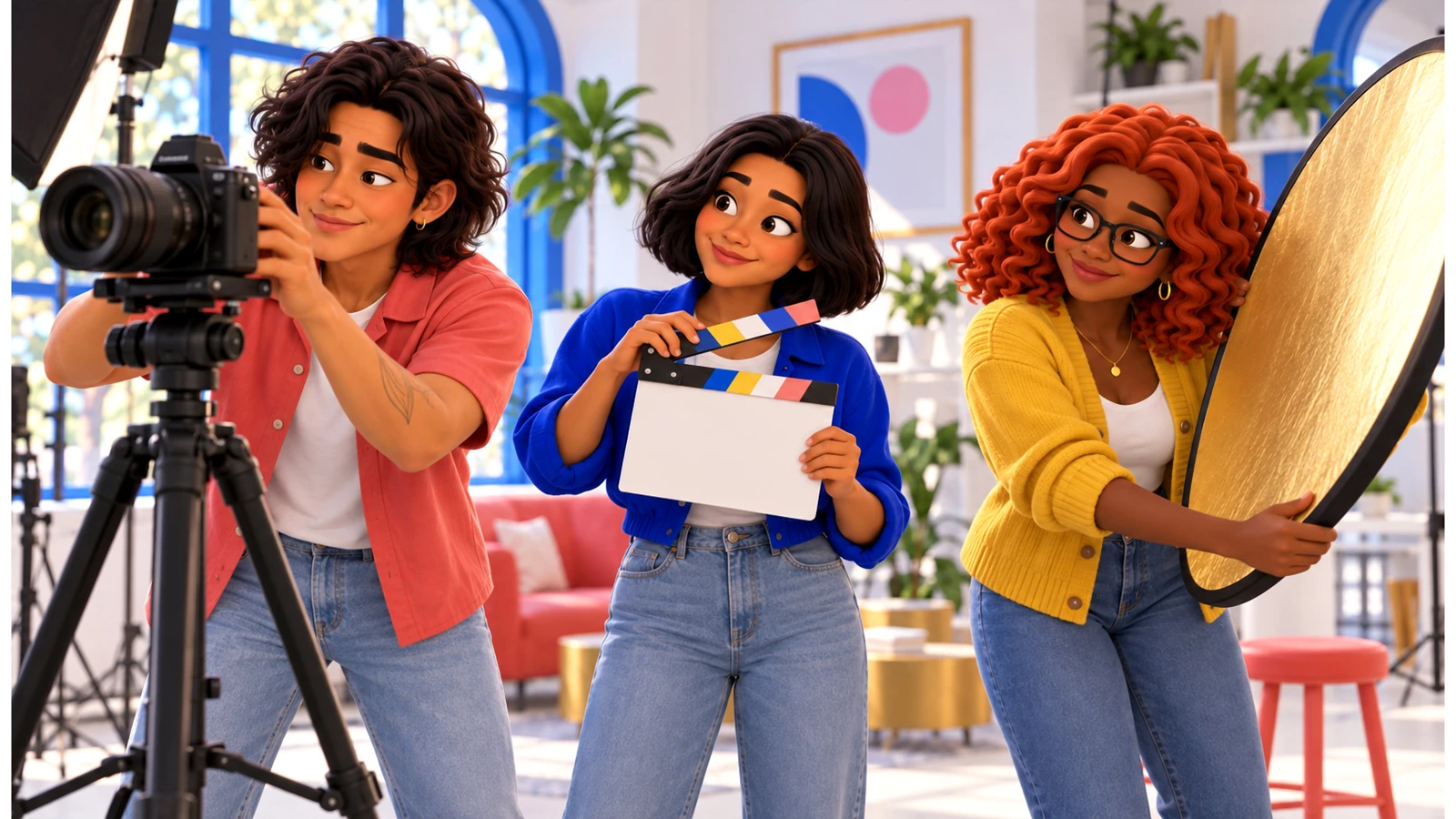
Caio, Mari and Gia set up a camera shoot in a bright studio.
Credit matters. It is not the only thing to check.
TikTok: Introducing Stitch
TikTok’s official Stitch announcement shows how remix culture lets users combine part of another video with their own; the original creator controls whether Stitch is enabled, and the feature credits the original post. That platform feature is different from downloading someone’s entire video and reposting it elsewhere.
Open the original referenceThe track sounds good. The upload is paused.
A credit line is not the whole permission question.
Hear what matters to each person. Choose a question. Notice what their answer adds, then check it against the case materials.
Caio
24, editor with a rough cut on the desk
“The sample makes the scene. I still need a reason I can explain for using it.”
Ask Caio
Does changing it automatically settle things?
Caio “No. “I edited it” describes what I did. It does not finish the rights analysis.”
What to check nextIdentify the work, the specific use and the applicable permission or legal basis.
What is the workable alternative?
Caio “Our own recording or material with a license that allows this use. I would rather change the cut than gamble on a rule I made up.”
What to check nextRead the actual license terms and keep the permission with the project.
Mateo
22, wants to share the finished piece tonight
“I was about to say “we will credit them.” Caio asked whether credit was the thing we needed.”
Ask Mateo
Why is credit not enough by itself?
Mateo “It tells people whose work it is. Permission asks a different question. I need to stop treating those as interchangeable.”
What to check nextKeep attribution, permission and a fair-use analysis distinct.
What if somebody says ten seconds is always fine?
Mateo “I want the source for that rule. A confident comment is not enough to build the whole release around.”
What to check nextRead the Copyright Office guidance instead of using a fixed-duration shortcut.
Two people to hear from. Start with either one.
Put their perspectives together
Make the creative choice alongside the rights question. The goal is an explanation grounded in this use, not a shortcut that promises every remix is allowed.
A person’s account explains their perspective. It still needs checking where it makes a factual claim.
Bring a companion into this.
Six ways to get unstuck
DudaFind the question
What detail about your planned use could change your first assessment?
Try your first takePautaCheck who decides
Apply the case’s fair-use questions to the particular use. There is no automatic percentage rule here.
Open the source fileLupaFollow the evidence
Trace the original, credit it accurately and distinguish permission from your own legal interpretation.
Check the originalOndaConsider the people
What do the original creator, remixer and audience each need to know about the relationship?
Consider another viewNexoLook at the bigger picture
What does a platform’s remix feature make possible, and which rights questions does it leave unresolved?
Read the explanationVozMake a next move
Plan an original remix and write a short rationale for how you would assess its use of someone else’s work. Include uncertainty and a permission-based alternative.
Build your responseFollow the question.
The U.S. Copyright Office explains that fair use is a case-by-case assessment of purpose, the original work, the amount used, and market effect. Educational intent is relevant, but does not automatically make every use fair. There is no universal safe number of seconds. For a class project, first identify the material you need, its permission or license, and why you are using it.
Giving credit answers who made it. Permission is another question.
A credit, a platform remix button and a legal basis to reuse a work do different jobs. A creator can appreciate attribution and still hold rights in the material. Moving a remix to another platform may also change the permissions you are relying on.
The Copyright Office describes fair use as a case-specific assessment using four factors. “For school,” “only a few seconds” and “I’m not making money” are not automatic answers. Identify the original work, what you want to use, your purpose and any license or permission. Then compare the relevant factors without presenting your first judgment as a guaranteed outcome. Creating your own material or using clearly licensed work may make the project easier to finish.
- Attribution
- Naming or crediting a source.
- License
- Permission to use a work under particular terms.
- Fair use
- A U.S. copyright doctrine evaluated in context using statutory factors.
Dar crédito, usar una función de remix y tener una base legal para reutilizar una obra son cosas distintas. Una persona puede agradecer la atribución y conservar derechos sobre el material. Llevar el remix a otra plataforma también puede cambiar los permisos en los que te apoyas.
La Oficina de Derechos de Autor describe el uso justo como una evaluación de cuatro factores que depende de cada caso. “Es para la escuela”, “son pocos segundos” y “no gano dinero” no son respuestas automáticas. Identifica la obra, el fragmento, tu propósito y cualquier licencia o permiso. Examina los factores sin prometer un resultado. Crear material propio o usar obras con licencias claras puede facilitar el proyecto.
- Atribución
- Identificar o dar crédito a una fuente.
- Licencia
- Permiso para usar una obra bajo condiciones específicas.
- Uso justo
- Doctrina estadounidense evaluada según el contexto y factores legales.
You want to explain a creator’s argument in a class video. Which planning note is strongest?
Choose an approach. You can explore every response.
Your turn. Make it useful.
Plan an original remix and write a short rationale for how you would assess its use of someone else’s work. Include uncertainty and a permission-based alternative.
Before you call it done: Does the rationale consider the actual use without promising that attribution or a platform feature makes it lawful?
How the seven fields work together here
These questions shape the same assignment. Work through them in plain language; you don’t need seven separate essays.
- Public relations
- What do the original creator, remixer and audience each need to know about the relationship? The idea behind this
- Communication strategy
- How will viewers distinguish the original material, your additions and your interpretation? The idea behind this
- Law and legal concepts
- Apply the case’s fair-use questions to the particular use. There is no automatic percentage rule here. The idea behind this
- Policy and policy studies
- What does a platform’s remix feature make possible, and which rights questions does it leave unresolved? The idea behind this
- Education and learning
- What detail about your planned use could change your first assessment? The idea behind this
- Journalism and reporting
- Trace the original, credit it accurately and distinguish permission from your own legal interpretation. The idea behind this
- Creativity
- Sketch a version using the source and another using original or licensed material. Compare purpose, meaning and constraints. The idea behind this
The research behind this case
These are our teaching applications of the ideas below. For the rule or factual claim itself, use this case’s source file.
Authority and jurisdiction
Cornell Legal Information Institute. Legal reference.
Whether legal authority binds a decision-maker depends on the relevant jurisdiction and legal system.
Keep in mind: This reference introduces a concept. The actual rule, jurisdiction, facts and current primary sources must be checked in each case.
Read the original sourceThe Double Diamond
Design Council. Professional design framework.
Understand the situation, define the challenge, explore alternatives, then test and improve a response.
Keep in mind: We adapt the process for small creative assignments. A polished artifact does not make an unsupported claim accurate.
Read the original sourceMake it specific.
Create a four-item rights log for your project: creator/source, intended use, permission or license, and any fair-use reasoning requiring review.
Make a reuse record before you edit.
- List each outside image, clip, sound or quote.
- Record its source and the permission, license or legal reasoning you would rely on.
- Check whether the planned publication matches those terms; use an alternative if you cannot support the use.
How you might tell a friend
Credit matters, but I still need to check the terms for this use and this platform.
Una forma de decirlo en español
Dar crédito importa, pero todavía tengo que revisar las condiciones para este uso y esta plataforma.
Use your own voice. Keep the meaning, the evidence and the limits.
Where this example applies
TikTok’s cited announcement is from 2020 and documents the feature’s launch; do not copy its menu instructions as a current tutorial. In-app permissions are not a blanket license for every later use.
The cultural reference starts a question. The other sources support the explanation.
Open the source file.
1TikTok: Introducing Stitch
Actual platform cultural example; original creator controls and attribution.
U.S. Copyright Office: Fair Use
Four-factor, case-specific assessment; education is not automatically fair use.
Sources checked September 23, 2026. General education; no independent expert review is claimed. Source standards