



Start close to home.
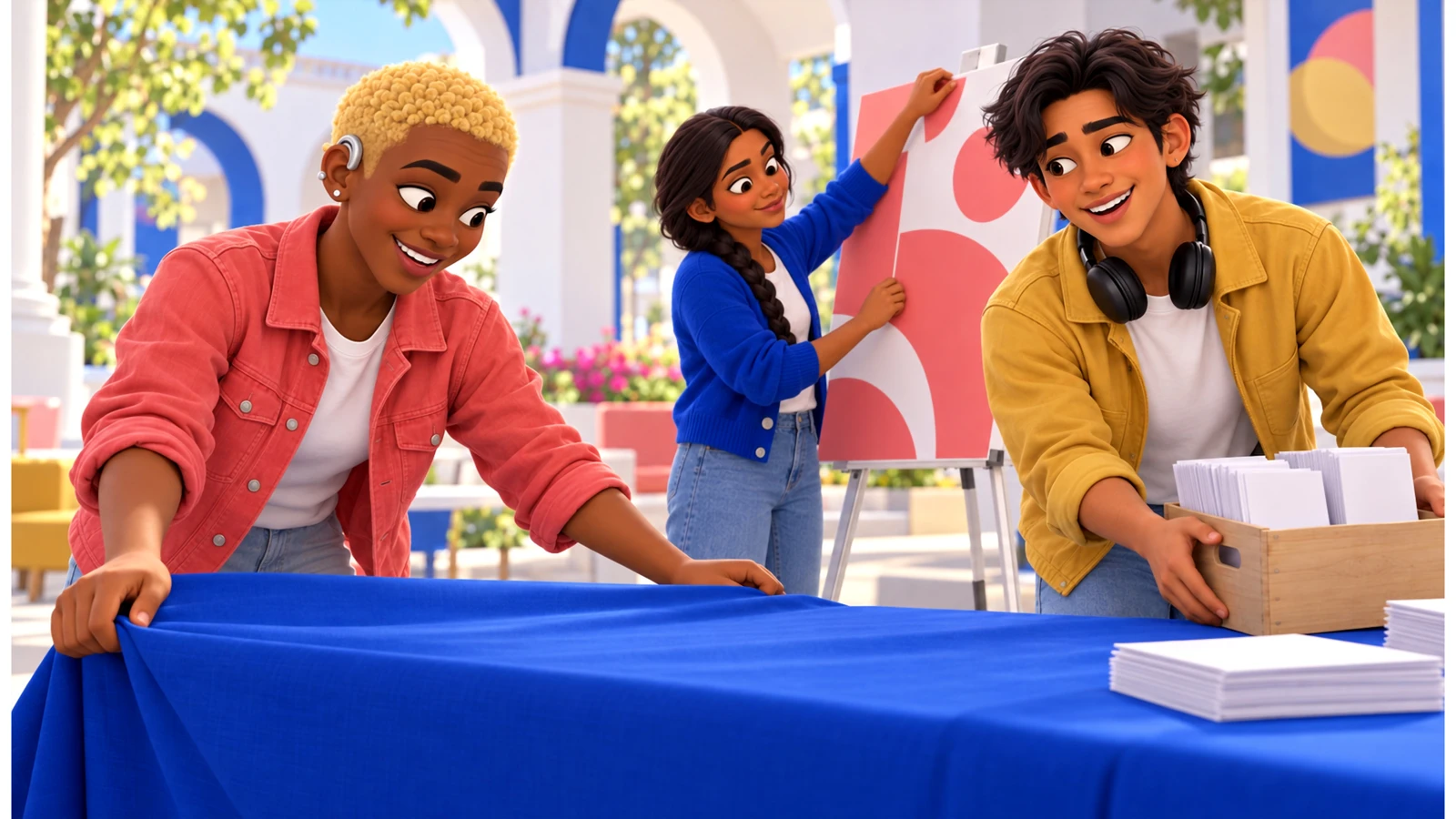
Jordy, Rafa and Anika set up a campus organization table.
I don’t need someone to pick for me. I need to know what I’m deciding and where to check it.
Start with your state or territory at Vote.gov
This case starts with a real tool, not a fictional election. Use the official information for your location before researching the choices on your ballot.
Open the original referenceA moment with the cast
Read the scene description
Anika turns her notebook toward you, Mari lowers her zine and Dec puts down his phone. Nexo follows the group’s attention toward the table. A silent animated scene.
At the library desk, the names are only the start.
Which office can do the thing you care about?
Hear what matters to each person. Choose a question. Notice what their answer adds, then check it against the case materials.
Mateo
22, comparing offices on a sample ballot
“Every post makes it sound like one election decides everything. I want to know who controls the thing I am actually worried about.”
Ask Mateo
Where would you start?
Mateo “The official sample ballot for my address, then what each office is responsible for. I do not want to ask the wrong office for a promise it cannot keep.”
What to check nextUse the official election office and the relevant office’s description of its responsibilities.
Can your friend use the same checklist?
Mateo “The questions, yes. My deadlines or ballot, not automatically. Their address and situation might put them under different rules.”
What to check nextVerify eligibility, registration, dates and methods through the applicable official election source.
Gia
21, turning research into a message friends can use
“I want to share something useful without pretending I am everybody’s election office.”
Ask Gia
What belongs in the group chat?
Gia “The official lookup link, what it helps you find and a reminder to check your own details. Not somebody’s full address or voter information.”
What to check nextShare the route to the information rather than collecting friends’ private information.
What if someone cannot vote yet?
Gia “They can still learn what an office does, ask questions and look for participation options they are eligible for. Being informed is not on hold.”
What to check nextFind an appropriate meeting, student role or civic learning opportunity.
Two people to hear from. Start with either one.
Put their perspectives together
Keep the office, authority and voting process separate. The next step should point a person to their own official information, not a copied deadline from another place.
A person’s account explains their perspective. It still needs checking where it makes a factual claim.
Bring a companion into this.
Six ways to get unstuck
DudaFind the question

What assumption about a deadline or eligibility rule would you check before passing it on?
Try your first takePautaCheck who decides

Which election office governs the place and election being discussed?
Open the source fileLupaFollow the evidence
Record the official source, place, election and check date. Separate facts from commentary.
Check the originalOndaConsider the people

What practical questions might a first-time participant have, and who might your chosen channel miss?
Consider another viewNexoLook at the bigger picture
If the proposed fix is clearer information, which participation barriers does that address and which remain?
Read the explanationVozMake a next move

Create a nonpartisan source guide for someone checking a local election. Use official information for their jurisdiction and date; keep candidate preference out of the guide.
Build your responseFollow the question.
A sample ballot shows which contests and measures you will encounter. A voter guide can provide background or arguments. They serve different purposes. Start by finding the ballot for your actual address. USA.gov explains the difference.
Registration rules, deadlines and voting options vary by state and territory. Vote.gov directs you to the relevant official information. If you are under 18, check preregistration and age rules for your location; some states have exceptions for certain 17-year-olds in primaries. Do not assume a friend’s rules apply to you. Check Vote.gov’s age guide.
Your address helps determine your ballot. Your feed does not.
A sample ballot tells you which contests and measures apply to a particular election and location. A voter guide explains or recommends choices. Keep those functions separate, even when the guide comes from someone you trust.
Start with official eligibility and registration information for your own state or territory. If you moved for school, ask the election office which address and process apply to your situation. Do not copy a friend’s deadlines or assume student status establishes eligibility. You can compare candidates’ or measures’ actual proposals with reliable reporting without asking this platform to decide for you. If you are not eligible to vote, community and campus participation offer other places to learn and contribute.
- Sample ballot
- A preview of the contests and measures for an election and location.
- Registration
- The process for being listed to vote where registration is required.
- Jurisdiction
- The geographic or legal area a particular authority covers.
Una papeleta de muestra indica qué elecciones y medidas corresponden a una elección y un lugar específicos. Una guía electoral explica o recomienda opciones. Son funciones distintas, aunque confíes en quien preparó la guía.
Empieza por la información oficial de elegibilidad e inscripción de tu estado o territorio. Si te mudaste por estudios, consulta a la oficina electoral qué dirección y proceso corresponden a tu situación. No copies los plazos de una amistad ni supongas que ser estudiante establece elegibilidad. Puedes comparar las propuestas y consultar periodismo confiable sin que esta plataforma decida por ti. Si no puedes votar, también hay espacios comunitarios y estudiantiles donde aprender y participar.
- Papeleta de muestra
- Vista previa de las elecciones y medidas correspondientes.
- Inscripción electoral
- Proceso para figurar como votante donde se requiere inscripción.
- Jurisdicción
- Ámbito geográfico o jurídico de una autoridad.
You moved recently. A friend sends their sample ballot and says, “Just use this one.” What would you do?
Choose an approach. You can explore every response.
Your turn. Make it useful.
Create a nonpartisan source guide for someone checking a local election. Use official information for their jurisdiction and date; keep candidate preference out of the guide.
Before you call it done: Can a reader locate the official office and identify which details still need a current check?
How the seven fields work together here
These questions shape the same assignment. Work through them in plain language; you don’t need seven separate essays.
- Public relations
- What practical questions might a first-time participant have, and who might your chosen channel miss? The idea behind this
- Communication strategy
- How will a reader check the information without relying only on a screenshot? The idea behind this
- Law and legal concepts
- Which election office governs the place and election being discussed? The idea behind this
- Policy and policy studies
- If the proposed fix is clearer information, which participation barriers does that address and which remain? The idea behind this
- Education and learning
- What assumption about a deadline or eligibility rule would you check before passing it on? The idea behind this
- Journalism and reporting
- Record the official source, place, election and check date. Separate facts from commentary. The idea behind this
- Creativity
- Try a source checklist and a plain-language audio guide. Test whether both lead to the same official information. The idea behind this
The research behind this case
These are our teaching applications of the ideas below. For the rule or factual claim itself, use this case’s source file.
Authority and jurisdiction
Cornell Legal Information Institute. Legal reference.
Whether legal authority binds a decision-maker depends on the relevant jurisdiction and legal system.
Keep in mind: This reference introduces a concept. The actual rule, jurisdiction, facts and current primary sources must be checked in each case.
Read the original sourceSituational theory of problem solving
Jeong-Nam Kim and James E. Grunig, 2011. Research article.
How people recognize a problem, connect it to their lives and perceive barriers helps explain their communication about it.
Keep in mind: A prompt for asking about people’s circumstances, not a way to infer someone’s beliefs from their identity.
Read the original sourceMake it specific.
At Vote.gov, choose your state or territory. Check your registration information and follow the official route to your election office. Find your sample ballot and any rules that apply to you.
Build your own official-information checklist.
- Find your election office through Vote.gov or USAGov.
- Check eligibility, registration details, deadlines and the sample ballot that applies to you.
- Write down one question for the election office and one factual claim to research about a contest.
How you might tell a friend
First I’m checking which ballot and deadlines apply to me. Then I can research the choices.
Una forma de decirlo en español
Primero voy a comprobar qué papeleta y fechas me corresponden. Después puedo investigar las opciones.
Use your own voice. Keep the meaning, the evidence and the limits.
Where this example applies
United States. No candidate, party or ballot-measure endorsement. Rules vary by jurisdiction.
The cultural reference starts a question. The other sources support the explanation.
Open the source file.
1Your state or territory’s voting information
The official registration gateway and routes for checking or updating registration.
Preparing to vote at 18 and under
Preregistration and voting-age exceptions depend on location.
Sample ballots and voter guides
What each contains and where to find the ballot that applies to you.
Sources checked September 23, 2026. General education; no independent expert review is claimed. Source standards