
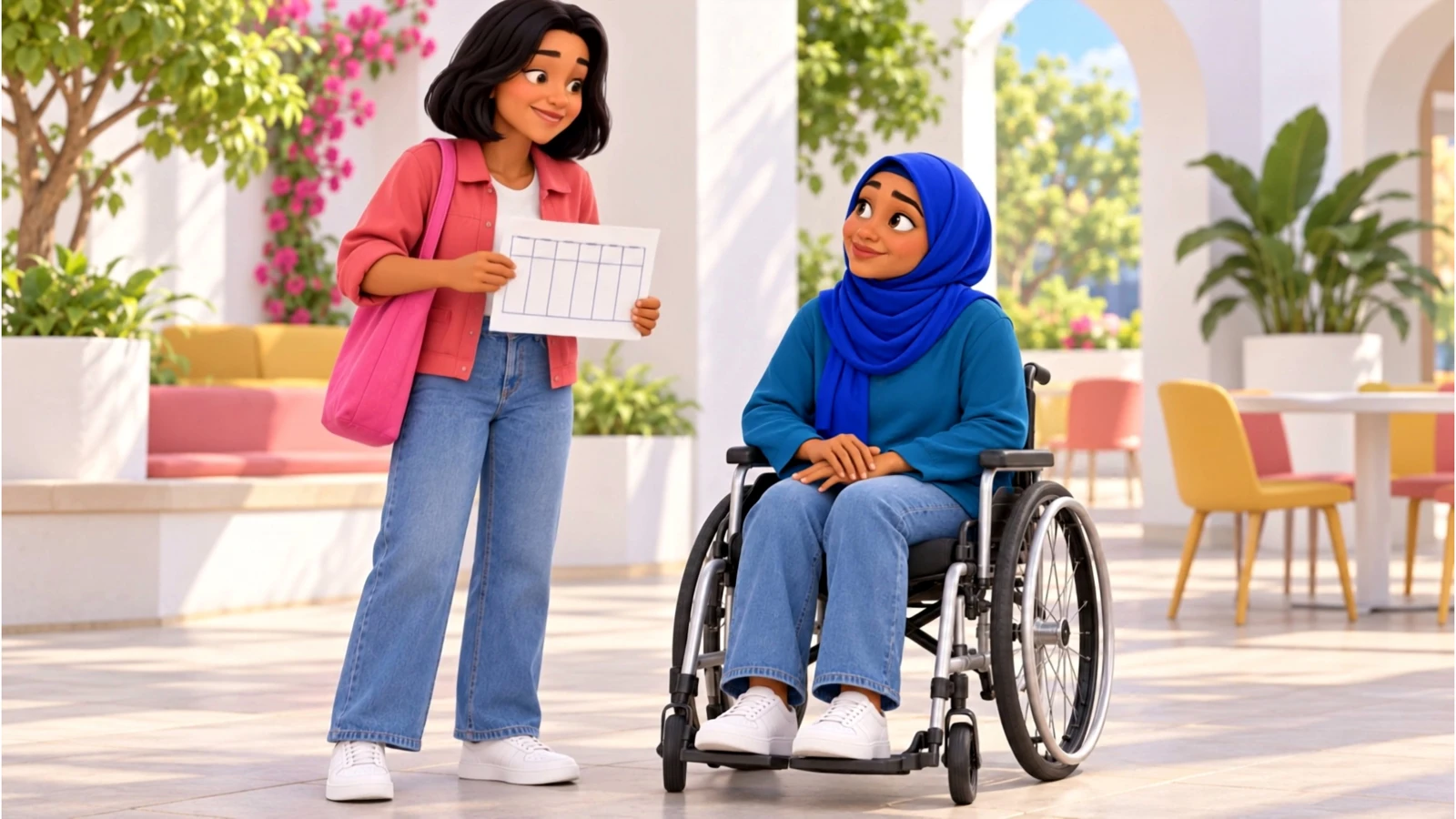
Teacher field guide
Social policy
Whose room is it, anyway?
Who gets a say when a shared space changes?
Libraries, rec centers and after-school rooms change hours and fees all the time, and those changes land hardest on people with the least flexible schedules. Learning to read a budget and ask the right decision-maker lets students defend a shared space without pretending money doesn’t matter.
What students make
People map plus a 4–6 sentence note
The civic idea
Words that do the work.
- Trade-offVentajas y costos
A choice that helps one goal while limiting another.
Paid rentals help close the $200 weekly gap but take away free evenings Sami and Dec use.
- EquityEquidad
Giving people what they need to have a fair chance, which may not be the same thing for everyone.
The same evening slot means a different thing for Sami after a print-shop shift than for someone free all day.
- ProjectionProyección
An estimate based on assumptions that may change.
Each rental is projected to add $120, but demand is uncertain.
- AuthorityAutoridad
The power or responsibility to make a particular decision.
The nonprofit board decides, not a city community board and not the crew.
- NeedNecesidad
What a person or group requires to take part, not just what they prefer.
Sami needs an accessible place after work; Mari needs the evening staff to be paid.
- PilotPrograma piloto
A trial run of a change for a set time, with a plan to review it.
Option C tests one rental evening for six weeks while seeking more funding.

Mira, “keep it free” doesn’t pay the person closing up, and I’m that person. So what’s our plan for the gap?
The evidence
Handle the case file.
Every artifact comes with a question. The captions are the lesson.
Nonprofit board agendaExhibit A
The proposal
Option A keeps the current free evenings with a funding gap. Option B replaces Tuesday and Thursday evenings with paid rentals. Option C pilots one rental evening for six weeks while seeking additional funding. The board will discuss the options; no vote has happened.
Supports An agenda is not an adopted decision. A pilot is still a change with consequences.
Illustrative weekly figuresExhibit B
The budget note
Evening staffing and utilities: $600. Current grants and donations: $400. Each paid rental is projected to add $120 after its extra costs. Two bookings would add $240; one would add $120. Demand is uncertain.
Supports These are invented estimates for practice. Two bookings could cover the $200 gap if the projection holds; one alone would leave $80.
Listening notesExhibit C
The missing voices
Sami works afternoons. Dec rehearses on Thursdays. Mari closes the shop. A nearby resident worries about late noise. The proposed meeting time overlaps with several shifts.
Supports Four voices do not represent everyone. Ask who is missing and offer a way to contribute outside the meeting.
The workshop
45 minutes, block by block.
5 min
Name the decision
TeacherRead the agenda aloud. Ask: is this a final vote? Who decides?
StudentsIdentify the decision-maker and the stage of the proposal.
CheckStudents say “nonprofit board, discussion only, no vote yet.”
10 min
Work the numbers
TeacherModel $600 − $400 = $200. Provide calculators.
StudentsModel zero, one and two rentals; underline “demand is uncertain.”
CheckCorrect figures: a $200 gap, an $80 gap with one rental, a $40 surplus with two.
10 min
People map
TeacherDraw the map: who uses the room, when, and who might miss the meeting.
StudentsAdd Sami, Dec, Mari and the resident; add missing voices as questions.
CheckMap includes at least one missing voice written as a question.
12 min
Draft the comment
TeacherShare the four parts: position, effect, figure, request.
StudentsWrite a 90-second comment or 120–160 word letter.
CheckComment uses one figure accurately and asks for something the board can do.
6 min
Board test
TeacherPartners play board members.
StudentsAsk one good-faith question; the speaker revises one line.
CheckEach comment shows one revision made in response.
2 min
Exit
TeacherAsk for a person affected who may miss the meeting.
StudentsName them and one alternate way to contribute.
CheckAnswer names a real route, like a written comment.
Differentiated routes
One case. Seven ways in.
Each route changes what students read, make and prove, not only how long it takes.
Middle school
Grades 6–8: Make a people map of who uses the room, then write a short note to the board asking one budget question and one access question.
- Sources
- The agenda and listening notes; the budget note with the $200 example worked out.
- Product
- People map plus a 4–6 sentence note
- Raises the rigor
- Add a question about someone not in the listening notes.
Supports
- Calculator and worked example
- People-map organizer
- Frames: “I use the room when __. Could the board explain __?”
- Written comment instead of speaking
Success looks like
- Names the nonprofit board as the decision-maker
- Asks one budget question
- Asks one access question
- Treats the agenda as a proposal, not a final decision
High school
Grades 9–10: Prepare a 90-second public comment recommending an option, using at least one figure accurately.
- Sources
- All three evidence cards.
- Product
- 90-second spoken comment (about 200 words) with written script
- Raises the rigor
- Acknowledge the projected $80 gap under the pilot and propose how to address it.
Supports
- Comment template with four parts
- Timer practice with a partner
Success looks like
- States a position on a specific option
- Uses a figure accurately and conditionally
- Names an affected group
- Makes a request the board can act on
High school
Grades 11–12: Write a policy memo comparing all three options on cost, access and uncertainty, and recommend one.
- Sources
- All evidence plus Bacchi’s “What’s the problem represented to be?” excerpt.
- Product
- Policy memo, 400–500 words
- Raises the rigor
- Analyze how framing the issue as “a funding problem” leaves out access, and propose a review metric.
Supports
- Options matrix template
- Model memo header
Success looks like
- Compares all three options fairly
- Uses figures accurately and names assumptions
- Applies the framing question
- Recommends a measurable review
High school
Honors: Argue whether a community space should ever charge for access, using this case and one other example you research.
- Sources
- Case evidence plus one teacher-approved article on library or rec-center fees.
- Product
- Argument essay, 600–700 words
- Raises the rigor
- Distinguish equality (same rules for all) from equity (fair chance for each) in your argument.
Supports
- Research note-catcher
- Counterargument frames
Success looks like
- Clear, qualified thesis
- Integrates two contexts
- Uses equity and equality accurately
- Addresses the funding counterargument
AP English Language
AP Lang: Write a synthesis-style argument: should the board adopt Option C?
- Sources
- The three evidence cards treated as sources A, B and C.
- Product
- Synthesis essay, about 550 words, 40 minutes
- Raises the rigor
- Cite at least two sources and concede what the projection cannot guarantee.
Supports
- Source citation practice: (Source B)
- Thesis frame with a qualifier
Success looks like
- Defensible, qualified thesis
- Integrates two or more sources with commentary
- Line of reasoning addresses the budget constraint
- Concedes uncertainty precisely
Middle Years
IB MYP: Develop an inquiry statement on community and access and design a feedback survey for evening users.
- Sources
- Case evidence; global context: Fairness and development.
- Product
- Survey (6–8 questions) plus 200-word rationale
- Raises the rigor
- Explain how your survey reaches people who can’t attend the meeting.
Supports
- Inquiry statement frame
- Survey question bank with good and leading examples
Success looks like
- Inquiry statement connects concepts to the case
- Questions are neutral and useful to the board
- Survey reaches people who can’t attend
- Rationale uses evidence from the case
Diploma
IB DP: Write a perspectives analysis of the room decision from the board, Mari, Sami and the nearby resident.
- Sources
- The listening notes and budget note.
- Product
- Analysis, 700–900 words
- Raises the rigor
- Analyze how power operates in a nonprofit setting that isn’t a government, and reflect on your own position.
Supports
- Perspective table: interest, power, constraint
- Reflection prompt: whose voice is easiest to hear?
Success looks like
- Represents four perspectives fairly
- Analyzes power and legitimacy in a nonprofit context
- Uses figures accurately
- Reflects on own assumptions
Access for every learner
- Provide a calculator and a worked $600 − $400 example
- Read one option at a time aloud
- Spanish vocabulary: propuesta, proyección, autoridad, equidad
- Offer a written comment instead of public speaking
- Pre-fill two people on the people map
Extension
- Model what happens if only four of six pilot rentals are booked
- Research the difference between a nonprofit board and a public community board in your area
Annotated student work
What a draft shows us.
Write a comment to the nonprofit board about the evening rentals.
First draft
1The board should not take away our free nights. The Common Room is important to the community and a lot of people use it. I have been coming here for movie nights since it opened and it’s one of the only places we can all hang out without paying. Renting it out just shows 2the board cares more about money than people. 3Sami and Dec would lose their spot and that is not fair. 4Please keep it free for everyone. Thank you for listening.
- 1Gap No vote has happened. Treat it as a proposal still being discussed.
- 2Gap Guesses a motive. The budget shows a real $200 gap to address.
- 3Evidence Good affected perspectives. Say which evenings and why they matter.
- 4Audience Clear position, but the board needs a plan for the gap. What could it do?
Revised
I use the Common Room on weeknights, and I’m commenting on the rental options. Option B would replace both Tuesday and Thursday free evenings. Sami meets clients after her print-shop shift, and Dec rehearses Thursdays, so losing both nights hits people with the least flexible schedules. I understand the $200 weekly gap is real. Option C’s one-night pilot could cut it to about $80 if bookings hold. I’m asking the board to choose the pilot, collect written input from evening users who can’t attend, and review the results with them after six weeks.
Assessment
One-page rubric.
Mark the evidence you see. Leave room for a comment and a next step.
| Criterion | Beginning | Developing | Proficient | Advanced |
|---|---|---|---|---|
| Evidence | No figures or perspectives. | Mentions money or people vaguely. | Uses one figure and one affected perspective accurately. | Uses figures conditionally and names an uncertainty. |
| Reasoning | Assigns bad motives to the board. | States a preference without addressing the gap. | Recommends an option and addresses the gap. | Weighs trade-offs across options and explains the choice. |
| Audience & purpose | Speaks to the wrong decision-maker. | Addresses the board but asks for nothing specific. | Makes a request the board can act on. | Requests a process that includes people who can’t attend. |
| Revision | No change. | Tone edits only. | Replaces a motive claim with evidence. | Adds a figure, a perspective and a follow-up request. |
Evidence I saw
Next step
Standards
What this case teaches, by the book.
CCSS 6–8 4
RI.6.7Students combine the agenda, budget note and listening notes to understand the full proposal.W.8.1Students write a comment supporting an option with a figure and an affected perspective.SL.7.4Students deliver a 90-second comment with relevant details and clear pronunciation.RH.6-8.7Students integrate the budget figures with the text of the agenda.
CCSS 9–10 3
RH.9-10.7Students calculate the $200 gap and $80 pilot gap and integrate them with the proposal text.W.9-10.1Students argue for an option while addressing the budget constraint as a counterclaim.SL.9-10.4Students present a comment so board members can follow the reasoning.
CCSS 11–12 3
RI.11-12.7Students integrate the agenda, budget note and listening notes to evaluate each option.W.11-12.1Students write a recommendation with claims, counterclaims and stated assumptions.SL.11-12.3Students evaluate a board member’s likely reasoning and premises.
C3 Framework 4
D2.Civ.6.6-8Students describe how a civil-society organization (the nonprofit) shapes neighbors’ lives.D2.Civ.13.9-12Students evaluate each option’s intended and unintended outcomes.D2.Civ.9.9-12Students use a deliberative process to weigh options before recommending one.D4.8.6-8Students apply democratic procedures by preparing a comment for the board.
AP English Language 3
Claims and Evidence (CLE)Students use the budget figures accurately and conditionally in a comment.Reasoning and Organization (REO)Students structure a 90-second comment: position, effect, figure, request.Rhetorical Situation (RHS)Students tailor the comment to a nonprofit board facing a real gap.
IB MYP 3
Individuals and Societies B: InvestigatingStudents investigate who uses each evening and who is missing from the meeting.Individuals and Societies D: Thinking criticallyStudents evaluate options from several stakeholder perspectives.Language and Literature C: Producing textStudents produce a spoken comment for a specific audience.
IB DP 2
Global Politics — key concepts: power, equality and justiceStudents analyze who holds decision-making power over a shared space and who bears the costs.Language A: language and literature — Time and spaceStudents consider how the same room means different things to people in different circumstances.
Take it off the page
Find the room where your community’s decisions happen.
- With a trusted adult, look up an upcoming library board, school committee or rec-center meeting agenda
- Identify which body decides and whether the item is for discussion or a vote
- Write one question about who uses the space and when
- Check whether written comments are accepted if you can’t attend