Lesson 3: What should a group do after a public mistake? Educator guide
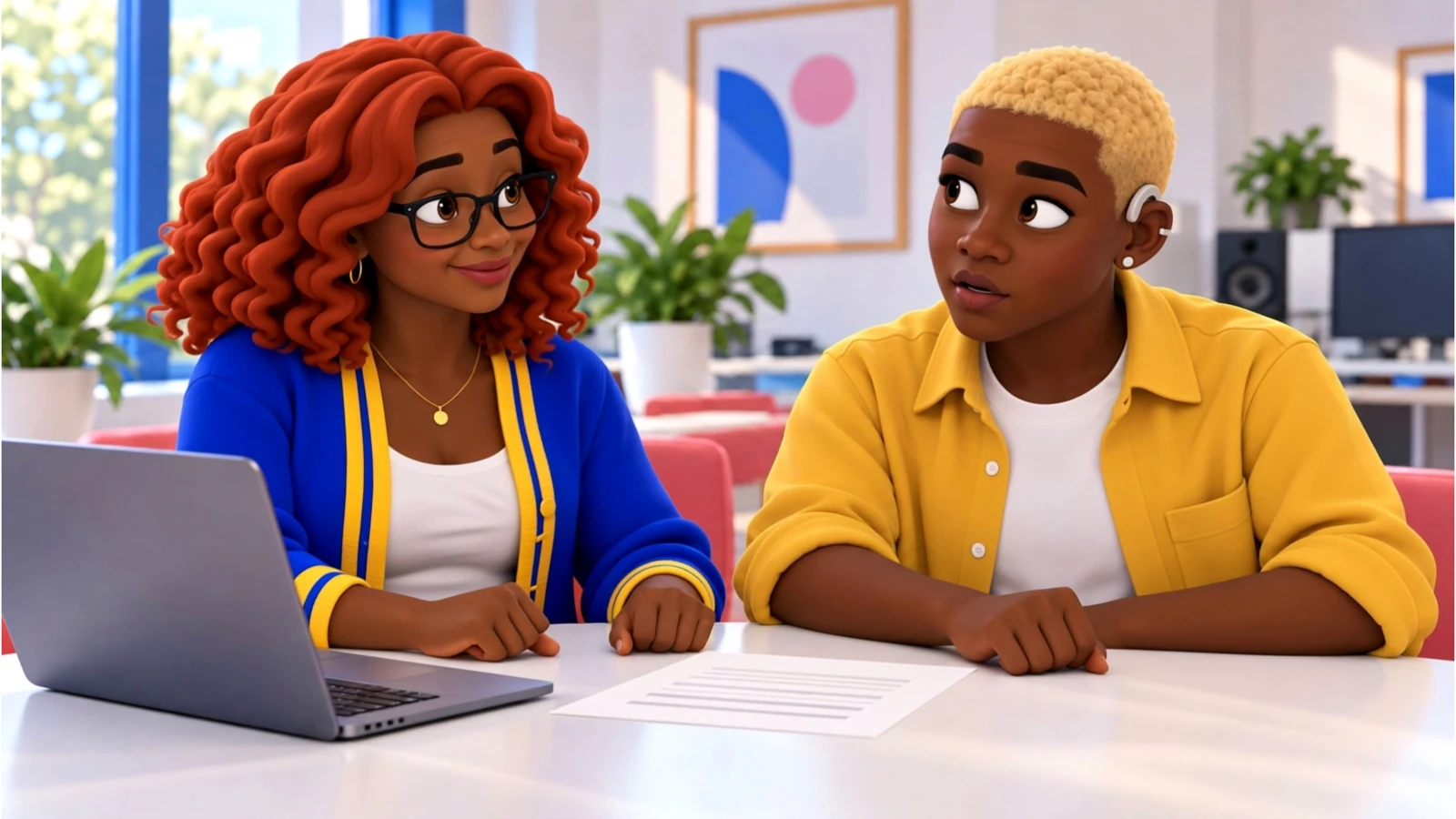
The crew’s recap caption blamed younger neighbors for a late start, but the event log shows the projector failed.
- Grades 6–12 and college
- 45-minute lesson
- 4 evidence documents
- Lesson 3 of 20
Content note
The recap caption blames younger attendees for a late start. Keep the discussion on the event in the story, and do not ask students to describe times they were blamed or stereotyped.
Overview
Students read a short story in which the crew’s recap caption blames “the younger crowd” for a late start. They build a timeline from Jordy’s setup log, which shows that a projector failure caused the delay, and compare it with Gia’s first apology draft. They then write a correction that names the error and a repair step with an owner and a way to check it.
Key terms
- Claim
A claim is a statement that something is true. You can check a claim with evidence. En español: afirmación
In this case: The caption claims the late start happened because “the younger crowd” was not organized. Jordy’s setup log checks that claim.
- Correction
A correction is a public statement that replaces wrong information with accurate information. En español: corrección
In this case: Gia edits the original caption, not just her story, so people who saw it learn what was wrong.
- Accountability
Accountability is owning a mistake and doing what you said you would do to fix it. En español: rendición de cuentas
In this case: The crew names who fixes the caption, who contacts Anika and Dec, and who checks the next recap against the log.
Where this example applies
Media literacy and interpretation. No claims about real people or policing rules.
Grade levels, subjects and time
- Grade levels
- 6–12, plus college and community groups.
- Subjects
- English language arts; also communications and law.
- Time
- 45 minutes for the lesson steps on this page. The student page takes 20 to 30 minutes.
Learning objectives
Students will be able to:
- identify the claim in a caption and the record that challenges it;
- tell apart an apology that expresses regret and a correction that fixes a claim;
- write a correction and a repair step with a named owner and a way to check that it happened.
What students should already be able to do
The student edition for each grade band assumes students can already:
- Grades 6–8
- find a time or a fact in a short record; tell a feeling from a fact; write a complete sentence that answers a question.
- Grades 9–10
- summarize a short record accurately; tell an apology from a correction; write a short message for a named audience.
- Grades 11–12
- name the audiences for a message and the channels that reach them; summarize what a professional code asks of its members; write a structured plan under headings.
- College and community
- summarize what a professional code asks of its members; write a policy with clear roles and steps; write a correction for a public audience.
Skills, terms and roles
New skill
Correct a public mistake
Name the wrong claim, replace it with what the record shows and assign an owner to each repair step.
Skills students use again
- Find the original source (Lesson 1). Jordy’s setup log is the original record that checks the caption.
Key terms
- New in this case
- Correction, Accountability
- From earlier cases
- Claim (Lesson 1)
Character spotlight
Gia leads. Gia wrote the caption. Because she owns the mistake, she can put the log’s times ahead of her feelings.
- Jordy: They kept the setup log and want to keep Anika and Dec out of the repair work.
- Caio: He edited the recap and insists on fixing the same post instead of burying it under a new one.
The student’s role
You’re the one who checks the log’s times before the correction goes up.
Materials
- The student page for Lesson 3: What should a group do after a public mistake?. Students read the case, look at the evidence and write their response there.
- The evidence handout below: 4 documents, one copy per pair.
- The student edition for your grade band, printed or on screen. See printable pages by grade band.
Evidence handout
Evidence A Recap caption, posted Saturday 11:08 a.m.
The caption
“Great night, once the younger crowd finally got organized.”
What it shows: What the crew told viewers: that younger people caused the slow start.
What it leaves out: Any evidence for that explanation, and what caused the delay.
Ask: Which group does this caption ask readers to blame, and on what evidence?
Evidence B Setup log, Friday evening
Jordy’s event log
5:40 p.m. Projector failure reported. 6:00 p.m. Attendees seated. 6:20 p.m. Replacement projector connected. Note: Anika and Dec helped carry chairs before doors opened.
What it shows: The projector failed at 5:40 p.m. and was replaced at 6:20 p.m. Anika and Dec helped set up.
What it leaves out: What each person at the screening experienced, and whether any latecomers affected the start.
Ask: What happened at 5:40 that the caption never mentions?
Evidence C Voice note to the crew
Anika’s message
“We were helping you set up. Why are we the problem in this post?”
What it shows: Anika was helping with setup, and the caption made her part of the problem.
What it leaves out: Whether Anika wants any public response from the crew.
Ask: What fact does Anika add, and what is she asking the crew?
Evidence D Draft correction, Saturday 2:15 p.m., not posted
Gia’s first correction
“Sorry if this came across wrong. We love our younger neighbors and would never want anyone to feel excluded.”
What it shows: Gia’s good intentions and her wish to apologize.
What it leaves out: The wrong claim, the projector failure and any change the crew will make.
Ask: What fact does this correct? Who does the word “if” put the problem on?
Printable pages by grade band
Each grade band has its own student pages and educator pages for this case. The educator pages show every student page with sample answers. See every printable page for this case, including the course editions.
| Grade band | Educator pages | Student pages |
|---|---|---|
| Grades 6–8 | Open on screen Print this case Download PDF, 550 KB | Open on screen Print this case Download fillable PDF, 425 KB |
| Grades 9–10 | Open on screen Print this case Download PDF, 576 KB | Open on screen Print this case Download fillable PDF, 445 KB |
| Grades 11–12 | Open on screen Print this case Download PDF, 584 KB | Open on screen Print this case Download fillable PDF, 451 KB |
| College and community | Open on screen Print this case Download PDF, 592 KB | Open on screen Print this case Download fillable PDF, 453 KB |
Real news and research for this case
These news stories and studies are real. Each link opens the original in a new tab.
Real source News NPR Public Editor October 21, 2022
That was wrong
How a real newsroom corrects mistakes: name the error, fix it on the story and keep a public list.
Read on npr.org (opens in a new tab)Real source News NPR October 8, 2017
Dove Expresses 'Regret' For Racially Insensitive Ad
A real brand apology after an ad played into a racial stereotype; compare the words with what changed afterward.
Read on npr.org (opens in a new tab)More news and research (5)
Real source News NBC News January 17, 2018
H&M hires diversity leader after outrage over 'monkey hoodie' ad
Shows a company trying to move from saying sorry to a repair step, and invites the question: is it enough?
Read on nbcnews.com (opens in a new tab)Real source Video CBS News (YouTube) October 8, 2017
Dove apologizes for racially insensitive ad
A short news report on the apology, useful for spotting which parts are regret and which are repair.
Watch on YouTube (opens in a new tab)Real source News The Ohio State University News April 12, 2016
The 6 elements of an effective apology, according to science
Research found taking responsibility and offering repair matter most, exactly the difference between an apology and a fix.
Read on news.osu.edu (opens in a new tab)Real source Research Negotiation and Conflict Management Research (Lewicki et al.) April 6, 2016
An Exploration of the Structure of Effective Apologies
The peer-reviewed study behind the six apology elements, including the offer of repair.
Read on doi.org (opens in a new tab)Real source Research Communication Monographs (Walter & Murphy) May 15, 2018
How to unring the bell: A meta-analytic approach to correction of misinformation
Combines 65 studies on what makes corrections work, including why a clear explanation beats a bare denial.
Read on doi.org (opens in a new tab)Links checked September 24, 2026.
Professional standards
Many professions publish a code of ethics. These parts of real codes apply to this case.
Real source Public Relations Society of America (PRSA) 2000
PRSA Code of Ethics: Free Flow of Information
Act promptly to correct erroneous communications for which the practitioner is responsible.
In plain words: Public relations professionals who belong to PRSA agree to fix their own mistakes quickly.
Ask: The recap caption went up Saturday at 11:08 a.m. What should the crew change first, and where?
Sample answers
- Grades 6–8
- First, the crew should change the caption in the same post, because people saw the mistake there.
- Grades 9–10
- The crew should first change the caption itself, in the original post, because that is where people saw the wrong claim.
- Grades 11–12
- The first change is the caption, edited in the original post with a correction note, because the error should be fixed where it appeared.
Real source Radio Television Digital News Association (RTDNA) 2015
RTDNA Code of Ethics: Independence and transparency
Ethical journalism requires owning errors, correcting them promptly and giving corrections as much prominence as the error itself had.
In plain words: The RTDNA code asks news staff to make a correction as easy to see as the mistake was.
Ask: Would a new post reach the readers who saw the recap caption, or would editing the original reach more?
Read the full code on the RTDNA website (opens in a new tab)Real source National Communication Association (NCA) 2024
Credo for Ethical Communication: “We accept responsibility for the short- and long-term consequences of our own communication…” (one of nine unnumbered principles)
We accept responsibility for the short- and long-term consequences of our own communication and expect the same from others.
In plain words: Members of the National Communication Association commit to taking responsibility for the short- and long-term effects of what they say.
Ask: Gia drafted “Sorry if this came across wrong.” Who does “if” make responsible for the harm to Anika and Dec?
Read the full code on the NCA website (opens in a new tab)Share, schedule or open in your apps
Reading passage by grade band
Each grade band has its own longer reading passage built from this case’s story and its real sources. Real news, laws and research are cited in the text with their dates. Three “Stop and think” questions sit inside each passage. Open a band to read it, or print that band on its own.
Grades 6–8: The caption that blamed the wrong people
438 words
The caption that blamed the wrong people
The story: A recap goes up
Remember the screening you helped save in Lesson 1? It happened. On Saturday morning, the crew posted a short recap video that Caio edited. Gia wrote the caption: “Great night, once the younger crowd finally got organized.”
The caption sounded believable. A few people did arrive late. But on Sunday, Jordy opens the setup log from Friday night. It says the projector failed at 5:40 p.m. Everyone was seated at 6:00. The replacement projector was not connected until 6:20. The log also says Anika and Dec helped carry chairs before the doors opened.
Then Anika sends the crew a voice note. “We were helping you set up. Why are we the problem in this post?”
Gia wrote the caption, and she wants to fix it. Her first draft says, “Sorry if this came across wrong. We love our younger neighbors and would never want anyone to feel excluded.” It is kind. It also never mentions the projector.
From sorry to a real fix
You met the word claim in Lesson 1. A claim is a statement that something is true. You can check a claim with evidence. The caption claimed the younger crowd caused the late start. Jordy’s log is the original source, and it shows a broken projector instead.
A correction is a public statement that replaces wrong information with accurate information. It should appear where people saw the mistake. So the crew edits the recap caption itself. Caio says it simply: they fix the same post instead of burying it under a new one.
Accountability is owning a mistake and doing what you said you would do to fix it. That means naming who does each job. Gia corrects the caption. Caio keeps a visible correction note with the video. Jordy adds a source check before the crew posts again. Anika and Dec do not have to do any of the repair work.
How will the crew know the fix worked? Jordy has an idea. Ask a few people who saw the first post why the screening started late. If they still say “the younger crowd,” the correction did not land.
What research says about apologies
Researchers have studied what makes an apology work. A 2016 study found that two parts matter most: taking responsibility and offering to repair the harm (The Ohio State University News, April 12, 2016). Gia’s first draft does neither.
Real newsrooms correct mistakes too. NPR’s public editor explains how the network names an error and fixes it on the story. NPR also keeps a public list of corrections (NPR, October 21, 2022). Your job in this case is to check the log’s times before the correction goes up.
Key terms in this passage
- Claim
- A claim is a statement that something is true. You can check a claim with evidence.
- Correction
- A correction is a public statement that replaces wrong information with accurate information.
- Accountability
- Accountability is owning a mistake and doing what you said you would do to fix it.
Real sources cited
- The Ohio State University News, “The 6 elements of an effective apology, according to science,” April 12, 2016. Open the source (opens in a new tab)
- NPR Public Editor, “That was wrong,” October 21, 2022. Open the source (opens in a new tab)
Grades 9–10: Fix the post, not just the feeling
581 words
Fix the post, not just the feeling
The story: Sunday at the edit desk
The screening from Lesson 1 went ahead, and on Saturday at 11:08 a.m. the crew posted a recap. Caio, who edits the crew’s videos, cut it together. Gia wrote the caption: “Great night, once the younger crowd finally got organized.” It sounded right to her. A few people had come in late, and the start had slipped.
On Sunday, Jordy opens the setup log they kept on Friday. The entries are short and exact. At 5:40 p.m., a projector failure was reported. At 6:00, attendees were seated. At 6:20, the replacement projector was connected. A note at the bottom says Anika and Dec helped carry chairs before the doors opened. Jordy admits something uncomfortable in the group chat. Nobody opened the log before posting, including Jordy.
Then Anika’s voice note arrives: “We were helping you set up. Why are we the problem in this post?”
Gia owns the caption, and she knows it. She has already drafted a correction, though it has not gone up. It reads, “Sorry if this came across wrong. We love our younger neighbors and would never want anyone to feel excluded.” When she reads it back, she hears the problem herself. “If?” she says. It came across exactly the way she wrote it. The draft also never mentions the projector.
Building the correction
Start with the skill from Lesson 1, finding the original source. The caption makes a claim, a statement that something is true that you can check with evidence. The log is the original record, and it contradicts the claim. The delay came from equipment, not from a group of people.
A correction is a public statement that replaces wrong information with accurate information. Placement matters. Caio insists on fixing the same post rather than burying it under a new one, because the people who saw the mistake need to see the fix. The correction should name the wrong claim, give the log’s times and leave Gia’s feelings for last, or out entirely.
Accountability is owning a mistake and doing what you said you would do to fix it. The crew assigns owners. Gia corrects the original post. Caio keeps a visible correction note with the edit. Jordy adds a source check before the crew publishes anything new. Anika decides for herself how she feels about the response. Jordy argues that Anika should not have to approve the correction in public. The crew can offer her a private way to answer and leave it there.
How real organizations get this right or wrong
A 2016 study of apologies found that taking responsibility and offering to repair the harm mattered most (The Ohio State University News, April 12, 2016). The peer-reviewed paper behind it identified six elements of an effective apology, including an offer of repair (Lewicki et al., Negotiation and Conflict Management Research, April 6, 2016).
Brands face the same test. In 2017, Dove expressed regret after an ad played into a racial stereotype (NPR, October 8, 2017). In 2018, H&M hired a diversity leader after outrage over a “monkey hoodie” ad (NBC News, January 17, 2018). Comparing the words of an apology with what changed afterward is exactly the move Jordy suggests. Judge a fix by what readers understand, not by how sorry it sounds.
Professional codes set the bar. The PRSA code asks practitioners to “act promptly to correct erroneous communications for which the practitioner is responsible” (PRSA Code of Ethics, October 2000). Your job is to check the log’s times before the correction goes up.
Key terms in this passage
- Claim
- A claim is a statement that something is true. You can check a claim with evidence.
- Correction
- A correction is a public statement that replaces wrong information with accurate information.
- Accountability
- Accountability is owning a mistake and doing what you said you would do to fix it.
Real sources cited
- The Ohio State University News, “The 6 elements of an effective apology, according to science,” April 12, 2016. Open the source (opens in a new tab)
- Negotiation and Conflict Management Research (Lewicki et al.), “An Exploration of the Structure of Effective Apologies,” April 6, 2016. Open the source (opens in a new tab)
- NPR, “Dove Expresses 'Regret' For Racially Insensitive Ad,” October 8, 2017. Open the source (opens in a new tab)
- NBC News, “H&M hires diversity leader after outrage over 'monkey hoodie' ad,” January 17, 2018. Open the source (opens in a new tab)
- Public Relations Society of America (PRSA), “PRSA Code of Ethics,” October 2000. Open the source (opens in a new tab)
Grades 11–12: When an explanation becomes blame
721 words
When an explanation becomes blame
The story: The log nobody opened
The crew’s first neighborhood screening, the one saved from a cropped clip in Lesson 1, went ahead on Friday. On Saturday at 11:08 a.m., the crew posted a recap. Caio, 24, had edited the video. Gia, 21, wrote the caption: “Great night, once the younger crowd finally got organized.” It seemed accurate to her in the loose way captions often do. A few people had arrived late, and the evening had started late, so the two facts fused into a cause.
On Sunday at the edit desk, Jordy opens the setup log. At 5:40 p.m., a projector failure was reported. At 6:00, attendees were seated. At 6:20, a replacement was connected, twenty minutes after the audience sat down. The final line notes that Anika and Dec, the two youngest people involved, carried chairs before the doors opened. Jordy writes in the chat that no one opened the log before posting, Jordy included.
Anika’s voice note lands next: “We were helping you set up. Why are we the problem in this post?” Gia had already drafted a response, which was never posted: “Sorry if this came across wrong. We love our younger neighbors and would never want anyone to feel excluded.” Rereading it, she recognizes the conditional “if” as a dodge. The draft also never mentions the projector.
Two jobs in one caption
The caption did two jobs at once. It explained the late start, and it assigned blame for it to a group of people. The first job is a claim, a statement that something is true that can be checked with evidence. Lesson 1 gave you the method: find the original source. The log is that source, and it replaces the caption’s explanation with a mechanical one.
A correction is a public statement that replaces wrong information with accurate information. A strong correction here has a clear order. It names the wrong claim, states what the log shows and places the fix where the original audience will see it. Caio’s rule, fix the same post instead of burying it under a new one, follows from that last requirement.
Accountability is owning a mistake and doing what you said you would do to fix it. In practice, accountability becomes a list of named owners. Gia corrects the post. Caio keeps a visible correction note with the edit. Jordy adds a source check before publication. Each owner is a named person rather than the crew in general, so anyone can check later whether the work was done. Just as important is what accountability does not require. Anika should not have to comfort Gia or approve the correction in public. Jordy suggests offering Anika a private way to respond and then letting her decide what she thinks. Jordy also proposes a test of success that ignores view counts. Ask a few people who saw the first post why the screening started late. If they still say “the younger crowd,” the fix failed.
What research and professional codes add
A 2016 study of apologies found that acknowledging responsibility and offering repair mattered most among six elements (Lewicki et al., Negotiation and Conflict Management Research, April 6, 2016). Research on misinformation points the same way. A meta-analysis of 65 studies found that corrections work better when they explain what is true rather than simply denying the false claim (Walter and Murphy, Communication Monographs, May 15, 2018). Gia’s draft offered neither an explanation nor a repair.
Journalists write the prominence rule into their ethics. The RTDNA code says ethical journalism requires “owning errors, correcting them promptly and giving corrections as much prominence as the error itself had” (RTDNA Code of Ethics, June 11, 2015). NPR’s public editor describes naming the error, fixing it on the story and keeping a public list (NPR, October 21, 2022).
The film connection sharpens the stakes. In Zootopia (2016), Judy tells a press conference that a set of incidents has a biological explanation tied to one group, and Nick’s reaction shows a personal cost her official answer overlooks. In our reading, good intentions do not erase the effect of an unsupported claim about a group. The animal groups in the film are not a scientific model of human race. The crew’s caption is far smaller, but it made the same kind of move. Your job is to check the log’s times before the correction goes up.
Key terms in this passage
- Claim
- A claim is a statement that something is true. You can check a claim with evidence.
- Correction
- A correction is a public statement that replaces wrong information with accurate information.
- Accountability
- Accountability is owning a mistake and doing what you said you would do to fix it.
Real sources cited
- Negotiation and Conflict Management Research (Lewicki et al.), “An Exploration of the Structure of Effective Apologies,” April 6, 2016. Open the source (opens in a new tab)
- Communication Monographs (Walter & Murphy), “How to unring the bell: A meta-analytic approach to correction of misinformation,” May 15, 2018. Open the source (opens in a new tab)
- Radio Television Digital News Association (RTDNA), “RTDNA Code of Ethics,” 2015. Open the source (opens in a new tab)
- NPR Public Editor, “That was wrong,” October 21, 2022. Open the source (opens in a new tab)
- Critical Media Project, “Zootopia: the press conference,” No date listed. Open the source (opens in a new tab)
College and community: Corrections, repair and responsibility
737 words
Corrections, repair and responsibility
The story: A believable caption
After the crew’s first neighborhood screening, the one saved from a cropped clip in Lesson 1, the crew posted a recap on Saturday at 11:08 a.m. Caio, 24, edited the video, and Gia, 21, wrote the caption: “Great night, once the younger crowd finally got organized.” The caption was plausible for an ordinary reason. Some people did arrive late, and the event did start late.
Jordy’s setup log from Friday tells a different story. A projector failure was reported at 5:40 p.m. Attendees were seated by 6:00. The replacement was connected at 6:20. The log also records that Anika, 16, and Dec, 17, helped carry chairs before the doors opened. The caption had turned two volunteers into the cause of a delay they had no part in.
Anika responds with a voice note: “We were helping you set up. Why are we the problem in this post?” Gia’s unpublished first draft reads, “Sorry if this came across wrong. We love our younger neighbors and would never want anyone to feel excluded.” Its conditional “if” shifts responsibility to the reader. It also omits the facts, which leaves the false explanation standing.
Anatomy of a repair
The caption contains a causal claim, a statement that something is true that can be checked with evidence. Applying the Lesson 1 skill, finding the original source, the crew checks the claim against the log, and the log refutes it.
A correction is a public statement that replaces wrong information with accurate information. Three design choices determine whether it works. The first is placement. Caio insists on editing the original post rather than publishing a new one, so the correction reaches the same audience. The second is content. The correction names the specific error and states the documented cause. The third is order. The facts come before the author’s feelings, which may not belong in the correction at all.
Accountability is owning a mistake and doing what you said you would do to fix it. The crew converts that principle into assigned tasks: Gia corrects the post, Caio keeps a visible correction note with the edit and Jordy adds a pre-publication source check. The case also marks the boundary of accountability. The people harmed are not recruited into the repair. Anika is not asked to approve the correction publicly or to reassure Gia. She is offered a private channel and left to decide how she feels. Finally, Jordy defines success by audience understanding rather than reach. If people who saw the original post still attribute the delay to “the younger crowd,” the correction has not worked.
Evidence from research and practice
Research on apologies supports the crew’s priorities. Lewicki and colleagues identified six elements of an effective apology and found that acknowledging responsibility and offering repair carried the most weight (Negotiation and Conflict Management Research, April 6, 2016). Research on misinformation reaches a compatible conclusion. Walter and Murphy’s meta-analysis of 65 studies found that corrections are more effective when they give a clear explanation rather than a bare denial (Communication Monographs, May 15, 2018).
Professional codes translate these findings into obligations. PRSA members commit to “act promptly to correct erroneous communications for which the practitioner is responsible” (PRSA Code of Ethics, October 2000). The RTDNA code requires “giving corrections as much prominence as the error itself had” (RTDNA Code of Ethics, June 11, 2015). The National Communication Association’s credo states, “We accept responsibility for the short- and long-term consequences of our own communication and expect the same from others” (NCA Credo for Ethical Communication, 2024).
Corporate cases show the gap between regret and repair. Dove expressed regret after an ad played into a racial stereotype (NPR, October 8, 2017). H&M hired a diversity leader after outrage over its “monkey hoodie” ad (NBC News, January 17, 2018). Whether such steps count as repair is a fair question to put to any organization, including your own.
The film connection shows the same error at a larger scale. In Zootopia (2016), Judy tells a press conference that a set of incidents has a biological explanation tied to one group. Nick’s reaction shows a personal cost that her official answer overlooks. In our reading, good intentions do not erase the effect of an unsupported claim about a group, and the animal groups in the film are not a scientific model of human race. Your job in this case is to check the log’s times before the correction goes up.
Key terms in this passage
- Claim
- A claim is a statement that something is true. You can check a claim with evidence.
- Correction
- A correction is a public statement that replaces wrong information with accurate information.
- Accountability
- Accountability is owning a mistake and doing what you said you would do to fix it.
Real sources cited
- Negotiation and Conflict Management Research (Lewicki et al.), “An Exploration of the Structure of Effective Apologies,” April 6, 2016. Open the source (opens in a new tab)
- Communication Monographs (Walter & Murphy), “How to unring the bell: A meta-analytic approach to correction of misinformation,” May 15, 2018. Open the source (opens in a new tab)
- Public Relations Society of America (PRSA), “PRSA Code of Ethics,” October 2000. Open the source (opens in a new tab)
- Radio Television Digital News Association (RTDNA), “RTDNA Code of Ethics,” 2015. Open the source (opens in a new tab)
- National Communication Association (NCA), “Credo for Ethical Communication,” 2024. Open the source (opens in a new tab)
- NPR, “Dove Expresses 'Regret' For Racially Insensitive Ad,” October 8, 2017. Open the source (opens in a new tab)
- NBC News, “H&M hires diversity leader after outrage over 'monkey hoodie' ad,” January 17, 2018. Open the source (opens in a new tab)
- Critical Media Project, “Zootopia: the press conference,” No date listed. Open the source (opens in a new tab)
Pacing options
10-minute bellringer
10 minutes
One piece of evidence and one question. Use it to open the case or to review it the next day.
One class period
45 minutes
Teach the lesson steps on this page in four parts.
The student edition also has a one-period plan for each grade band:
- Grades 6–8: 45 minutes
- Grades 9–10: 50 minutes
- Grades 11–12: 60 minutes
- College and community: 75 minutes
Full chapter
79 to 106 minutes
Teach every page of the student edition chapter. The educator edition has notes and sample answers beside each page.
- Grades 6–8: 79 minutes
- Grades 9–10: 92 minutes
- Grades 11–12: 98 minutes
- College and community: 106 minutes
Minutes for each page
How long each student edition page takes, and what to cut when you have one class period.
Open your grade band.
Grades 6–8: full chapter 79 minutes, one period 45 minutes
| Page | Full chapter | One period | How to cut |
|---|---|---|---|
| Opener | 6 min | 4 min | Read What happened aloud. Skip the opening question. |
| Key terms | 5 min | 3 min | Read the key terms aloud. Skip Who is involved. |
| Look at the evidence | 10 min | 8 min | Students fill in only the “What it shows” boxes. |
| Look at the evidence, continued | 6 min | 4 min | Read Anika’s message and Gia’s draft aloud. Skip the boxes. |
| Key idea | 8 min | 3 min | Read the second paragraph of the key idea aloud. Skip the code of ethics. |
| Sort the evidence | 8 min | Skip | Skip this page. |
| Practice | 8 min | 5 min | Vote on the options. Skip the draft fixes. |
| Your task | 15 min | 13 min | Fill in the planner together. Students write the correction on their own. |
| Check your work | 5 min | Skip | Skip this page. Check corrections against the success criteria yourself. |
| Questions to discuss | 8 min | 5 min | Use question 1 as an exit ticket. |
| Talk about this case at home | At home | At home |
Grades 9–10: full chapter 92 minutes, one period 50 minutes
| Page | Full chapter | One period | How to cut |
|---|---|---|---|
| Opener | 5 min | 4 min | Read What happened aloud. Skip the opening question. |
| Key terms | 5 min | Skip | Skip this page. Define correction and accountability aloud in one minute. |
| Look at the evidence | 8 min | 7 min | Students fill in only the “What it shows” boxes. |
| Look at the evidence, continued | 6 min | 4 min | Read Anika’s message and Gia’s draft aloud. Students fill in only the “What it shows” boxes. |
| Key idea | 8 min | 4 min | Read the third paragraph of the key idea aloud. Skip the code of ethics. |
| Sort the evidence | 8 min | Skip | Skip this page. |
| Practice | 8 min | 5 min | Vote on the options. Skip the draft fixes. |
| Your task | 8 min | 6 min | Fill in the plan grid together on the board. |
| Your draft | 18 min | 15 min | Students write the correction in class and the repair plan at home. |
| Check your work | 8 min | Skip | Collect drafts and score them with the rubric yourself. |
| Questions to discuss | 10 min | 5 min | Use question 3 as an exit ticket. |
| Talk about this case at home | At home | At home |
Grades 11–12: full chapter 98 minutes, one period 60 minutes
| Page | Full chapter | One period | How to cut |
|---|---|---|---|
| Opener | 5 min | 4 min | Read What happened aloud. Skip the opening question. |
| Key terms | 5 min | Skip | Skip this page. |
| Look at the evidence | 8 min | 7 min | Students fill in only the “What it shows” boxes. |
| Look at the evidence, continued | 6 min | 4 min | Read Anika’s message and Gia’s draft aloud. Skip the boxes. |
| Key idea | 10 min | 8 min | Skip the In the news section. |
| Sort the evidence | 8 min | Skip | Skip this page. |
| Practice | 6 min | Skip | Skip this page. |
| Your task | 12 min | 10 min | List the audiences together on the board. |
| Your draft | 22 min | 20 min | Students draft the plan in class and finish the measurement section at home. |
| Check your work | 6 min | Skip | Collect plans and score them yourself. |
| Questions to discuss | 10 min | 7 min | Discuss questions 2 and 3 only. |
| Talk about this case at home | At home | At home |
College and community: full chapter 106 minutes, one period 75 minutes
| Page | Full chapter | One period | How to cut |
|---|---|---|---|
| Opener | 5 min | 4 min | Read What happened aloud. Skip the opening question. |
| Key terms | 5 min | Skip | Skip this page. Define correction and accountability aloud. |
| Look at the evidence | 8 min | 7 min | Participants fill in only the “What it shows” boxes. |
| Look at the evidence, continued | 6 min | 4 min | Read Anika’s message and Gia’s draft aloud. Skip the boxes. |
| Key idea | 10 min | 8 min | Skip the In the news section. |
| Sort the evidence | 6 min | Skip | Skip this page. |
| Practice | 6 min | Skip | Skip this page. |
| Your task | 12 min | 10 min | Fill in the first two planner boxes together. |
| Your draft | 30 min | 30 min | |
| Check your work | 8 min | 6 min | Skip the rubric boxes. |
| Questions to discuss | 10 min | 6 min | Discuss question 2 only. |
| Talk about this case at home | At home | At home |
Minutes for each page are in the educator edition for each grade band.
10-minute bellringer
- 1 min Project Evidence A as students come in.
- 5 min Students read it on their own. Each student writes a one-sentence answer to the question.
- 4 min Take two or three answers. Then ask the follow-up questions.
Evidence A Recap caption, posted Saturday 11:08 a.m.
The caption
“Great night, once the younger crowd finally got organized.”
Question Which group does the caption blame for the slow start?
Follow-up questions
- What evidence does the caption give for that?
- What would you want to know about the night before you repeat this caption?
Listen for: Students point out that the caption names a group (“the younger crowd”) but gives no evidence about what caused the delay.
This is the same bellringer as on the bellringers page, which has one for every case.
Lesson steps
This plan takes 45 minutes in four parts. Each step says what you do, what students do and how to check.
Warm-up 5 minutes
1 Read the caption 5 min
- You
- Show the caption alone. Keep discussion on the event in the story.
- Students
- Silently note the claim and the group it blames.
- Check
- Students name “younger crowd” as the group blamed.
Read and discuss 18 minutes
2 Build the timeline 10 min
- You
- Hand out Jordy’s event log.
- Students
- Build a timeline from 5:40 to 6:20 and mark which entry challenges the caption.
- Check
- Timelines show the projector failure as the cause of delay.
3 Examine the apology 8 min
- You
- Project Gia’s first draft. Ask: what does it correct?
- Students
- Highlight words about intent in one color, facts in another.
- Check
- Students find zero corrected facts in the draft.
Film connection questions
- Where does a guess start sounding like a finding?
- Who has to live with the explanation after the camera leaves?
- What would a correction need to say without asking the harmed person to make the speaker feel better?
Questions for the people in the case
- Gia: What goes first in the correction? Check next: Put the wrong claim and the log’s times first, on the post where people saw the caption.
- Gia: Why not post the draft you already wrote? Check next: Mark each phrase in the draft as intent or fact. A correction needs at least one corrected fact.
- Jordy: Should Anika approve the correction before it goes up? Check next: Correct the record without asking the people blamed to sign off or speak publicly.
- Jordy: How will you know the fix worked? Check next: Check what readers now understand about the delay, not how many saw the correction.
Method for this case
Research, planning, implementation, evaluation. This classroom version draws on public relations and sociology. Where this method comes from (opens in a new tab)
- Research: Put the recap beside the event log. Ask Anika what the group label changes for her.
- Planning: Name who needs the correction and what they should understand afterward.
- Implementation: Replace the inaccurate claim. State the repair and who will carry it out.
- Evaluation: Ask readers what they now believe caused the delay. Views alone do not show understanding.
Task 15 minutes
4 Write the plan 15 min
- You
- Introduce the plan parts: goal, audience, key message, channel, repair owner, measure.
- Students
- Draft a 70–100 word correction plus one repair with an owner and a check.
- Check
- Correction names the error, the evidence, the fix and who does what.
Wrap-up 7 minutes
5 Editorial desk 5 min
- You
- Assign roles: fact-checker, reach-checker, responsibility-checker.
- Students
- Partners check one role each and suggest one edit.
- Check
- Each draft receives one specific edit tied to a role.
6 Exit 2 min
- You
- Frame: “Our next recap will change because __.”
- Students
- Complete the frame.
- Check
- Answer names a repeatable process, not a feeling.
Educator notes by page
These notes follow the pages of the student edition chapter. The educator edition prints the same notes beside each page. Heat check tells you how likely a page is to bring up strong feelings: low, medium or high. Medium and high pages come with a cool-down. Open a page to see what to say, what to watch for and how to support students.
Opener
Heat check: Medium
Why: The caption blames an age group, and students may bring up times they were blamed. Cool-down: Keep the talk on the crew’s post. Nobody needs to share a personal story.
Say this
- “Imagine a post says your group caused a problem, and you were helping. What should the post say instead?” Take two answers. Keep the focus on the crew’s post.
Watch for
- Misconception:
- Students treat the caption as a harmless joke.
- Listen for:
- “It’s just a caption.”
- Then:
- Ask who the caption names and what it says they did. Point to Anika’s message.
Support
- Read What happened aloud while students follow along.
- Write the three times on the board: 5:40, 6:00 and 6:20.
Key terms
Heat check: Low
Say this
- “Write your first guess now. You will come back to it at the end.” Keep first guesses private unless a student wants to share.
Watch for
- Misconception:
- Students think saying sorry is the same as a correction.
- Listen for:
- “She apologized, so it’s fixed.”
- Then:
- Reread the definition. A correction replaces wrong information with supported information.
Support
- Pair students who share a language to explain each term.
- Frame: “The claim was ___. The correction says ___.”
Look at the evidence
Heat check: Low
Say this
- “Put your finger on 5:40 in the log. Now find anything in the caption about the projector.” Wait for “nothing.”
Watch for
- Misconception:
- Students decide Gia is a bad person.
- Listen for:
- “Gia is just rude.”
- Then:
- Ask what the evidence shows Gia did. The caption made a claim she never checked.
Support
- Give the four documents on separate half-pages.
- Read Anika’s message aloud in a neutral voice.
Stretch
Ask which document was written at the time and which were written later, and why that matters.
Key idea
Heat check: Low
Say this
- “A correction replaces wrong information with supported information. Which document supplies the supported information?” Wait for the setup log.
- “The PRSA code says to act promptly to correct errors. What should the crew fix first?” Point to the caption.
Watch for
- Misconception:
- Students treat the PRSA code as a law.
- Listen for:
- “The crew could get sued for that.”
- Then:
- Say: “A code of ethics is a standard a profession sets for its own members. The PRSA code is not a law.”
Support
- Read the code card aloud. Point out the label: it is a quotation from a real code.
Stretch
Read the RTDNA card. Ask whether a new post or an edit to the original would reach more of the same readers.
Sort the evidence
Heat check: Medium
Why: The missing-perspective question can lead to talk about how younger people are treated. Cool-down: Keep it about the people in the case. No student speaks for an age group. Return to the log.
Say this
- “Put the four accounts side by side. Which one was written down at the time?” Wait for the log. Model one row together.
Watch for
- Misconception:
- Students trust the caption because Gia was there.
- Listen for:
- “Gia was there, so her caption counts.”
- Then:
- Ask which account was recorded at the time. The log was written that night, and the caption came the next morning.
Support
- Let students write A (agree) or D (differ) in each box before writing sentences.
Practice
Heat check: Low
Say this
- “Gia is ready to post. What goes first?” Vote first.
Watch for
- Misconception:
- Students choose A because it sounds sincere.
- Listen for:
- “She should say how bad she feels.”
- Then:
- Ask what A tells Anika about the delay.
Your task and draft
4 grade bands
The task is different in each grade band. Open yours.
Grades 6–8
Your task
Say this
- “Which line does Anika need most?” Pairs answer.
Grades 9–10
Your task
Say this
- “A repair plan says what, who, when and how we’ll know. Which part do plans skip?” Wait for “how we’ll know.”
Watch for
- Misconception:
- The plan asks Anika to vouch for the crew.
- Listen for:
- “Anika can post that it’s fine now.”
- Then:
- Ask who should do the repair. Offer a private reply.
Your draft
Say this
- “Read your correction as someone who saw only the first caption. Do you now know what caused the delay?” Partners read each other’s correction aloud.
Watch for
- Misconception:
- The correction buries the error under the apology.
- Listen for:
- “We’re so sorry, we love our neighbors…”.
- Then:
- Put the wrong claim in the first sentence.
Grades 11–12
Your task
Say this
- “Who saw the caption, and who was named in it? Those are two different audiences.” List both groups before students choose channels.
Watch for
- Misconception:
- Measurement counts views or likes.
- Listen for:
- “We’ll see how many people liked the fix.”
- Then:
- Ask what a like tells you about what someone understands. Then ask for a question to put to viewers.
Your draft
Say this
- “Your plan has to protect the crew’s reputation and the people it blamed. Where do those pull apart?” Take one answer, then point to the RTDNA card.
Watch for
- Misconception:
- The plan deletes the post to protect the crew.
- Listen for:
- “Just take it down.”
- Then:
- Ask how people who saw screenshots will learn the cause. Deleting does not reach them.
College and community
Your task
Say this
- “Your club’s recap just blamed the wrong people. Who fixes it, where and by when?” Push for named roles and a place, not “we’ll be careful.”
Watch for
- Misconception:
- The policy is a list of values.
- Listen for:
- “We value honesty and inclusion.”
- Then:
- Ask what a member does on the day of an error. Write it as a step.
Support
- Frame: “When ___, the ___ does ___ by ___.”
Your draft
Say this
- “Read your correction as Anika would. Does it name what happened before it says sorry?” Partners read corrections aloud.
Watch for
- Misconception:
- The correction repeats the stereotype to explain it.
- Listen for:
- “We said younger people are disorganized, but…”.
- Then:
- Name the error without repeating the label more than once.
Check your work
Heat check: Low
Say this
- “Would Anika recognize what happened in your correction? Mark your level, then make one change.” Ask for one added fact or one removed excuse.
Watch for
- Misconception:
- Students soften the tone instead of fixing facts.
- Listen for:
- “I made it sound nicer.”
- Then:
- Point to the Revision row. Ask for one fact, owner or check added.
Questions to discuss
Say this
- “Answer with a detail from the log or the messages, not a story about someone you know.” Post the question numbers and call on one student per question.
Stretch
Compare a real newsroom’s published correction policy with the crew’s plan.
Talk about this case at home
Say this
- “Take this page home or read it with someone you trust.” Nobody needs to share a personal story to complete it.
Sample response
Model response
Task: Write a correction and a repair plan that are bigger than “sorry.”
Our recap wrongly blamed younger attendees for the late start. The event log shows a projector failure delayed the screening. We have corrected the original caption and contacted the people it blamed. Gia and Jordy will check factual claims against the event record before the next recap.
Worked example, grades 9–10
Prompt: Write a correction and a short repair plan with a named owner and a date to check it.
Student response
Correction: Our recap said the screening started late because the younger crowd wasn’t organized. 1 That was wrong, and we’re sorry. 2 Jordy’s event log shows the projector failed at 5:40 p.m. and the new one wasn’t connected until 6:20. Anika and Dec actually helped carry chairs before doors opened.
Repair plan: Gia will edit the original caption today so the correction is where people saw the mistake. 3 We will also ask Anika to post that she’s okay with the correction so people know it’s resolved. Before we post any recap, Jordy will check claims about what caused a problem against the event log. 4 We’ll check on Friday whether the next recap went through that step.
- Strength. Good order: the correction names the error before it apologizes, so it does its main job first.
- Evidence. Precise evidence with a time lets readers see why the caption’s explanation doesn’t hold.
- Revise. This puts repair work on the person who was blamed. The crew can offer a private way to respond, but Anika shouldn’t have to vouch in public.
- Strength. Strong measure: it checks whether the promised process happened, not just whether the comments stopped.
Before: We will also ask Anika to post that she’s okay with the correction so people know it’s resolved.
After: We’ll message the people the caption blamed to say it’s corrected, and they can reply privately if we missed something.
Why: The crew still reaches the people who were harmed, but the work of fixing the record stays with the crew.
Educator commentary: The correction is accurate, leads with the error and cites the log with times. The repair plan names an owner, a process and a date, which many drafts miss. Asking Anika to vouch for the crew is the one line that shifts the burden onto the person harmed; fixing it moves the plan to Advanced on Audience.
Task answers by grade band
What a strong student in each grade band writes in the student edition task.
Open your grade band.
Grades 6–8
Fix Gia’s apology using a four-line template, then read it aloud as Anika would hear it.
Students make: Four-sentence correction.
Steps students follow
- Find the claim in Evidence A. What did it say caused the delay?
- Check the log in Evidence B. Write what happened at 5:40 and at 6:20.
- Choose one change the crew will make next time.
- Write a four-sentence correction with the template in the Your draft box.
- Read your correction aloud as Anika would hear it.
- Cross out any sentence that is only about how sorry Gia feels.
Sample answers for the task boxes
- The wrong claim
- The younger crowd made the screening start late.
- What happened at 5:40
- The projector failed.
- What happened at 6:20
- The new projector was connected.
- One change the crew will make
- Jordy will check the log before the crew posts a recap.
Sample draft: Your correction
Sample answer Grades 6–8
1 We said the younger crowd made the screening start late. 2 The record shows the projector failed at 5:40, and the new one was connected at 6:20. We changed the caption in the same post. 3 Next time Jordy will check the log before we post.
- Names the wrong claim first.
- Replaces the claim with a fact from the log.
- Names one change and who will make it.
Check your work questions
- Does your correction name the wrong claim?
- Does it say what the log shows?
- Does it name one change?
- Did you leave out how sorry Gia feels?
- One change I made
- I cut “we feel terrible” because it did not fix the claim.
My take: sample answers
- I think the crew should ___ because ___.
- I think the crew should fix the caption because the log shows the projector broke.
- The evidence that changed my first guess is ___.
- The setup log changed my first guess. It shows the projector failed at 5:40.
- One question I still have is ___.
- One question I still have is whether Anika wants the crew to post anything else.
Grades 9–10
Write a correction and a one-paragraph repair plan with a named owner and a date to check it.
Students make: Correction (70–100 words) plus repair paragraph (80–120 words).
Steps students follow
- Underline the claim about the late start in Evidence A.
- Find the times in Evidence B that show what caused the delay.
- Fill in the plan grid: action, owner, when and how you will know.
- Write a correction of 70 to 100 words on the Your draft page.
- Name the wrong claim in your first sentence.
- Write a repair paragraph of 80 to 120 words with an owner and a date.
- Check that your plan asks nothing of Anika or Dec.
Sample answers for the task boxes
- Action
- Edit the original caption and add a correction note.
- Owner
- Gia edits the caption. Jordy checks the next recap.
- When
- The caption today. The log check before every recap.
- How we’ll know
- On Friday, we check that the next recap went through the log.
Sample draft: Your correction, 70 to 100 words
Sample answer Grades 9–10
Correction: our recap said the screening started late because the younger crowd wasn’t organized. 1 That was wrong, and we’re sorry. 2 Jordy’s event log shows the projector failed at 5:40 p.m., and the replacement wasn’t connected until 6:20. Anika and Dec helped carry chairs before the doors opened. We have edited the original caption, so the correction appears where people saw the mistake. If we got anything else wrong, message Jordy.
- Names the error before it apologizes.
- Cites the record with a time.
Sample draft: Your repair plan, 80 to 120 words
Sample answer Grades 9–10
Gia will edit the original caption today and add a visible correction note. We will message the people the caption blamed to say it is corrected. 1 They can reply privately if we missed something, but they do not have to. Before we post any recap, Jordy will check every claim about a cause against the event log. 2 On Friday, we will check whether the next recap went through that step. If it did not, Gia and Jordy will add the check to our posting list.
- Keeps the work of repair off the people who were blamed.
- Gives a date and a way to check that the repair happened.
Check your work questions
- Does your correction name the wrong claim before it apologizes?
- Does it cite the times in the log?
- Does your plan name who does what, and by when?
- Did you avoid asking Anika or Dec to reassure anyone?
- One change I made after feedback
- I cut the line asking Anika to post that the crew handled it well, because that puts the repair work on her.
My take: sample answers
- My claim: ___.
- The correction should name the wrong claim before it apologizes.
- The best evidence is ___, because ___.
- Jordy’s setup log, because it was written that night and shows the projector failed.
- Someone who disagrees might say ___.
- An apology that shows feelings is enough between friends.
- I would change my mind if ___.
- Anika asked the crew for a public apology before anything else.
Grades 11–12
Build a full crisis communications plan for the recap error: goals, audiences, key message, channels, holding statement, correction and measurement.
Students make: Communications plan, one page (about 400 words).
Steps students follow
- Reread Evidence A, B, C and D. List every audience that saw the caption or was named in it.
- Match each audience to a channel that reaches it.
- Write one key message that is accurate for every audience.
- Plan a holding statement and a correction.
- Write a measure that checks understanding, not views.
- Cite one code to resolve a tension between reputation and harm.
- Draft the plan, about 400 words, on the Your draft page.
Sample answers for the task boxes
- Audiences and channels
- Recap viewers: the edited post. Anika and Dec: a direct message. The whole crew: the group chat.
- Key message
- The projector failed. Younger attendees did not cause the delay.
- Measurement
- Ask several viewers what caused the delay. Success means they name the projector.
- A tension, and the code that resolves it
- Editing the caption keeps the error visible, which hurts our reputation. RTDNA asks for corrections as prominent as the error, so we edit it in place.
Sample draft: Your communications plan, about 400 words
Sample answer Grades 11–12
Goal: people who saw the recap learn that a projector failure, not younger attendees, delayed the screening. Audiences and channels: recap viewers see the edited caption and a visible correction note. 1 Anika and Dec get a direct message from Gia. The crew reads the plan in the group chat. Key message: the projector failed at 5:40 p.m. and was replaced at 6:20. Younger attendees did not cause the delay. Holding statement: We got the cause of Friday’s delay wrong in our recap, and we are correcting it now. Correction: Gia rewrites the caption to name the error and the logged cause, and Caio keeps a visible correction note. Repair: Gia and Jordy check every claim about a cause against the event log before the next recap. 4 Nobody asks Anika or Dec to comment in public. Measurement: a week later, 2 the crew asks people who saw the first post what caused the delay. If they still say “the younger crowd,” the correction did not reach them. Tension: editing the original keeps the error visible, which is uncomfortable for the crew. The RTDNA code asks for corrections with as much prominence as the error, 3 so the crew edits the post in place instead of deleting it.
- Matches an audience to a channel that reaches it.
- Measures understanding, not views.
- Uses a professional code to resolve the tension.
- Keeps the repair off the people who were blamed.
Check your work questions
- Does every audience have a matching channel?
- Is your key message accurate and the same everywhere?
- Does your measure check understanding, not views?
- Do you cite a code to resolve one tension?
- One change I made after feedback
- I replaced “track likes on the correction” with a question for viewers, because likes do not show what people understand.
My take: sample answers
- My claim: ___.
- A correction must replace the false cause with the logged cause, in the same post.
- The best evidence is ___, because ___.
- The setup log, because it was recorded at the time instead of remembered afterward.
- Someone who disagrees might say ___.
- Deleting the post removes the harm faster than correcting it.
- The limit of the evidence is ___.
- The log does not show whether latecomers affected the start at all.
- I would change my mind if ___.
- Attendees’ accounts showed that latecomers delayed the start.
College and community
Write a corrections policy for a student club’s social accounts, then use it to write the correction for the crew’s recap caption.
Students make: Corrections policy, 250–350 words, plus a posted correction of 70–100 words.
Steps students follow
- Reread Evidence A, B, C and D. List what the crew’s process missed.
- Decide who writes corrections, where they appear and how quickly.
- Choose whether the club edits the original, posts a new one or does both.
- Write a repair step with an owner and a check.
- Draft the policy, 250 to 350 words, on the Your draft page.
- Write the correction for the recap caption, 70 to 100 words.
- Cite the PRSA or RTDNA code and say whom it applies to.
Sample answers for the task boxes
- Who writes corrections
- The person who wrote the post, checked by a second officer.
- Where corrections appear, and how fast
- In the original post, as soon as the error is confirmed.
- Edit, new post or both, and why
- Edit the original. RTDNA asks for corrections with as much prominence as the error itself had.
Sample draft: Your corrections policy, 250 to 350 words
Sample answer College and community
Corrections policy for our club’s accounts. When we post something wrong, we fix it where people saw it, and we repair any harm. 1. Who writes it: the person who wrote the post drafts the correction. 1 A second officer checks it against the record before it goes up. 2. Where it goes: we edit the original post and add a visible correction note. 2 We do not delete a post that blamed someone, because screenshots can keep spreading. 3. How fast: we correct as soon as the error is confirmed. PRSA asks members to act promptly to correct errors they are responsible for. RTDNA asks that corrections get as much prominence as the error. 4. What it says: the error first, then the checked fact, then what we changed. An apology can follow, but it never replaces the fact. 5. Repair: we message the people the post blamed and offer a private way to reply. 3 We never ask them to reassure us. The officer who wrote the post owns this step. 6. Check: a week later, the second officer asks a few readers what they now understand. If they still repeat the error, we post the correction again. These codes bind their members, not our club, but their standards fit what we publish.
- The policy names who writes and who checks.
- Defends the choice to edit in place.
- Keeps the repair off the people who were blamed.
Sample draft: Your correction, 70 to 100 words
Sample answer College and community
Correction: our recap said the screening started late because the younger crowd was not organized. That was wrong. Jordy’s setup log shows 1 a projector failure was reported at 5:40 p.m., and the replacement was connected at 6:20. Anika and Dec helped carry chairs before the doors opened. We have edited this caption and messaged the people it blamed. We are sorry we blamed people who were helping us. If we got anything else wrong, message Jordy.
- The correction states what the log shows.
Check your work questions
- Does your policy say who writes corrections, where they appear and how quickly?
- Does it include a repair step with an owner and a check?
- Does your correction name the error and state what the log shows?
- Do you cite a code accurately and repeat no stereotype?
- One change I made after feedback
- I moved the apology after the facts, because the error has to be corrected before the apology means anything.
My take: sample answers
- My claim: ___.
- The crew owes a correction in place, a named repair plan and no request for reassurance.
- The best evidence is ___, because ___.
- The log, because it contradicts the caption with a record made that night.
- Someone who disagrees might say ___.
- A quiet deletion avoids drawing more attention to the error.
- The limit of the evidence is ___.
- Nobody knows how far the recap was reshared.
- I would change my mind if ___.
- Anika and Dec said they preferred no public correction.
Sample task answers for each grade band are in the educator edition for that band.
Evidence answers
Sample answers for the two boxes under each document in the student edition. Grades 6–8 students write one question they still have instead of what the document leaves out.
Evidence A The caption
Look closely: Which group does this caption ask readers to blame, and on what evidence?
| Grade band | What it shows | What it leaves out |
|---|---|---|
| Grades 6–8 | The caption blames younger people for the slow start. | One question: What really made the screening start late? |
| Grades 9–10 | The crew told viewers that younger people caused the slow start. | Any evidence for that, and what caused the delay. |
| Grades 11–12 | A public claim about cause that names an age group and no evidence. | What the setup log recorded at the time. |
| College and community | A published claim that blames an age group without support. | The recorded cause of the delay, and who saw the post. |
Evidence B Jordy’s event log
Look closely: What happened at 5:40 that the caption never mentions?
| Grade band | What it shows | What it leaves out |
|---|---|---|
| Grades 6–8 | The projector broke at 5:40, and the new one worked at 6:20. | One question: Did any latecomers slow down the start? |
| Grades 9–10 | Projector failed at 5:40 p.m., replaced at 6:20. Anika and Dec helped set up. | Whether any latecomers affected the start at all. |
| Grades 11–12 | A same-night record: a 5:40 failure, a 6:20 fix, and Anika and Dec helping. | What each attendee experienced, and whether latecomers mattered. |
| College and community | A record made that night, which contradicts the caption’s cause. | What attendees experienced, and how far the recap spread. |
Evidence C Anika’s message
Look closely: What fact does Anika add, and what is she asking the crew?
| Grade band | What it shows | What it leaves out |
|---|---|---|
| Grades 6–8 | Anika was helping set up, and the post made her look like the problem. | One question: What does Anika want the crew to do now? |
| Grades 9–10 | Anika was helping with setup, and the caption blamed her anyway. | Whether Anika wants any public response from the crew. |
| Grades 11–12 | The person the caption blamed, correcting the record and naming the harm. | What response Anika wants, public or private. |
| College and community | A direct account from someone the caption misrepresented. | What repair, if any, Anika wants from the crew. |
Evidence D Gia’s first correction
Look closely: What fact does this correct? Who does the word “if” put the problem on?
| Grade band | What it shows | What it leaves out |
|---|---|---|
| Grades 6–8 | Gia wants to say sorry and cares about younger neighbors. | One question: Why doesn’t the draft mention the projector? |
| Grades 9–10 | Gia’s good intentions and her wish to apologize. | The wrong claim, the projector failure and any change the crew will make. |
| Grades 11–12 | An apology about intent that uses “if” and corrects no fact. | The false cause, the real cause and any repair. |
| College and community | A conditional apology that centers intent over impact. | Every checkable fact: the claim, the cause and the fix. |
Practice answers
The feedback students see for each choice on the student page.
What should go first in the correction?
Why the best answer is best, by grade band
- Grades 6–8
- B. It fixes the wrong claim and says what the log shows. A is about Gia’s feelings, and C leaves the mistake uncorrected.
- Grades 9–10
- B. It owns the error and gives new facts people can check. A centers Gia’s feelings, and C lets screenshots keep spreading the claim.
- Grades 11–12
- B. A correction has to replace the claim with the record. A offers regret without facts, and C removes the post but not the belief.
- College and community
- B. It corrects the record where the harm happened. A and C each leave the false cause standing for the people who saw it.
Which repair plan can the crew carry out?
Whose perspective is missing?
Prompt: Whose view is missing from these documents? What would you ask them?
- Grades 6–8
- Dec’s view is missing. I would ask him if the correction should mention him.
- Grades 9–10
- The views of Dec and the other attendees. I would ask attendees why they thought the screening started late.
- Grades 11–12
- People who saw the recap but were not there. I would ask what they now believe caused the delay.
- College and community
- Viewers who saw screenshots of the caption elsewhere. I would ask how they could learn about the correction.
Discussion answers
The numbers match the questions to discuss on the student page. Each sample answer is what a strong student in that grade band might say.
The caption felt true to Gia because a few people came in late. Why was that not enough evidence?
Heat check: MediumWhy: Students may repeat age stereotypes or defend the caption. Cool-down: Ask what the log recorded at 5:40. Keep the talk on evidence, not on what younger people are like.
- Grades 6–8
- Some people coming late does not show they caused the delay. The log shows the projector broke.
- Grades 9–10
- A few latecomers matched Gia’s guess, but she never checked the cause. The log shows the projector failed at 5:40 p.m.
- Grades 11–12
- It was a believable story, not a record. The same-night log shows an equipment failure, and nothing links the latecomers to the delay.
- College and community
- A plausible story still has to be verified. Gia generalized from a few latecomers to a group, while the log recorded a different cause at the time.
What evidence would show that the repair happened?
Heat check: Low- Grades 6–8
- The caption is fixed, and people who saw it know about the projector.
- Grades 9–10
- The edited caption, a message sent to the people it blamed, and the next recap checked against the log.
- Grades 11–12
- Ask viewers why the screening started late. If they name the projector, not “the younger crowd,” the correction reached them.
- College and community
- Check understanding, not views. Ask people who saw the first post what caused the delay, and confirm the next recap went through the log check.
After the correction goes up, what is still up to Anika and Dec to decide?
Heat check: MediumWhy: Students may pressure the people who were blamed to forgive or to respond in public. Cool-down: Say that Anika and Dec owe the crew nothing. Ask what the crew can offer instead: a private way to respond.
- Grades 9–10
- Whether to respond at all, and how they feel about the correction. The crew cannot decide that for them.
- Grades 11–12
- Whether to respond, in public or in private, and whether they trust the crew again. The repair work stays with the crew.
- College and community
- Whether to accept the apology and whether to engage at all. The crew can offer a private channel but cannot ask for reassurance.
Sample explanation
One way a student could explain the case in plain words:
We blamed the wrong people. The event log shows an equipment delay. We corrected the caption, contacted the people it affected and added a source check before the next post.
En español: Culpamos a quienes no correspondía. El registro muestra que hubo un retraso por el equipo. Corregimos el texto, contactamos a las personas afectadas y añadimos una revisión de fuentes antes de la próxima publicación.
Annotated student draft
Prompt: Write the correction the crew should post under the recap.
First draft
We want to apologize for our last post. 1 We didn’t mean to offend anyone and we love having younger people at our events. It was a really stressful night and 2 things were hectic so we said something we shouldn’t have. Honestly we were all tired and trying to get everything set up on time, and it’s been a lot. 3 We are sorry if anyone was hurt. 4 We promise it won’t happen again and 5 we hope everyone keeps coming! Thank you all for your support and understanding, it means a lot to us.
- Revise. Talks about intent. It still doesn’t say what was wrong.
- Evidence. This is where the fact goes: the projector failed at 5:40.
- Audience. “If” puts the problem on readers. Name who was blamed.
- Revise. Impossible to check. Name a specific process instead.
- Strength. Good goal, but a repair makes that more likely than a hope.
Revised draft
Correction: our recap said the screening started late because younger attendees were disorganized. That was wrong. Jordy’s event log shows the projector failed at 5:40 p.m. and the replacement was connected at 6:20. Anika and Dec actually helped carry chairs before doors opened. We have edited the original caption and messaged the people it blamed. Starting with the next event, Gia and Jordy will check any claim about causes against the event log before we post. We’re sorry we blamed people who were helping us. If you see something we got wrong, message Jordy.
Rubric
Score each row. Proficient is the target for most students.
| Criterion | Beginning | Developing | Proficient | Advanced |
|---|---|---|---|---|
| Evidence | No evidence about the delay. | Mentions “technical issues” vaguely. | Cites the projector failure from the log. | Cites specific times and corrects who actually helped. |
| Reasoning | Apologizes for feelings only. | Admits error but not what it was. | Names the inaccurate claim and replaces it. | Explains why the claim harmed a group and how the repair prevents a repeat. |
| Audience & purpose | Does not consider who saw the post. | Speaks to readers in general. | Reaches the people who were blamed. | Reaches the original audience and the blamed group through appropriate channels. |
| Revision | No change. | Softens tone only. | Adds facts and a repair. | Adds facts, an owner, a check and removes shifting of blame. |
Support and challenge
Support
- Pre-build the timeline with blanks for three times
- Read Anika’s message aloud in a neutral voice
- Spanish vocabulary: corrección, estereotipo, reparación
- Allow students to annotate a provided draft instead of writing from scratch
- Reduce the plan to three parts: fix, owner, check
- Use a four-line template: “We said __. The record shows __. We changed __. Next time __ will __.” Let students annotate a provided draft.
Supports written for each grade band:
Grades 6–8
- Template: “We said __. The record shows __. We changed __. Next time __ will __.”
- Timeline already started
- Word bank: correction, cause, evidence, blame
- Pair reading
Grades 9–10
- Plan grid: action, owner, when, how we’ll know
- Model correction to annotate
Grades 11–12
- Plan template with seven headings
- Example measurement questions
College and community
- Policy template: who writes corrections, where they appear, how fast and who owns the repair
- Highlighting key from the workshop: words about intent in one color, facts in another
- Correction frame: what we said, what the log shows, what we changed
Challenge
- Draft how the crew would measure whether younger neighbors come back
- Compare a real published correction policy from a newsroom with the crew’s plan
- Analyze how the correction reaches people who saw the original. Separate a factual correction from an apology and a repair. Identify a measurable follow-up.
College level: Use PRSA and SPJ duties to compare communication goals. Explain tensions between reputation protection, accountability and minimizing further harm.
- Grades 6–8
- Add one sentence that tells people who saw the original where the fix is posted.
- Grades 9–10
- Explain why asking Anika to vouch for Gia puts the work on the wrong person.
- Grades 11–12
- Resolve a tension between protecting the crew’s reputation and minimizing harm, citing a professional code.
- College and community
- Decide whether the club edits the original caption, posts a new one or does both, and defend the choice with the RTDNA prominence rule.
More extension prompts
These activities are not on the student page. Use them for students who finish early or want a different angle.
- Check the rules Law
- Professional ethics and legal liability are different questions. Do not label this post unlawful without a relevant rule and facts.
- Compare the options Public policy
- Who can approve a post, and who is responsible for checking its claims?
- Reflect on your thinking Learning
- Compare your first draft with a revision after another person reads it.
Try it at your school
Help a club you’re in write a corrections rule.
- Ask the editor or advisor of a school newsletter, club account or yearbook how they fix mistakes
- Suggest a three-step checklist: name the error, show the evidence, say what changes
- Offer to test it on an old post together
- Keep any real examples anonymous
Who to ask School newspaper or yearbook advisor, club advisor, student council secretary
Stay safe Don’t repost someone else’s mistake to criticize them. Talk to the club privately first.
Classroom resources
Free outside resources we checked for this case. Watch, Try and Read items work for students. Teach items are for you and stay off the student pages. Preview a link before you use it with a class.
Read
Articles, official pages and case records.
Students and educators Ethics and Journalism Initiative (NYU Carter Journalism Institute)
Best Practices: Corrections
Read a short checklist for public corrections and compare it with the crew’s repair plan.
- Grades 9–12
- Ages 16–24
Also on the student page, under Explore more.
Open on ethicsandjournalism.org (opens in a new tab)Students and educators Greater Good Science Center (UC Berkeley)
The Three Parts of an Effective Apology
Read about the parts of an apology that repair trust and check which ones the crew’s post includes.
- Grades 9–12
- Ages 16–24
Also on the student page, under Explore more.
Open on greatergood.berkeley.edu (opens in a new tab)Teach
Lesson plans, slides and guides for you. These stay off the student pages.
For educators News Literacy Project
News Goggles: Corrections and clarifications
Annotated slides that show how real newsrooms name an error, fix it and say what changed.
- Grades 6–8
- Grades 9–12
Free classroom slides; no login needed for this resource.
Open on newslit.org (opens in a new tab)Links checked September 25, 2026.
Standards
Common Core codes come from our standards map for this case. Each code links to the official standard. The C3 row names what students do for each code. The College and community row names the AAC&U VALUE rubrics and ACRL Framework frames the task practices. AAC&U says VALUE rubrics are for reviewing learning across a college, not for grading, so score the task with the case rubric.
What each standard means
RI.6.1- Use evidence from the text to support what it says directly and what you can infer from it.
RI.6.8- Follow an argument in a text and tell which claims are backed by reasons and evidence and which are not.
W.6.2- Write an informative text that explains a topic by choosing, organizing and analyzing relevant information.
W.6.1.b- Support a claim with clear reasons and relevant evidence from credible sources.
SL.6.1.c- Ask and answer specific questions with details that add to the discussion.
SL.6.1.d- Review the main ideas of a discussion and show you understand other views by reflecting and paraphrasing.
RI.7.1- Use several pieces of evidence from the text to support what it says directly and what you can infer.
RI.7.8- Trace an argument in a text and judge whether its reasons and evidence are sound and sufficient.
RI.7.9- Analyze how two authors writing on the same topic present key information differently through the evidence or interpretations they choose.
W.7.1.a- State your claim, recognize opposing claims and put the reasons and evidence in a logical order.
W.7.1.b- Support a claim with logical reasoning and relevant evidence from accurate, credible sources.
SL.7.1.c- Ask questions that draw out more detail, and respond with relevant ideas that bring the discussion back on topic.
SL.7.1.d- Take in new information from others and change your view when the evidence calls for it.
RI.8.1- Use the evidence that most strongly supports your analysis of what a text says and implies.
RI.8.8- Break down an argument, judge whether its reasoning and evidence hold up and spot evidence that does not belong.
RI.8.9- Find where two texts on the same topic disagree, on facts or on interpretation.
W.8.1.a- State your claim, show how it differs from opposing claims and put the reasons and evidence in a logical order.
W.8.1.b- Support a claim with logical reasoning and relevant evidence from accurate, credible sources.
W.8.1.c- Use words and phrases that show how claims, counterclaims, reasons and evidence connect.
SL.8.1.c- Ask questions that connect several speakers’ ideas, and respond with relevant evidence and observations.
SL.8.1.d- Take in new information from others and qualify or defend your view based on the evidence.
RI.9-10.1- Support an analysis with solid, complete evidence from the text, both for what it states and for what it implies.
RI.9-10.6- Identify an author’s view or purpose and analyze how the author uses rhetoric to advance it.
RI.9-10.8- Evaluate an argument’s claims, reasoning and evidence, and identify false statements and faulty reasoning.
W.9-10.1.a- Introduce a precise claim, distinguish it from opposing claims and organize the claims, counterclaims, reasons and evidence clearly.
W.9-10.1.b- Develop claims and counterclaims fairly, giving evidence for each and their strengths and limits, with the audience in mind.
SL.9-10.1.c- Move a discussion forward with questions that connect it to larger ideas, bring others in and test ideas and conclusions.
SL.9-10.1.d- Respond to different views, sum up where people agree and disagree, and adjust your view when the evidence calls for it.
RI.11-12.1- Back up an analysis with the strongest evidence from the text, including where the text leaves things uncertain.
RI.11-12.7- Combine and evaluate sources in different media to answer a question or solve a problem.
W.11-12.1.a- Introduce a precise, informed claim, show why it matters, distinguish it from opposing claims and organize the argument logically.
W.11-12.1.b- Develop claims and counterclaims fairly and fully, with the best evidence for each, keeping the audience’s knowledge, values and possible biases in mind.
SL.11-12.1.c- Keep a discussion moving with questions that probe reasoning and evidence, and make sure the full range of views is heard.
SL.11-12.1.d- Respond to different views, pull together what each side says, resolve conflicts where possible and name what still needs research.
D2.Civ.7.6-8- Apply civic virtues and democratic principles at school and in the community.
D2.Civ.10.9-12- Analyze how personal interests and perspectives affect the use of civic virtues, democratic principles and rights.
D4.3.9-12- Present arguments and explanations to audiences outside the classroom in print, oral or digital form.
Civic Engagement VALUE Rubric- AAC&U’s rubric for taking part in community life, including civic communication and working within community structures toward a civic aim. In this case: Students write a correction that reaches the younger neighbors the caption blamed.
Written Communication VALUE Rubric- AAC&U’s rubric for writing that fits its context and purpose, develops its content and uses sources and evidence. In this case: Students write a corrections policy and a correction that fit a club’s social accounts.
Ethical Reasoning VALUE Rubric- AAC&U’s rubric for recognizing ethical issues and applying and weighing different ethical perspectives. In this case: Students weigh the club’s reputation against the harm to the people the caption blamed.
Information Creation as a Process- Information is made through a process, and how it was made affects what it can be trusted for. In this case: Students compare how a caption, a setup log and a correction were each produced and what each can show.
Plain wording is our paraphrase. The official text is at each link.
Course versions
Each course version changes what students read, make and show. The names are the official course names.
Open your course to see its task.
Honors (set by your school)
Task: Argue whether deleting the post is ever the right correction strategy.
- Students make
- Argument, 500–600 words.
- Assess
- The argument is judged on whether its position survives the strongest counterargument and whether its proposed standard is specific enough for the crew to follow, not on length.
Steps and sample answers
Steps students follow
- Choose a position: is deleting the post ever the right correction?
- List who sees the caption if it is deleted and who sees it if it is edited.
- Write the strongest counterargument and your answer to it.
- Write a standard the crew could follow for future errors.
- Draft your opening and counterargument paragraphs on the Your draft page.
- Finish the argument, 500 to 600 words, on lined paper or in the online workspace.
- Check your argument with the questions on the Check your work page.
Sample answers for the task boxes
- My position
- Deleting is rarely right. An edit with a visible note reaches more of the people who saw the error.
- If the post is deleted
- Screenshots keep the claim alive, and nobody sees a fix.
- If the post is edited
- People who return see the fix, and the record stays.
- The strongest counterargument, and my answer
- Someone might say a post left up with a note keeps showing the stereotype. But the note can name the error without repeating the words about younger people.
- The standard I propose
- Edit the original post, add a note that names the error, and message the people it blamed.
Sample draft: Your opening paragraph
Sample answer Honors (set by your school)
When the crew’s recap caption blamed “the younger crowd” for a late start, the easiest fix might seem to be deleting the post. But 1 deleting erases the record of the error without reaching the people who saw it. Screenshots of the caption can keep spreading, and nobody who saw them learns what was wrong. The crew should edit the original post instead. A visible correction note should name the error and give the cause from Jordy’s log: a projector failure at 5:40 p.m.
- States the position with a reason about who sees what.
Sample draft: Your counterargument paragraph
Sample answer Honors (set by your school)
The strongest objection is that a post left up with a correction note keeps showing the stereotype to new viewers. That concern is serious, because the caption blamed people who were helping. But 1 a correction note does not have to repeat the words about younger people. It can say that the recap gave the wrong cause for the delay and that the projector failed. New viewers then see the logged cause, not the blame. 2 Deletion cannot do that for anyone who saw a screenshot.
- Answers the strongest objection directly.
- Accounts for screenshots and reshares.
Check your work questions
- Do you take a clear position on deleting the post?
- Do you use case evidence and the SPJ guidance accurately?
- Do you answer the strongest counterargument directly?
- Is your standard specific enough for the crew to follow?
- One change I made after feedback
- I added screenshots to my counterargument paragraph, because a deleted post can still spread that way.
This case in the Honors (set by your school) educator edition
Open on screen Print this casePre-AP English 1 and Pre-AP English 2
Task: Close-read Gia’s first apology word by word. Mark every phrase about intent and every phrase about fact, then lead a four-person conversation on whether “Sorry if this came across wrong” corrects anything.
- Students make
- Annotated draft plus a 150-word discussion summary.
- Assess
- The annotated draft is checked for complete, accurate highlighting, and the summary is scored for representing more than one view fairly with evidence.
- Course skills
- Close observation and analysis, Academic conversation, Evidence-based writing.
Steps and sample answers
Steps students follow
- Highlight every phrase about intent in Gia’s draft in one color.
- Highlight every phrase about fact in a second color.
- Check each fact phrase against the log in Evidence B.
- Discuss in a group of four: does “Sorry if this came across wrong” correct anything?
- Take one role: opener, evidence-finder, questioner or summarizer.
- Write a summary of about 150 words on the Your draft page.
- Add the view you do not hold, in fair words.
Sample answers for the task boxes
- Phrases about intent
- “Sorry if this came across wrong” and “would never want anyone to feel excluded”
- Phrases about fact
- None. The draft names no time, cause or change.
- What the log says that the draft leaves out
- The projector failed at 5:40 p.m., and Anika and Dec helped carry chairs.
- Our discussion question
- Does “Sorry if this came across wrong” correct anything?
Sample draft: Your discussion summary, about 150 words
Sample answer Pre-AP English 1 and Pre-AP English 2
Our group asked whether Gia’s draft, “Sorry if this came across wrong,” corrects anything. Three of us said it does not. 1 Every phrase in the draft is about intent, such as “would never want anyone to feel excluded.” No phrase names the wrong claim or the projector failure that Jordy logged at 5:40 p.m. Our evidence-finder pointed out that the word “if” suggests the problem might be in how readers took the caption. 2 One member disagreed. She argued that a sincere apology matters to Anika and that facts can come in a second post. We agreed that warmth has value. Still, 3 the log shows the caption gave a false cause, and only a correction replaces it. The draft apologizes, but it does not correct the record.
- Reports the close reading accurately.
- Represents a view the writer does not hold.
- Ties the group’s position to the event log.
Check your work questions
- Did you mark every phrase about intent?
- Did you check each fact phrase against the log?
- Does your summary represent more than one view fairly?
- Did you use academic language in the discussion?
- The view I did not hold, in one sentence
- A sincere apology matters to Anika, and facts can come in a second post.
- What I changed after the discussion
- I stopped calling Gia’s draft fake, because it shows real regret even though it corrects nothing.
This case in the Pre-AP English 1 and Pre-AP English 2 educator edition
Open on screen Print this caseAP English Language and Composition
Task: Write a rhetorical analysis comparing Gia’s first draft with the model correction.
- Students make
- Comparative rhetorical analysis, about 500 words, 40 minutes.
- Assess
- The 40-minute draft receives practice feedback on the three AP Lang scoring rows, and the revision is judged on sharper commentary about audience.
- Course skills
- Rhetorical Situation (RHS), Reasoning and Organization (REO), Style (STL).
Steps and sample answers
Steps students follow
- Annotate both texts side by side for word choice and order.
- Write a thesis that explains how the two texts build the writer’s ethos differently.
- Draft your thesis paragraph and one body paragraph on the Your draft page.
- Explain how each choice positions Anika, not readers in general.
- Finish the analysis, about 500 words, in 40 minutes.
- Revise one paragraph after a peer marks a weak spot in the commentary.
Sample answers for the task boxes
- A choice in Gia’s draft, and its effect
- “Sorry if this came across wrong” makes the harm conditional, so Anika has to show she was hurt.
- A choice in the model correction, and its effect
- “That was wrong.” concedes the error plainly, before any excuse.
- Thesis
- Gia’s draft protects her image by talking about intent. The model correction earns more credibility because it names its own error and the logged cause first.
Sample draft: Thesis paragraph
Sample answer AP English Language and Composition
Gia’s first draft and the crew’s model correction answer the same caption, but 1 they build very different ethos. The draft protects Gia’s image by talking about intent: “We love our younger neighbors.” The model correction earns more credibility because it names its own error and the logged cause first. For Anika, who was blamed while she helped set up, that difference decides whether the crew can be trusted.
- The thesis compares ethos, not only content.
Sample draft: Body paragraph
Sample answer AP English Language and Composition
The model correction concedes before it explains. Its second sentence is “That was wrong.” It offers no qualifier and no “if.” Only then does it give evidence from Jordy’s event log: the projector failed at 5:40 p.m. 1 This order positions Anika as someone owed a correction, not as someone who must forgive. Gia’s draft reverses the order. Its first words, “Sorry if this came across wrong,” ask Anika to decide whether she was hurt. 2 The draft never states a fact she could check.
- Commentary names the effect on a specific reader.
- Explains why the draft cannot earn credibility.
Check your work questions
- Does your thesis explain how purpose differs between the two texts?
- Do you analyze specific word choices?
- Do you link choices to Anika and other readers?
- Does your commentary explain effects, not only devices?
- The paragraph I revised, and how
- I revised my second paragraph so that it explains how “if” positions Anika, not readers in general.
This case in the AP English Language and Composition educator edition
Open on screen Print this caseAP Seminar
Task: Team multimedia presentation: “What does an organization owe people it misrepresents?” The team examines PR ethics, journalism standards, sociology of stereotypes and the view of the people affected, then presents a repair standard to a student club.
- Students make
- 10-minute team presentation plus individual oral defense.
- Assess
- The presentation and defenses are scored with educator-adapted rubrics modeled on the published team presentation and defense criteria; this is practice, not a submitted performance task.
- Course skills
- Evaluate Multiple Perspectives, Synthesize Ideas, Team, Transform, and Transmit.
Steps and sample answers
Steps students follow
- Choose one perspective: PR ethics, journalism standards, the sociology of stereotypes or the people affected.
- Find what your perspective says an organization owes people it misrepresents.
- Write your section of the team script on the Your draft page.
- Name one limit of your main source.
- Build a 10-minute presentation with your team that proposes one repair standard.
- Practice answering an oral-defense question about your source’s limits.
Sample answers for the task boxes
- My perspective
- Public relations ethics
- What my perspective says the crew owes
- PRSA asks members to act promptly to correct erroneous communications they are responsible for.
- One limit of my main source
- The PRSA code applies to PRSA members, and the crew are not PR professionals.
Sample draft: Your section of the team script
Sample answer AP Seminar
Public relations ethics gives a clear first answer. The PRSA Code of Ethics asks members to “act promptly to correct erroneous communications for which the practitioner is responsible.” 1 The crew wrote the caption, so the crew is responsible for fixing it. Jordy’s setup log shows what the fix must say: the projector failed at 5:40 p.m., and younger attendees did not cause the delay. The code has limits. 2 It applies to PRSA members, and the crew are not PR professionals. It also says nothing about the people the caption blamed. That is why our team pairs it with the view of the people affected.
- Applies the code’s standard to the case.
- Names a limit of the source, as the oral defense will require.
Sample draft: Our team’s repair standard, first draft
Sample answer AP Seminar
Correct the error where it appeared, as soon as it is found. Name the cause from the record. Tell the people who were blamed, and let them respond privately.
Check your work questions
- Is your team’s question clear and significant?
- Do you represent more than one perspective fairly?
- Does the presentation reach a repair standard the evidence supports?
- Can you answer a question about your source’s limits?
- An oral-defense question I practiced, and my answer
- Does the PRSA code apply to the crew? No. It applies to PRSA members, so we use it as a model, not a rule.
- One change our team made after feedback
- We added the view of the people affected, because every code we read was written for the organization.
This case in the AP Seminar educator edition
Open on screen Print this caseOfficial course framework: College Board, AP Seminar course page (opens in a new tab)
Pre-IB (a school pathway, not an IB program)
Task: Write a comparative commentary on Gia’s first draft and the correction the crew finally posted: how does each text position its readers and the people the caption blamed? Then hold a three-minute paired discussion on whether intent or impact should decide how a public message is judged.
- Students make
- Comparative commentary (450–550 words) plus a three-minute paired discussion.
- Assess
- The educator applies the school’s own pre-IB rubric for comparison, evidence and discussion; no IB criteria, marks or grades are assigned.
Steps and sample answers
Steps students follow
- Read Gia’s first draft in Evidence D and the posted correction side by side.
- Fill in the comparison grid for both texts.
- Mark one choice of wording and one choice of order in each text.
- Draft your opening and one comparison paragraph on the Your draft page.
- Finish the commentary, 450 to 550 words, on lined paper or in the online workspace.
- Discuss with a partner for three minutes: should intent or impact decide how a message is judged?
Sample answers for the task boxes
- Purpose of each text
- The draft tries to show good intentions. The correction replaces a false cause with the logged one.
- What each text asks readers to believe
- The draft: the crew means well. The correction: a projector failure, not younger people, caused the delay.
- A choice of order
- The correction states the error before it apologizes.
- A choice of wording
- The draft’s “if” makes the harm sound uncertain.
Sample draft: Your opening paragraph
Sample answer Pre-IB (a school pathway, not an IB program)
Gia’s first draft and the crew’s posted correction respond to the same caption, but 1 they ask readers to reach different conclusions. The draft asks readers to believe that the crew means well. The correction asks them to believe something they can check: the projector failed at 5:40 p.m., and younger attendees did not cause the delay. The difference shows how a text can express regret without taking responsibility for what it said.
- Sets up a comparison instead of two separate descriptions.
Sample draft: Your first comparison paragraph
Sample answer Pre-IB (a school pathway, not an IB program)
1 The two texts differ most in their order. The draft opens with “Sorry if this came across wrong,” so the apology comes first and the error never appears. The correction opens with the error itself: “our recap said the screening started late because younger attendees were disorganized. That was wrong.” By naming the claim first, the correction takes responsibility for its own words. The draft’s “if” does the opposite. 2 It makes the harm sound uncertain, as if it depended on how readers took the caption.
- Analyzes a specific choice of order.
- Explains the effect of one word on the people who were blamed.
Sample draft: Discussion plan: my position on intent and impact
Sample answer Pre-IB (a school pathway, not an IB program)
Impact should decide, because Anika and Dec were blamed whatever Gia intended.
Check your work questions
- Do you compare the texts rather than describe one after the other?
- Do you analyze specific choices of wording and order?
- Do you distinguish intent, impact and accountability?
- Did you answer your partner’s point with evidence?
- My partner’s point, and my answer
- My partner said Gia meant no harm. I answered that the log shows the caption blamed people who were helping.
This case in the Pre-IB (a school pathway, not an IB program) educator edition
Open on screen Print this caseIB Middle Years Programme (MYP)
Task: Create a statement of inquiry on fairness and representation and a corrections checklist for a student club.
- Students make
- Checklist (8–10 items) plus 200-word justification.
- Assess
- The educator uses Language and literature criteria A and D and Individuals and societies criterion D, applying the school’s own year-level descriptors.
- Course skills
- Language and Literature A: Analysing, Language and Literature D: Using language, Individuals and Societies D: Thinking critically.
Steps and sample answers
Steps students follow
- Write a statement of inquiry that links fairness and communication.
- List what went wrong with the recap caption, one item per line.
- Turn each item into a yes-or-no checklist question.
- Write a checklist of 8 to 10 items on the Your draft page.
- Write a justification of about 200 words that cites the case.
- Test your checklist on one other real or invented club post.
Sample answers for the task boxes
- Statement of inquiry
- When a community’s public messages blame a group without evidence, fairness requires a correction that reaches the people who were harmed.
- What went wrong: 1
- The caption named a cause nobody checked.
- What went wrong: 2
- It blamed a group by age.
Sample draft: Your corrections checklist, 8 to 10 items
Sample answer IB Middle Years Programme (MYP)
1. Did we check every claim about a cause against a record? 2. Does the post blame a group of people? 3. Did we correct the original post, not only post a new one? 4. Does the correction name the error in its first sentence? 5. Does it give the checked fact? 6. Did we message the people the post blamed? 7. Did we avoid asking them to reassure us? 8. Did someone check that readers now understand the fix?
Sample draft: Your justification, about 200 words
Sample answer IB Middle Years Programme (MYP)
Our checklist comes from what went wrong with the crew’s recap caption. The caption said the screening started late because “the younger crowd” was not organized. Nobody checked Jordy’s log, which shows the projector failed at 5:40 p.m. 1 Item 1 would have caught that. Item 2 matters because the caption blamed a whole age group, including Anika and Dec, who were helping set up. Items 3 and 4 come from the crew’s own fix: Gia corrected the original post instead of burying the error. Item 7 comes from Jordy’s point that Anika already did the work of telling the crew. 2 The last item measures understanding, not views. 3 Fairness here means the correction reaches the people who were harmed.
- Ties a checklist item to evidence from the case.
- Justifies an item that can be tested.
- Connects the checklist back to the statement of inquiry.
Check your work questions
- Does your statement of inquiry connect fairness to communication?
- Can each checklist item be answered yes or no?
- Does your justification cite the case?
- Did you test the checklist on a second post?
- What happened when I tested the checklist
- On an invented post about a band’s late start, items 1 and 5 caught an unchecked claim about the cause.
This case in the IB Middle Years Programme (MYP) educator edition
Open on screen Print this caseOfficial course framework: International Baccalaureate, MYP curriculum (opens in a new tab)
IB Diploma Programme: Language A: language and literature
Task: Write a guided textual analysis of the crew’s published correction, reading it against the caption it replaces. Then apply the same guiding question to one longer real correction or apology statement the teacher selects.
- Students make
- Guided analysis, 600–800 words, written in 75 minutes.
- Assess
- The educator gives practice feedback on understanding and interpretation, analysis of the writer’s choices, focus and organization, and language; no IB marks are predicted.
- Course skills
- Language A: language and literature — Readers, writers and texts.
Fit: partial. The published correction is a usable practice text for analyzing how an organization constructs accountability, but the case’s texts are very short, so a full Paper 1 rehearsal needs a longer real correction or apology statement alongside it.
Steps and sample answers
Steps students follow
- Read the guiding question, the caption in Evidence A and the published correction.
- Annotate the correction in three layers: sequence, agency and hedging.
- Compare who does what in the caption and in the correction.
- Write a thesis that answers the guiding question.
- Draft your opening and first body paragraph on the Your draft page.
- Apply the same guiding question to the longer correction your teacher selects.
- Finish the analysis, 600 to 800 words, on lined paper within the 75 minutes.
Sample answers for the task boxes
- Sequence
- Error first, then the log, then the fix.
- Agency
- The caption blames “the younger crowd.” The correction says “we.”
- Hedging
- Almost none. “That was wrong.” has no qualifier.
- Thesis
- The correction rebuilds trust by moving agency from “the younger crowd” to “we.” It states the error before any apology and backs it with logged times.
Sample draft: Your opening paragraph
Sample answer IB Diploma Programme: Language A: language and literature
A public correction is a text type with a hard job: it must replace a claim readers already believe. The crew’s correction does that job by reversing the caption it replaces. The caption made “the younger crowd” the agent of the delay. 1 The correction makes the crew the agent of the error. It states the error before any apology, and it backs the new account with times from Jordy’s log.
- Analyzes agency, as the challenge asks.
Sample draft: Your first body paragraph
Sample answer IB Diploma Programme: Language A: language and literature
Sequence carries much of the correction’s meaning. It opens by restating the caption’s claim and 1 then closes it with three words: “That was wrong.” Only then does it introduce evidence: “Jordy’s event log shows the projector failed at 5:40 p.m.” The precise time does rhetorical work. 2 A reader can check it, which the caption’s vague “finally got organized” never allowed. The apology comes near the end, after the facts and the repair, so it cannot be read as a substitute for them.
- Makes a precise reference to sequence.
- Connects precise detail to rebuilding trust.
Sample draft: One question I will ask of the longer correction
Sample answer IB Diploma Programme: Language A: language and literature
Does the longer correction name its error before it apologizes, as the crew’s correction does?
Check your work questions
- Does your thesis answer the guiding question directly?
- Do you analyze sequence, agency and word choice with precise references?
- Do you connect the conventions of corrections to their purpose?
- Did you apply the guiding question to the longer correction?
- One change I made after feedback
- I cut my summary of the Zootopia scene, because the analysis should stay on the two texts in front of me.
This case in the IB Diploma Programme: Language A: language and literature educator edition
Open on screen Print this caseSteps and sample answers for each course are in the educator edition for that course.
Not recommended for this case
- AP United States Government and Politics
- The case is about an organization’s correction ethics, not government or political behavior, and the route depends on sample reach data about a club caption. It practices a data skill without AP Government content; use a real dataset on media and political knowledge instead.
- IB Diploma Programme: Global politics
- A club correcting a caption involves no exercise of political power and no contested legitimacy between political actors; the case’s questions belong to communication ethics, not global politics.
Sources
Case sources
- Public Relations Society of America (PRSA), “PRSA Code of Ethics (opens in a new tab).” October 2000. Professional guidance on honesty, accuracy and correcting erroneous communication.
- Society of Professional Journalists, “SPJ Code of Ethics (opens in a new tab).” September 6, 2014. Verification, minimizing harm and accountability.
- Critical Media Project, “Zootopia: the press conference (opens in a new tab).” No date listed. The press conference excerpt used in the film connection, with its film context.
Research behind the lesson
These are our teaching applications of the ideas below. For a rule or a fact, use the case sources.
- Robert M. Entman, 1993. Framing (opens in a new tab). Research article. What a message selects and emphasizes can shape how a problem, its causes and possible responses are understood. Keep in mind: Identifying a frame does not establish a speaker’s intent or prove how every audience member will respond.
- Society of Professional Journalists, 2014. Verification, context and accountability (opens in a new tab). Professional ethics code. Check information, preserve relevant context, consider harm and correct errors openly. Keep in mind: Professional ethical guidance is not a statute or a guarantee that a claim is true.
Professional codes
- Public Relations Society of America (PRSA), PRSA Code of Ethics (opens in a new tab). First developed in 1950. The current code was adopted by PRSA members in October 2000, according to PRSA's Board of Ethics and Professional Standards handbook. The page shows no later revision date.
- Radio Television Digital News Association (RTDNA), RTDNA Code of Ethics (opens in a new tab). Revised code adopted June 11, 2015.
- National Communication Association (NCA), Credo for Ethical Communication (opens in a new tab). Approved by the NCA Legislative Council in 1999; reaffirmed in 2011; reaffirmed with edits in 2017 and 2024.
Standards and course frameworks
- Common Core State Standards Initiative, English Language Arts Standards, Reading: Informational Text: grade 6 (opens in a new tab), grade 7 (opens in a new tab), grade 8 (opens in a new tab), grades 9–10 (opens in a new tab), grades 11–12 (opens in a new tab). Checked September 24, 2026.
- Common Core State Standards Initiative, English Language Arts Standards, Writing: grade 6 (opens in a new tab), grade 7 (opens in a new tab), grade 8 (opens in a new tab), grades 9–10 (opens in a new tab), grades 11–12 (opens in a new tab). Checked September 24, 2026.
- Common Core State Standards Initiative, English Language Arts Standards, Speaking and Listening: grade 6 (opens in a new tab), grade 7 (opens in a new tab), grade 8 (opens in a new tab), grades 9–10 (opens in a new tab), grades 11–12 (opens in a new tab). Checked September 24, 2026.
- National Council for the Social Studies, “College, Career, and Civic Life (C3) Framework (opens in a new tab).” Checked September 25, 2026.
- College Board, Pre-AP shared principles and instructional practices (opens in a new tab). Checked September 25, 2026.
- College Board, AP English Language and Composition course page (opens in a new tab). Checked September 25, 2026.
- College Board, AP Seminar course page (opens in a new tab). Checked September 25, 2026.
- International Baccalaureate, MYP curriculum (opens in a new tab). Checked September 25, 2026.
- International Baccalaureate, Language A: language and literature course page (opens in a new tab). Checked September 25, 2026.
- American Association of Colleges and Universities (AAC&U), “VALUE Rubrics (opens in a new tab).” 2009. Checked September 25, 2026.
- Association of College and Research Libraries (ACRL), a division of the American Library Association, “Framework for Information Literacy for Higher Education (opens in a new tab).” 2016. Checked September 25, 2026.
Margin notes
- Evidence to check
- A rule or process
- Who it affects
- A next step
The companions are characters in the story. Their notes point to something to check or ask.
AP, Pre-AP and IB activities are practice designed by No, Pero Why?. They are not official College Board or IB materials. Honors expectations are set by your school. College tasks are practice designed by No, Pero Why?. They are not official materials from AAC&U, ACRL or any college, and no college has reviewed them. This guide gives general education, not legal advice.