Lesson 14: Does giving credit let the crew use the song? Educator guide
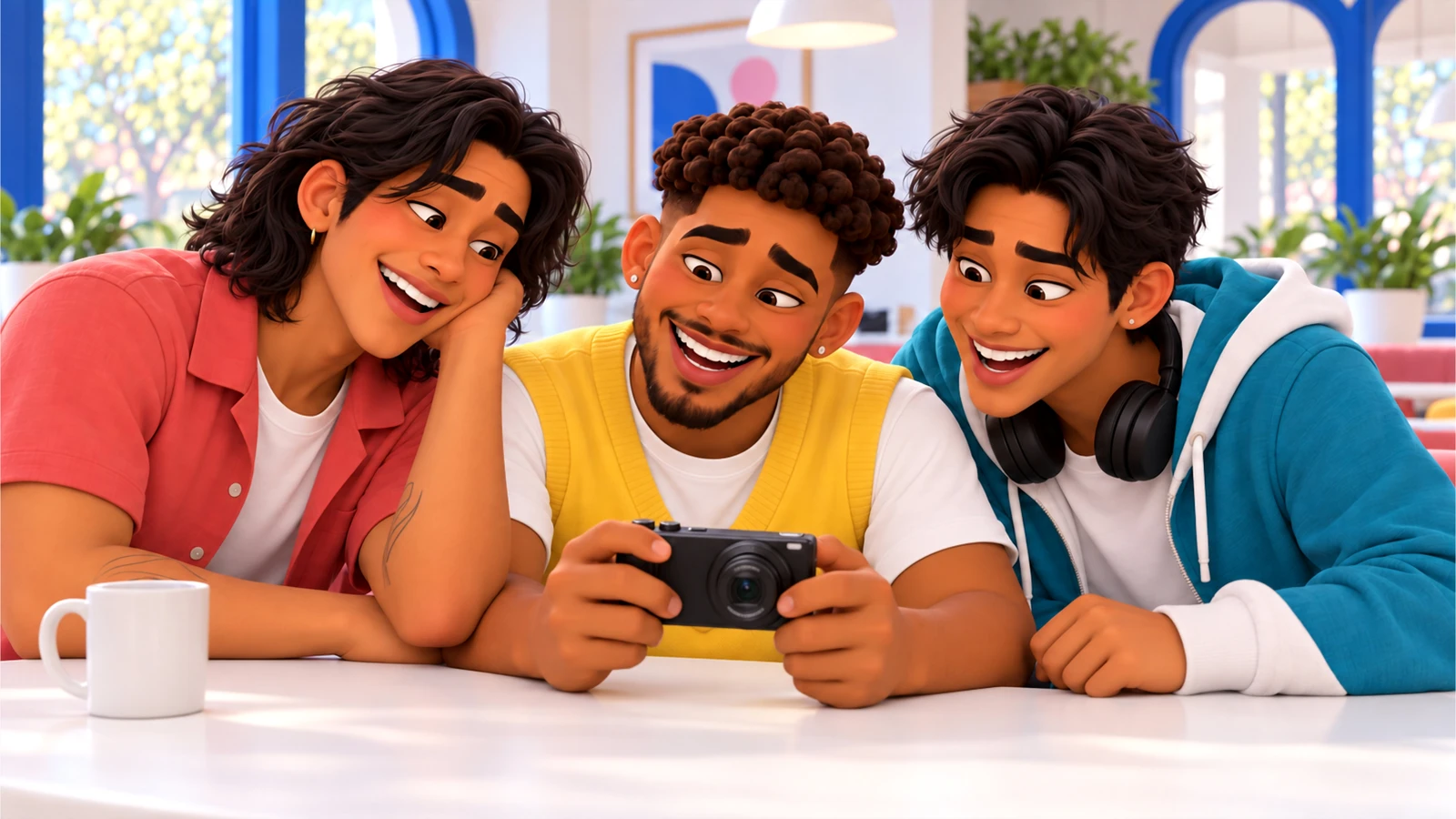
Mateo wants to post the crew’s film tonight and credit the song’s artist, but Caio wants to check the license first.
- Grades 6–12 and college
- 45-minute lesson
- 3 evidence documents
- Lesson 14 of 20
Overview
Students read a story in which Caio’s film recap uses a sampled track and a six-second TikTok clip. Mateo wants to post it tonight with a credit in the caption. They separate attribution, permission and fair use, then apply the U.S. Copyright Office’s four fair-use factors to the crew’s planned use. They then complete a rights log and propose a licensed or original alternative.
Key terms
- Attribution
Attribution is naming the person who made a work, such as a song, a photo or a video. En español: atribución
In this case: Mateo’s plan, “We’ll credit them in the caption,” would name the artist. It answers who made the song, not whether the crew may use it.
- License
A license is permission from a rights holder to use a work under specific terms. En español: licencia
In this case: The rights log says “permission unknown” for both borrowed pieces. A license from each owner would fill in that column.
- Fair use
Fair use is a part of U.S. copyright law that allows some uses without permission, judged case by case with four factors. En español: uso justo
In this case: The crew would weigh the four factors for 20 seconds of a released song used as background mood. No number of seconds settles it.
Where this example applies
General U.S. copyright literacy. In-app music permissions are not a blanket license for every later use, such as a festival screening.
Grade levels, subjects and time
- Grade levels
- 6–12, plus college and community groups.
- Subjects
- English language arts; also law and civics.
- Time
- 45 minutes for the lesson steps on this page. The student page takes 20 to 30 minutes.
Learning objectives
Students will be able to:
- tell apart giving credit, having permission and making a fair use;
- apply the four fair-use factors to one planned use and state what is uncertain;
- keep a rights log for a creative project and propose a use the creators are allowed to make.
What students should already be able to do
The student edition for each grade band assumes students can already:
- Grades 6–8
- find a detail in a short text and point to it; sort items into two groups and give a reason; write a complete sentence that answers a question.
- Grades 9–10
- summarize a short source accurately; explain the difference between a claim and evidence; organize a short piece of writing into paragraphs.
- Grades 11–12
- summarize a legal decision from a short official summary; apply a named rule to a new example; write an explanatory text of about 300 words.
- College and community
- summarize an official source accurately; keep a log of sources and permissions; write a guide for a named group of readers.
Skills, terms and roles
New skill
Check permission, not just credit
Find who holds the rights to each piece you borrow and what the license lets you do with it.
Skills students use again
- Find the original source (Lesson 1). You trace the six-second clip back to the post and the person who made it.
- Spot and disclose a material connection (Lesson 8). Saying where something came from is honest, but it is not the same as permission.
- Apply a precedent by comparing fact patterns (Lesson 12). Fair use is decided by weighing factors against the facts of each use.
Key terms
- New in this case
- Attribution, License, Fair use
- From earlier cases
- Disclosure (Lesson 8)
Character spotlight
Caio leads. Caio edits freelance projects and runs film nights at the bookshop. He knows how a song sets a scene, and he checks before posting other people’s work.
- Mateo: He wants the film online tonight and starts out treating credit as permission.
The student’s role
You’re the one who fills in the rights log before the film goes up.
Materials
- The student page for Lesson 14: Does giving credit let the crew use the song?. Students read the case, look at the evidence and write their response there.
- The evidence handout below: 3 documents, one copy per pair.
- The student edition for your grade band, printed or on screen. See printable pages by grade band.
Evidence handout
Evidence A Edit timeline
Caio’s rough cut, Friday, 9:40 p.m.
0:00–0:18 crew footage, no music. 0:18–0:38 sampled track, pitched up slightly, under the setup montage. 0:38–1:52 crew footage and interviews. 1:40–1:46 a 6-second clip downloaded from a stitched TikTok post.
What it shows: The film borrows two pieces: 20 seconds of a released song and a six-second TikTok clip.
What it leaves out: Who owns each piece, whether a license covers this use and which part of the song is used.
Ask: Which two parts of the cut did the crew not make?
Evidence B Group-chat message
Mateo’s message, Friday, 10:02 p.m.
“We’ll credit them in the caption. Post tonight?”
What it shows: Mateo plans to name the artist in the caption and post the film tonight.
What it leaves out: Whether anyone who owns the song agreed to this use.
Ask: Which question does the caption answer? Which question does it skip?
Evidence C Rights log
Rights log, started Saturday morning
Columns: element, who made it, where it came from, permission or license and date. Row 1: setup-montage music, the recording artist, a streaming download, permission unknown. Row 2: 6-second clip, a TikTok creator, downloaded from TikTok, permission unknown.
What it shows: The crew has listed both borrowed pieces, who made them and where each one came from.
What it leaves out: A license or permission for either piece, and what the TikTok creator agreed to when posting.
Ask: Which column says “unknown” in both rows?
Printable pages by grade band
Each grade band has its own student pages and educator pages for this case. The educator pages show every student page with sample answers. See every printable page for this case, including the course editions.
| Grade band | Educator pages | Student pages |
|---|---|---|
| Grades 6–8 | Open on screen Print this case Download PDF, 453 KB | Open on screen Print this case Download fillable PDF, 441 KB |
| Grades 9–10 | Open on screen Print this case Download PDF, 492 KB | Open on screen Print this case Download fillable PDF, 371 KB |
| Grades 11–12 | Open on screen Print this case Download PDF, 463 KB | Open on screen Print this case Download fillable PDF, 472 KB |
| College and community | Open on screen Print this case Download PDF, 612 KB | Open on screen Print this case Download fillable PDF, 477 KB |
Real news and research for this case
These news stories and studies are real. Each link opens the original in a new tab.
Real source Video CrashCourse (YouTube) May 7, 2015
Copyright, Exceptions, and Fair Use: Crash Course Intellectual Property #3
Explains why giving credit is not the same as permission, and how fair use is weighed.
Watch on YouTube (opens in a new tab)Real source News NPR May 18, 2023
Supreme Court sides against Andy Warhol Foundation in copyright infringement case
Even a famous artist’s new version wasn’t fair use when it served the same purpose as the original.
Read on npr.org (opens in a new tab)More news and research (4)
Real source News The Christian Science Monitor February 6, 2024
How Universal's licensing pullout is affecting music on TikTok
Explains the licensing deal behind the songs creators use and what happens when it ends.
Read on csmonitor.com (opens in a new tab)Real source Research Harvard Business School Working Knowledge March 5, 2025
What Happened When TikTok Songs Went Silent for Three Months
Research on what the music blackout meant for creators, artists and the platform.
Read on library.hbs.edu (opens in a new tab)Real source Government source U.S. Copyright Office 2023
Andy Warhol Found. for the Visual Arts, Inc. v. Goldsmith (Fair Use Index summary)
A one-page official summary of the facts, question and holding, good for tracing how transformative purpose was judged.
Read on copyright.gov (opens in a new tab)Real source Government source U.S. Copyright Office September 2021
Copyright Basics (Circular 1)
The official starting point on what copyright covers and who owns a song or recording.
Read on copyright.gov (opens in a new tab)Links checked September 24, 2026.
Professional standards
Many professions publish a code of ethics. These parts of real codes apply to this case.
Real source AIGA, the professional association for design
AIGA Standards of Professional Practice: The designer’s responsibility to other designers
A professional designer shall not accept instructions from a client that involve infringement of another person’s property rights without permission
In plain words: Designers who belong to AIGA agree not to use other people's creative work without permission, even when a client asks.
Ask: The rights log says “permission unknown” for the track and the TikTok clip. What does Caio need for each row?
Sample answers
- Grades 6–8
- For the song, Caio needs a yes from the song’s owner. For the clip, he needs the TikTok creator’s permission.
- Grades 9–10
- To fill in each row, Caio needs a license or permission, with its date, from the song’s owner and from the TikTok creator.
- Grades 11–12
- Caio needs a license or permission from each owner, with its terms and date, because a credit line fills neither column.
Real source Radio Television Digital News Association (RTDNA) 2015
RTDNA Code of Ethics: Independence and transparency
Using someone else’s work without attribution or permission is plagiarism.
In plain words: The RTDNA code calls it plagiarism when news staff use someone else's work without credit or permission.
Ask: Mateo will credit the artist. Which question does credit answer, and which question in the rights log is still open?
Read the full code on the RTDNA website (opens in a new tab)Real source Public Relations Society of America (PRSA) 2000
PRSA Code of Ethics: Competition
Preserve intellectual property rights in the marketplace.
In plain words: Public relations professionals who belong to PRSA agree to respect the ownership rights of people who create work.
Ask: The recap promotes the crew's film night. What would a licensed track or original music change in the rights log?
Read the full code on the PRSA website (opens in a new tab)Share, schedule or open in your apps
Reading passage by grade band
Each grade band has its own longer reading passage built from this case’s story and its real sources. Real news, laws and research are cited in the text with their dates. Three “Stop and think” questions sit inside each passage. Open a band to read it, or print that band on its own.
Grades 6–8: Credit is not permission
434 words
Credit is not permission
The story: A song that carries the scene
It is Friday night, and Caio is editing the crew’s festival film. It is a short recap made from crew footage and interviews. At 9:40 p.m., he saves a rough cut.
For 20 seconds, a released song plays under the setup montage. Caio pitched it up slightly, and the song sets the mood for the whole scene. The cut borrows one more piece. From 1:40 to 1:46, it shows a six-second clip downloaded from a TikTok post. That post used Stitch, TikTok’s remix tool. The crew did not make the song or the clip.
At 10:02 p.m., Mateo texts the crew chat: “We’ll credit them in the caption. Post tonight?” Caio writes back one question: “Credit gets us what, exactly?” Mateo does not have an answer.
Your role is to fill in the rights log before the film goes up.
Two different questions
Attribution is naming the person who made a work, such as a song, a photo or a video. It answers the question “Who made this?” A license is permission from a rights holder to use a work under specific terms. It answers a different question: “Did the owner say yes to this use?” Mateo’s caption would give attribution. It would not give the crew a license.
In Lesson 8, you learned that a disclosure is a clear statement that tells people about a relationship or fact they would want to know. Naming the artist is honest, like a disclosure. But being honest about where something came from is not the same as having permission to use it.
Pitching the song up does not make it the crew’s song either. “It’s still their song, just a little higher,” Caio says.
The crew starts a rights log. It lists each borrowed piece, who made it, where it came from and whether there is permission. Right now, both rows say “permission unknown.” Mateo thought Stitch covered the TikTok clip. But Stitch works inside TikTok. A festival film is somewhere else.
Caio has two backup plans. The crew can use a library track with clear terms, or Dec can record a drum loop the crew owns. Either way, they post Sunday.
When the music went silent
In February 2024, a licensing deal between Universal Music Group and TikTok ended. Videos using songs by artists like Taylor Swift and Olivia Rodrigo went silent (NPR, February 1, 2024). Nobody forgot to credit Taylor Swift. The license was the problem.
Fair use is a part of U.S. copyright law that allows some uses without permission, judged case by case with four factors (U.S. Copyright Office, updated July 2026).
Key terms in this passage
- Attribution
- Attribution is naming the person who made a work, such as a song, a photo or a video.
- License
- A license is permission from a rights holder to use a work under specific terms.
- Fair use
- Fair use is a part of U.S. copyright law that allows some uses without permission, judged case by case with four factors.
- Disclosure
- A disclosure is a clear statement that tells people about a relationship or fact they would want to know.
Real sources cited
- NPR, “TikTok removes music from UMG artists, including Olivia Rodrigo and Taylor Swift,” February 1, 2024. Open the source (opens in a new tab)
- U.S. Copyright Office, “Fair Use Index,” July 2026. Open the source (opens in a new tab)
Grades 9–10: What a caption credit can and cannot do
624 words
What a caption credit can and cannot do
The story: Rough cut, 9:40 p.m.
Caio edits freelance projects and runs film nights at the bookshop, so he knows what a song can do to a scene. On Friday night, he is cutting the crew’s festival film, a short recap built from crew footage and interviews. His rough cut, saved at 9:40 p.m., has a problem he likes too much. From 0:18 to 0:38, a released song plays under the setup montage, pitched up slightly, and it carries the whole sequence. From 1:40 to 1:46, the cut also uses a six-second clip downloaded from a TikTok post made with Stitch, TikTok’s remix tool.
At 10:02 p.m., Mateo texts the crew chat: “We’ll credit them in the caption. Post tonight?” Mateo wants the film online tonight. Caio replies with a question: credit gets them what, exactly? Mateo admits he does not have an answer.
Caio’s reasoning is simple. Twenty seconds of the song carries the montage, and that is exactly why he cannot just borrow it and hope. He wants to check the license before anyone posts. Your role is to fill in the rights log before the film goes up.
Credit, permission and the rights log
Attribution is naming the person who made a work, such as a song, a photo or a video. It answers “Who made this?” A license is permission from a rights holder to use a work under specific terms. It answers “Did the owner say yes to this use?” Mateo’s caption answers the first question and says nothing about the second.
Lesson 8 taught you that a disclosure is a clear statement that tells people about a relationship or fact they would want to know. Attribution is honest in the same way. It tells viewers where something came from. But honesty about the source is not permission to use it. Changing the pitch does not change ownership either. As Caio puts it, the song is still theirs, just a little higher.
Lesson 1 taught you to trace a clip to its original source. The rights log does that for every borrowed piece. It has columns for the element, who made it, where it came from, the permission or license and the date. Row 1 is the setup-montage music from a streaming download, permission unknown. Row 2 is the six-second clip from a TikTok creator, permission unknown. Mateo assumed Stitch covered the clip. Stitch permission works inside TikTok, and the festival film is not on TikTok, so the row stays “unknown” until the crew finds out.
Fair use is a part of U.S. copyright law that allows some uses without permission, judged case by case with four factors. The factors are the purpose of the use, the nature of the original work, the amount used and the effect on the original’s market (U.S. Copyright Office, updated July 2026). Lesson 12 taught you to compare facts against a legal standard, and fair use works the same way. No number of seconds is automatically safe. A short clip can count against fair use if it is the most recognizable part of a song.
Caio’s plan avoids the question entirely if the license falls through. The crew can use a library track with clear terms, or Dec can record a drum loop the crew owns. The film goes up Sunday.
When platforms and courts decide
When Universal Music Group’s licensing deal with TikTok expired in February 2024, videos using its artists’ songs, from Taylor Swift to Olivia Rodrigo, went silent (NPR, February 1, 2024). Credit was never the issue.
The Supreme Court tested fair use in 2023. It ruled against the Andy Warhol Foundation, finding that Warhol’s new version of a photograph was not fair use when it served the same purpose as the original (NPR, May 18, 2023).
Key terms in this passage
- Attribution
- Attribution is naming the person who made a work, such as a song, a photo or a video.
- License
- A license is permission from a rights holder to use a work under specific terms.
- Fair use
- Fair use is a part of U.S. copyright law that allows some uses without permission, judged case by case with four factors.
- Disclosure
- A disclosure is a clear statement that tells people about a relationship or fact they would want to know.
Real sources cited
- NPR, “TikTok removes music from UMG artists, including Olivia Rodrigo and Taylor Swift,” February 1, 2024. Open the source (opens in a new tab)
- NPR, “Supreme Court sides against Andy Warhol Foundation in copyright infringement case,” May 18, 2023. Open the source (opens in a new tab)
- U.S. Copyright Office, “Fair Use Index,” July 2026. Open the source (opens in a new tab)
Grades 11–12: Four factors and a rights log
715 words
Four factors and a rights log
The story: Post tonight, or check first?
At 9:40 on a Friday night, Caio, 24, saves a rough cut of the crew’s festival film. The recap mixes crew footage and interviews, and one choice makes it work. From 0:18 to 0:38, a released song, pitched up slightly, plays under the setup montage. A second borrowed element sits later in the timeline. From 1:40 to 1:46, the cut includes six seconds downloaded from a TikTok post that used Stitch, the app’s remix tool. Neither piece belongs to the crew.
Mateo, who likes turning “we should” into a plan, wants the film online that night. At 10:02 p.m., he proposes a solution that feels responsible: credit the artists in the caption and post. Caio’s answer is a single question. What does the credit get them? Mateo admits he does not know.
By the next day, Mateo has worked out why his instinct was wrong. He remembers when Universal Music Group’s deal with TikTok ran out and videos went silent. Nobody had forgotten to credit Taylor Swift. He also rethinks the clip. He had figured Stitch covered it, but Stitch is for TikTok, and this is a festival film.
Your role is to fill in the rights log before the film goes up.
Separating attribution, license and fair use
Attribution is naming the person who made a work, such as a song, a photo or a video. A license is permission from a rights holder to use a work under specific terms. The two answer different questions, “Who made this?” and “Did the owner say yes to this use?” A caption credit supplies the first and not the second. Lesson 8’s disclosure, a clear statement that tells people about a relationship or fact they would want to know, is a useful comparison. Like attribution, disclosure makes a post more honest. Neither one grants rights.
The rights log applies the Lesson 1 skill of tracing material to its source. For each element, it records who made it, where it came from, the permission or license and the date. Both current rows read “permission unknown.” The log also shows what the crew does not yet know, including what the TikTok creator agreed to when posting.
Without a license, the remaining path is fair use, a part of U.S. copyright law that allows some uses without permission, judged case by case with four factors. The factors are the purpose of the use, the nature of the original work, the amount used and the effect on the original’s market. The analysis resembles Lesson 12’s reasoning from precedent: you set the facts of your use against a standard and weigh each factor, rather than looking for a single rule. For the song, the purpose is setting a mood in a recap, the original is a released creative recording, the amount is 20 seconds and the effect on the market is uncertain. Caio’s pitch change does not transform the purpose. No duration is automatically safe, and a short excerpt can weigh heavily if it is the most recognizable part.
Caio’s backup plans take the question off the table: a library track with clear terms, or a drum loop that Dec records and the crew owns. The film goes up Sunday instead of Friday.
Licensing, courts and professional norms
The UMG and TikTok dispute showed how platform licenses work. When the deal expired in February 2024, videos using UMG artists’ songs went silent (NPR, February 1, 2024). Researchers later studied what the roughly three-month blackout meant for creators, artists and the platform (Harvard Business School Working Knowledge, March 5, 2025).
The Supreme Court’s 2023 decision in the Warhol case shows how the purpose factor works. The Court ruled against the Andy Warhol Foundation, finding that Warhol’s version of a photograph was not fair use when it served the same purpose as the original (NPR, May 18, 2023). The Copyright Office publishes a one-page summary of the facts and holding (U.S. Copyright Office, 2023). Its Fair Use Index stresses that fair use is decided case by case and that a use for education is not automatically fair (U.S. Copyright Office, updated July 2026).
News organizations treat the issue as an ethical one too. The RTDNA code states, “Using someone else’s work without attribution or permission is plagiarism” (RTDNA Code of Ethics, June 11, 2015).
Key terms in this passage
- Attribution
- Attribution is naming the person who made a work, such as a song, a photo or a video.
- License
- A license is permission from a rights holder to use a work under specific terms.
- Fair use
- Fair use is a part of U.S. copyright law that allows some uses without permission, judged case by case with four factors.
- Disclosure
- A disclosure is a clear statement that tells people about a relationship or fact they would want to know.
Real sources cited
- NPR, “TikTok removes music from UMG artists, including Olivia Rodrigo and Taylor Swift,” February 1, 2024. Open the source (opens in a new tab)
- Harvard Business School Working Knowledge, “What Happened When TikTok Songs Went Silent for Three Months,” March 5, 2025. Open the source (opens in a new tab)
- NPR, “Supreme Court sides against Andy Warhol Foundation in copyright infringement case,” May 18, 2023. Open the source (opens in a new tab)
- U.S. Copyright Office, “Andy Warhol Found. for the Visual Arts, Inc. v. Goldsmith (Fair Use Index summary),” 2023. Open the source (opens in a new tab)
- U.S. Copyright Office, “Fair Use Index,” July 2026. Open the source (opens in a new tab)
- Radio Television Digital News Association (RTDNA), “RTDNA Code of Ethics,” 2015. Open the source (opens in a new tab)
College and community: Rights clearance for small productions
787 words
Rights clearance for small productions
The story: Two borrowed elements
Caio, 24, is editing the crew’s festival film, a short recap of footage and interviews. His Friday rough cut, saved at 9:40 p.m., includes two elements the crew did not create. The first is 20 seconds of a released song, pitched up slightly, running from 0:18 to 0:38 under the setup montage. It sets the tone for the scene. The second is a six-second clip, from 1:40 to 1:46, downloaded from a TikTok post that used Stitch, the platform’s remix feature.
At 10:02 p.m., Mateo, 22, proposes a common solution. The crew will credit the artists in the caption and post that night. Caio responds with the question the case is built around. What does the credit get them? Mateo concedes he has no answer. By Saturday, he has revised his view on both elements. He recalls the 2024 TikTok music blackout, in which no one had failed to credit Taylor Swift, and he recognizes that an in-app remix permission may not extend to an off-platform screening. He moves both items to the rights log as unknowns.
Your role is to fill in the rights log before the film goes up.
Three concepts, three questions
Rights clearance begins by separating concepts that everyday language merges. Attribution is naming the person who made a work, such as a song, a photo or a video. A license is permission from a rights holder to use a work under specific terms. Fair use is a part of U.S. copyright law that allows some uses without permission, judged case by case with four factors. Attribution answers who made something. A license answers whether the owner agreed to this use. Fair use asks whether the law permits the use anyway.
The case builds on earlier skills. From Lesson 1, the rights log traces each element to its source, maker and permission status, with a date. From Lesson 8, a disclosure, a clear statement that tells people about a relationship or fact they would want to know, shows how honesty and authorization differ. Crediting an artist is a kind of disclosure, and it transfers no rights. From Lesson 12, the method of weighing facts against a legal standard applies to fair use, which works through factors rather than bright lines.
Applied to the song, the four factors are the purpose of the use, the nature of the original work, the amount used and the effect on the original’s market. The purpose is atmosphere in a recap, the original is a creative recording, the amount is 20 seconds and the market effect is uncertain. A pitch shift does not change the purpose, and the Copyright Office is clear that no number of seconds is automatically safe. Even a short part can weigh against fair use if it is the most recognizable part of the work. The TikTok clip raises a separate question, the scope of the creator’s consent. Stitch permission operates inside TikTok. Whether it reaches a downloaded clip in a film shown elsewhere is exactly what the rights log marks as unknown.
Caio’s decision reflects professional practice. When clearance is uncertain and the deadline is soft, substitute. The crew can use a library track with clear license terms or a drum loop recorded by Dec that the crew owns, and publish Sunday.
Markets, doctrine and codes
Platform licensing is contractual and can change without notice to users. When UMG’s agreement with TikTok expired in February 2024, videos using its artists’ recordings went silent (NPR, February 1, 2024). Coverage explained the licensing structure behind the songs creators use (Christian Science Monitor, February 6, 2024), and later research examined the effects of the roughly three-month blackout (Harvard Business School Working Knowledge, March 5, 2025).
The Supreme Court’s decision in Andy Warhol Foundation v. Goldsmith emphasized the first factor. A new work used for substantially the same purpose as the original was not fair use, despite its artistic changes (NPR, May 18, 2023; U.S. Copyright Office summary, 2023). The Copyright Office’s Fair Use Index notes that educational purpose does not make a use automatically fair (U.S. Copyright Office, updated July 2026). Its Circular 1 explains what copyright covers and who owns a song or a recording (U.S. Copyright Office, September 2021).
Professional codes align with the law. PRSA members commit to “preserve intellectual property rights in the marketplace” (PRSA Code of Ethics, October 2000). The AIGA standards bar designers from accepting instructions that involve “infringement of another person’s property rights without permission” (AIGA Standards of Professional Practice, no date listed). The RTDNA code calls use “without attribution or permission” plagiarism (RTDNA Code of Ethics, June 11, 2015). Note the “or.” Attribution and permission are separate obligations, which is the lesson Mateo learns.
Key terms in this passage
- Attribution
- Attribution is naming the person who made a work, such as a song, a photo or a video.
- License
- A license is permission from a rights holder to use a work under specific terms.
- Fair use
- Fair use is a part of U.S. copyright law that allows some uses without permission, judged case by case with four factors.
- Disclosure
- A disclosure is a clear statement that tells people about a relationship or fact they would want to know.
Real sources cited
- NPR, “TikTok removes music from UMG artists, including Olivia Rodrigo and Taylor Swift,” February 1, 2024. Open the source (opens in a new tab)
- The Christian Science Monitor, “How Universal's licensing pullout is affecting music on TikTok,” February 6, 2024. Open the source (opens in a new tab)
- Harvard Business School Working Knowledge, “What Happened When TikTok Songs Went Silent for Three Months,” March 5, 2025. Open the source (opens in a new tab)
- NPR, “Supreme Court sides against Andy Warhol Foundation in copyright infringement case,” May 18, 2023. Open the source (opens in a new tab)
- U.S. Copyright Office, “Andy Warhol Found. for the Visual Arts, Inc. v. Goldsmith (Fair Use Index summary),” 2023. Open the source (opens in a new tab)
- U.S. Copyright Office, “Fair Use Index,” July 2026. Open the source (opens in a new tab)
- U.S. Copyright Office, “Copyright Basics (Circular 1),” September 2021. Open the source (opens in a new tab)
- Public Relations Society of America (PRSA), “PRSA Code of Ethics,” 2000. Open the source (opens in a new tab)
- AIGA, the professional association for design, “AIGA Standards of Professional Practice,” No date listed. Open the source (opens in a new tab)
- Radio Television Digital News Association (RTDNA), “RTDNA Code of Ethics,” 2015. Open the source (opens in a new tab)
Pacing options
10-minute bellringer
10 minutes
One piece of evidence and one question. Use it to open the case or to review it the next day.
One class period
45 minutes
Teach the lesson steps on this page in four parts.
The student edition also has a one-period plan for each grade band:
- Grades 6–8: 45 minutes
- Grades 9–10: 50 minutes
- Grades 11–12: 60 minutes
- College and community: 75 minutes
Full chapter
87 to 110 minutes
Teach every page of the student edition chapter. The educator edition has notes and sample answers beside each page.
- Grades 6–8: 87 minutes
- Grades 9–10: 105 minutes
- Grades 11–12: 102 minutes
- College and community: 110 minutes
Minutes for each page
How long each student edition page takes, and what to cut when you have one class period.
Open your grade band.
Grades 6–8: full chapter 87 minutes, one period 45 minutes
| Page | Full chapter | One period | How to cut |
|---|---|---|---|
| Opener | 5 min | 5 min | |
| Key terms | 8 min | 3 min | Read the key terms aloud. Skip Who is involved. |
| Look at the evidence | 12 min | 12 min | |
| Key idea | 8 min | Skip | Read the first paragraph of the key idea aloud. Skip the code of ethics. |
| Sort the evidence | 10 min | 3 min | Do the first row together and stop. |
| Practice | 8 min | Skip | Skip this page. |
| Your task | 20 min | 18 min | Fill in the rights log together on the board. |
| Check your work | 6 min | Skip | Skip this page. Score the work yourself with the rubric. |
| Questions to discuss | 10 min | 4 min | Use question 1 as an exit ticket. |
| Talk about this case at home | At home | At home |
Grades 9–10: full chapter 105 minutes, one period 50 minutes
| Page | Full chapter | One period | How to cut |
|---|---|---|---|
| Opener | 5 min | 4 min | Read What happened aloud and go straight to the evidence. |
| Key terms | 6 min | Skip | Skip this page. Define attribution and license aloud in one minute. |
| Look at the evidence | 10 min | 8 min | Read Evidence B aloud. Students fill in only the boxes for Evidence A. |
| Look at the evidence, continued | 5 min | 3 min | Students fill in only the “What it shows” box. |
| Key idea | 10 min | 6 min | Read the second paragraph aloud. Skip the code of ethics. |
| Sort the evidence | 8 min | Skip | Skip this page. |
| Practice | 6 min | Skip | Skip this page. |
| Your task | 12 min | 10 min | Fill in factor 1 together, then let pairs finish the table. |
| Your draft | 25 min | 15 min | Students draft the four factors in class and finish the recommendation at home. |
| Check your work | 8 min | Skip | Collect drafts and score them with the rubric yourself. |
| Questions to discuss | 10 min | 4 min | Use question 3 as an exit ticket. |
| Talk about this case at home | At home | At home |
Grades 11–12: full chapter 102 minutes, one period 60 minutes
| Page | Full chapter | One period | How to cut |
|---|---|---|---|
| Opener | 5 min | 4 min | Read What happened aloud and go straight to the evidence. |
| Key terms | 5 min | Skip | Skip this page. |
| Look at the evidence | 8 min | 8 min | |
| Look at the evidence, continued | 4 min | 3 min | Students fill in only the “What it shows” box. |
| Key idea | 10 min | 8 min | Skip the In the news section. |
| Sort the evidence | 8 min | Skip | Skip this page. |
| Practice | 6 min | Skip | Skip this page. |
| Your task | 15 min | 12 min | Read the Warhol summary aloud together before students fill in the planner. |
| Your draft | 25 min | 20 min | Students draft the holding and application paragraphs in class and finish at home. |
| Check your work | 6 min | Skip | Collect drafts and score them with the rubric yourself. |
| Questions to discuss | 10 min | 5 min | Use question 1 as an exit ticket. |
| Talk about this case at home | At home | At home |
College and community: full chapter 110 minutes, one period 75 minutes
| Page | Full chapter | One period | How to cut |
|---|---|---|---|
| Opener | 5 min | 4 min | Read What happened aloud. |
| Key terms | 5 min | 3 min | Read the key terms aloud; skip the first-guess box. |
| Look at the evidence | 8 min | 8 min | |
| Look at the evidence, continued | 5 min | 4 min | Students fill in only the “What it shows” box. |
| Key idea | 10 min | 8 min | Skip the In the news section. |
| Sort the evidence | 8 min | Skip | Skip this page. |
| Practice | 6 min | Skip | Skip this page. |
| Your task | 15 min | 15 min | |
| Your draft | 30 min | 25 min | Students draft the rights log and credit sections in class and finish at home. |
| Check your work | 8 min | 5 min | Students answer the check questions and skip the rubric. |
| Questions to discuss | 10 min | 3 min | Use question 2 as an exit ticket. |
| Talk about this case at home | At home | At home |
Minutes for each page are in the educator edition for each grade band.
10-minute bellringer
- 1 min Project Evidence A as students come in.
- 5 min Students read it on their own. Each student writes a one-sentence answer to the question.
- 4 min Take two or three answers. Then ask the follow-up questions.
Evidence A Edit timeline
Caio’s rough cut, Friday, 9:40 p.m.
0:00–0:18 crew footage, no music. 0:18–0:38 sampled track, pitched up slightly, under the setup montage. 0:38–1:52 crew footage and interviews. 1:40–1:46 a 6-second clip downloaded from a stitched TikTok post.
Question Which parts of this cut did the crew not make?
Follow-up questions
- How many seconds of the sampled track are in the cut?
- Would a credit in the caption give the crew permission to use those parts?
Listen for: Students name the 20-second sampled track and the 6-second clip from a TikTok post.
This is the same bellringer as on the bellringers page, which has one for every case.
Lesson steps
This plan takes 45 minutes in four parts. Each step says what you do, what students do and how to check.
Warm-up 5 minutes
1 The paused upload 5 min
- You
- Set the scene: Caio’s film recap uses a sample; Mateo wants to post tonight with a credit.
- Students
- Vote: is credit enough? One reason.
- Check
- Everyone commits to a position.
Read and discuss 27 minutes
2 Three questions 10 min
- You
- Distinguish attribution, permission and fair use.
- Students
- Sort statements into the three categories.
- Check
- “We’ll credit them” goes under attribution only.
3 Four factors 10 min
- You
- Read the Copyright Office fair-use page together.
- Students
- Apply each factor to the crew’s use, marking uncertainty.
- Check
- Students avoid a guaranteed verdict.
4 Myth check 7 min
- You
- Test “ten seconds is always fine” and “it’s for school.”
- Students
- Find what the source says about each.
- Check
- Students cite that there’s no fixed-length rule and education isn’t automatic.
Questions for the people in the case
- Caio: You pitched it up. Doesn’t that make it yours? Check next: Name the original work and the exact use before calling it transformed.
- Caio: So what’s the plan? Check next: Read the actual license terms and log them with the source and date.
- Mateo: Why isn’t credit enough? Check next: Keep attribution, permission and fair use as three separate questions.
- Mateo: What about the six-second TikTok clip? Check next: Check whether an in-app permission covers a use outside the app.
Task 10 minutes
5 Rights log and alternative 10 min
- You
- Model a four-column rights log.
- Students
- Complete the log and propose a licensed or original alternative.
- Check
- Log is complete; alternative is realistic.
Wrap-up 3 minutes
6 Exit 3 min
- You
- Ask: what changes if the class draft becomes a public post?
- Students
- Write one change.
- Check
- Answer mentions audience, market or platform terms.
Educator notes by page
These notes follow the pages of the student edition chapter. The educator edition prints the same notes beside each page. Heat check tells you how likely a page is to bring up strong feelings: low, medium or high. Medium and high pages come with a cool-down. Open a page to see what to say, what to watch for and how to support students.
Opener
Heat check: Low
Say this
- “Mateo wants to post tonight with a credit in the caption. Is that enough?” Hold a quick thumbs-up or thumbs-down vote. Do not settle it yet.
Watch for
- Misconception:
- Students treat credit as permission.
- Listen for:
- “They gave credit, so it’s fine.”
- Then:
- Ask what question a credit answers. Write “Who made it?” and “Who said yes?” on the board.
Support
- Read What happened aloud while students follow along.
Key terms
Heat check: Low
Say this
- “Write your first guess now. You will check it against the evidence later.” First guesses stay private unless a student wants to share.
Watch for
- Misconception:
- Students hear “fair use” as any use that seems fair.
- Listen for:
- “It’s fair because they aren’t making money.”
- Then:
- Point to “judged case by case on four factors.” Everyday fairness does not decide it.
Support
- Draw three boxes: credit, permission, fair use. Students add one detail from the case to each box.
Look at the evidence
Heat check: Low
Say this
- “Put your finger on each row of the rights log. Which column says ‘unknown’?” Wait for “permission or license” in both rows.
Watch for
- Misconception:
- Students think the pitch change makes the song the crew’s own.
- Listen for:
- “They changed it, so it’s theirs now.”
- Then:
- Ask what the change added. The song is still recognizable, and nobody gave permission.
Support
- Reduce the work to one element, the song, for students who need it.
- Read the timeline aloud and list each borrowed piece on the board.
Stretch
Ask why Stitch permission inside TikTok may not cover the same clip in a festival film.
Grades 6–8: notes that replace the ones above
Say this
- “Put your finger on each row of the rights log. Which column says ‘unknown’?” Wait for the permission column.
- “Listen to Mateo’s message: ‘We’ll credit them in the caption. Post tonight?’ Which question does it answer?” Evidence B is not printed for grades 6–8. Read it twice.
Key idea
Heat check: Low
Say this
- “Credit answers one question and a license answers another. Which question does each answer?” Accept “who made it” and “did the owner say yes.”
- “The AIGA code says not to use someone’s work without permission. What would Caio need?” Wait for “a license for each row.”
Watch for
- Misconception:
- Students treat the AIGA code as a law.
- Listen for:
- “The crew could get arrested for breaking it.”
- Then:
- Say: “A code of ethics is a standard a profession sets for its members. AIGA’s code binds its members, not the crew.”
Support
- Read the code quotation aloud. Point out the label: it is a real source, quoted word for word.
Stretch
Compare the RTDNA line, which calls using work without attribution or permission plagiarism. Why does it name both?
Sort the evidence
Heat check: Low
Say this
- “Which piece of evidence challenges the idea that credit is enough?” Model the first row together.
Watch for
- Misconception:
- Students mark Stitch permission as proof the clip is fine to use.
- Listen for:
- “TikTok lets you stitch, so it’s allowed.”
- Then:
- Stitch works inside TikTok. It narrows the claim; it does not settle the festival use.
Support
- Let students write S, C or N in each box before they write sentences.
Practice
Heat check: Low
Say this
- “It is 10:02 p.m. and Mateo wants to post. Which plan do you choose?” Hold a vote before any discussion.
Watch for
- Misconception:
- Students choose the ten-second plan.
- Listen for:
- “Ten seconds is always fair use.”
- Then:
- Ask where the Copyright Office names a safe number of seconds. It names none.
Support
- Read the three options aloud before students choose.
Your task and draft
4 grade bands
The task is different in each grade band. Open yours.
Grades 6–8
Your task
Say this
- “Two parts of this film came from someone else. What do you need to know about each?” Write “Who made it?” and “Did they say yes?” on the board.
Watch for
- Misconception:
- Students write that the song is fine because it is short.
- Listen for:
- “It’s only 20 seconds.”
- Then:
- Point to the key idea: no number of seconds is automatically safe.
Grades 9–10
Your task
Say this
- “Work through the factors one at a time. For each one, which way does the evidence point?” Model factor 1 together before pairs continue.
Watch for
- Misconception:
- Students give a final verdict on fair use.
- Listen for:
- “So it’s definitely fair use.”
- Then:
- Ask which factor they are sure of. Replace “definitely” with “probably” or a question mark.
Support
- Frame: “Factor ___ points ___ because ___.”
Your draft
Say this
- “Your reader is Mateo, who wants to post tonight. What does he need from your recommendation?” Ask for one clear next step and a backup plan.
Watch for
- Misconception:
- Drafts repeat the seconds myth.
- Listen for:
- “Under 30 seconds is always allowed.”
- Then:
- Point to the Evidence row of the rubric. Ask which part of the song the 20 seconds use.
Grades 11–12
Your task
Say this
- “Read the holding twice. What did the Court decide, and about which use?” Students often overstate the ruling. Ask them to name the use.
Watch for
- Misconception:
- Students say Warhol made remixing illegal.
- Listen for:
- “After Warhol, remixing is illegal.”
- Then:
- Reread the summary. The Court decided one licensing use under factor one.
Your draft
Say this
- “Your reader is the crew. How does a 2023 ruling about a photograph apply to their song?” Ask for one sentence that names the crew’s purpose.
Watch for
- Misconception:
- The brief gives legal advice.
- Listen for:
- “This is definitely infringement.”
- Then:
- Point to the success list: no legal advice. Replace verdicts with a recommended step.
College and community
Your task
Say this
- “Your readers run a film night. What must they fill in before the screening?” Build the rights log columns on the board.
Watch for
- Misconception:
- Guides treat a credit line as clearance.
- Listen for:
- “Just credit everyone in the program.”
- Then:
- Point to the permission column. A credit fills only the “who made it” column.
Support
- Help frame: “If you are unsure about a piece, ask ___.”
Your draft
Say this
- “A guide gives steps a reader can follow. Could a club member use yours without you there?” Partners test each guide on the rough cut.
Watch for
- Misconception:
- Guides give a safe number of seconds.
- Listen for:
- “Keep clips under 10 seconds.”
- Then:
- Ask where the Copyright Office names that number. It names none.
Check your work
Heat check: Low
Say this
- “Mark your level in each row. Then make one change and say why.” Circulate and ask for one myth removed or one source added.
Watch for
- Misconception:
- Students add a credit line and call it a revision.
- Listen for:
- “I added the artist’s name.”
- Then:
- Point to the Revision row. Adding a credit is level 2; a rights plan is level 3.
Questions to discuss
Say this
- “Answer with a detail from the evidence, not a rule you heard online.” Post the question numbers and collect one answer per question.
Stretch
Compare Caio’s two backup plans: a library track with clear terms or a drum loop Dec records. What does each need in the rights log?
Talk about this case at home
Say this
- “Share this page at home, or read it with an adult you trust.” Nobody needs to share a personal story to complete it.
Sample response
Worked example, grades 9–10
Prompt: Write a four-factor analysis of the crew’s planned use and recommend a path.
Student response
Factor 1, purpose: We’re using about 20 seconds of the song as background mood for our recap, 1 not to comment on the song, so this factor probably weighs against fair use. Factor 2, nature of the work: The song is a creative recording, which also weighs against us. Factor 3, amount: 20 seconds is a small part, so this factor is fine because 2 anything under 30 seconds is allowed. Factor 4, market effect: Using it for free as background music 3 could replace a license the artist might sell. Recommendation: Credit doesn’t equal permission, and 4 Stitch only works inside TikTok, so we should swap in a licensed track or record our own before posting.
- Evidence. Accurate reading of purpose, with an honest “probably” instead of a verdict.
- Revise. There is no safe number of seconds. The Copyright Office says no formula guarantees that a set amount may be used, and even a small portion can count against fair use if it is the heart of the work.
- Strength. Strong: the writer connects market effect to how artists actually earn from music.
- Strength. Good: platform permission is correctly limited to the platform.
Before: Factor 3, amount: 20 seconds is a small part, so this factor is fine because anything under 30 seconds is allowed.
After: Factor 3, amount: 20 seconds is a small part of the song, but the factor also weighs which part is used, and if it is the song’s most recognizable hook, that could count against us.
Why: The revision replaces a myth with the actual factor, which weighs both how much and which part is used.
Educator commentary: The analysis applies all four factors, marks uncertainty and correctly limits platform permission, and its recommendation is practical. One sentence repeats the seconds myth the case exists to correct. Replacing it with the real amount-and-substantiality factor moves the analysis to Proficient on Evidence and Reasoning.
Task answers by grade band
What a strong student in each grade band writes in the student edition task.
Open your grade band.
Grades 6–8
Make a rights log for the crew’s short film and suggest a way to use music they’re allowed to use.
Students make: Rights log plus 3–4 sentences.
Steps students follow
- Circle each part of the rough cut in Evidence A that the crew did not make.
- Write who made each part, using the rights log in Evidence C.
- Mark each part with a check for permission or a question mark for unknown.
- Choose music the crew is allowed to use in place of the song.
- Write 3 or 4 sentences in the Your draft box that explain your plan.
- Check that your sentences say what credit does and what permission means.
Sample answers for the task boxes
- Borrowed part 1, and who made it
- The song, 20 seconds. The recording artist made it.
- Permission for part 1
- ? Unknown. A credit does not give permission.
- Borrowed part 2, and who made it
- The six-second TikTok clip. A TikTok creator made it.
- Permission for part 2
- ? Unknown. Stitch covers remixes inside TikTok.
- Music the crew is allowed to use
- A library track with clear terms or Dec’s own drum loop
Sample draft: Your draft
Sample answer Grades 6–8
1 Credit tells people who made the song. Permission means the owner said yes to how we use it. 2 We have credit but no permission yet. We should 3 use a library track with clear terms or record our own music.
- States what credit does, in the student’s own words.
- Applies the difference to the crew’s film.
- Suggests a realistic alternative.
Check your work questions
- Does your rights log list both borrowed parts?
- Does it say who made each part?
- Do your sentences explain credit and permission separately?
- Does your plan avoid promising that the use is legal?
- One change I made
- I changed “credit is enough” to “we need permission” because credit only names the artist.
My take: sample answers
- I think the crew should ___ because ___.
- I think the crew should check the license before posting because a credit does not give permission.
- The evidence that changed my first guess is ___.
- The rights log changed my first guess. It says “permission unknown” for both pieces.
- One question I still have is ___.
- One question I still have is who owns the song, the artist or someone else.
Grades 9–10
Write a four-factor analysis of the crew’s planned use and recommend a path.
Students make: Analysis, 300–400 words.
Steps students follow
- Reread Evidence A and C. List the two pieces the crew borrowed.
- Fill in the factor table with one note on each fair-use factor for the song.
- Put a question mark next to any factor the evidence cannot settle.
- Write a first draft of your analysis and recommendation on the Your draft page.
- Include one sentence on why Stitch permission does not cover the festival film.
- Revise it into a final analysis of 300 to 400 words on lined paper or online.
Sample answers for the task boxes
- Factor 1: purpose of the use
- Background mood for a recap, with no commentary on the song. Weighs against.
- Factor 2: nature of the work
- A released, creative recording. Weighs against fair use.
- Factor 3: amount used
- About 20 seconds. ? Which part: if it is the hook, it could count against us.
- Factor 4: effect on the market
- ? Free use as background music could replace a license the artist might sell.
- The path I recommend
- Before posting, the crew should check the license and swap in licensed or original music.
Sample draft: First draft: the four factors
Sample answer Grades 9–10
Factor 1, purpose: we use about 20 seconds of the song as background mood for our recap. We are not commenting on the song, 1 so this factor probably weighs against fair use. Factor 2, nature: the song is a creative recording, which also weighs against us. Factor 3, amount: 20 seconds is a small part of the song. 2 The factor also weighs which part is used, and if it is the hook, that could count against us. Factor 4, market: using it free as background music 3 could replace a license the artist might sell.
- An honest “probably” instead of a verdict.
- Replaces the seconds myth with the amount factor as the Copyright Office describes it.
- Connects market effect to how artists earn from music.
Sample draft: First draft: your recommendation
Sample answer Grades 9–10
We recommend pausing the upload. Credit does not give permission, and 1 Stitch permission applies inside TikTok, not to a downloaded clip in a festival film. Caio should check the track’s license or swap in a licensed track or music Dec records.
- Limits platform permission to the platform.
Check your work questions
- Does your analysis apply all four factors?
- Does it mark each factor you cannot settle?
- Does it explain why Stitch permission does not cover the festival film?
- Does it recommend a path without promising the use is legal?
- One change I made after feedback
- I changed “20 seconds is always allowed” to a sentence about which part is used, because no number of seconds is automatically safe.
My take: sample answers
- My claim: ___.
- The crew should pause the upload, check the license and swap in licensed or original music if needed.
- The best evidence is ___, because ___.
- The rights log, because it shows “permission unknown” for both borrowed pieces.
- Someone who disagrees might say ___.
- The credit shows respect for the artist, and the song plays for only 20 seconds.
- I would change my mind if ___.
- The crew found a license that covers a festival screening.
Grades 11–12
Write a brief on how the Supreme Court’s 2023 Warhol v. Goldsmith decision shapes the “purpose” factor, applied to the crew’s film.
Students make: Brief, 450–550 words.
Steps students follow
- Read the Copyright Office summary of Warhol v. Goldsmith. Underline the holding.
- Write the holding in one sentence of your own in the planner.
- Name the purpose of the crew’s use of the song.
- Compare that purpose with the purpose of the original song.
- Write a first draft of your brief’s key paragraphs on the Your draft page.
- Finish a brief of 450 to 550 words on lined paper or in the online workspace.
Sample answers for the task boxes
- The holding, in my words
- The Court held that factor one did not favor fair use for the licensing use, because it shared the original’s purpose and was commercial.
- The purpose of the crew’s use
- Background mood under the setup montage.
- The purpose of the original song
- A released song the artist might also license.
- Same purpose or a new one?
- The crew’s use sets a mood the way the song already does, so factor one probably weighs against fair use.
Sample draft: First draft: what the Court decided
Sample answer Grades 11–12
In 2023, the Supreme Court decided Andy Warhol Foundation v. Goldsmith. 1 The Court looked at one specific licensing use. It held that the first factor did not favor fair use for that use. The use shared substantially the same purpose as the original photograph, and it was commercial. A new look or meaning did not settle the question.
- States the scope of the holding accurately.
Sample draft: First draft: what it means for the crew’s film
Sample answer Grades 11–12
The crew’s film uses about 20 seconds of a released song as background mood under the setup montage. That is a job the song can already do for anyone who licenses it. Caio pitched the song up slightly. In Warhol, a new look alone did not settle the question, so 1 a slightly new sound may not either. The crew adds no commentary, 2 so the purpose factor probably weighs against fair use. 3 The other three factors still matter.
- Applies the holding to Caio’s pitch change.
- Draws a careful conclusion and marks it “probably.”
- Keeps factor one in its place in the four-factor test.
Sample draft: First draft: our recommendation
Sample answer Grades 11–12
We recommend pausing the upload. Caio should check whether the track’s license covers this use. If not, the crew can use a library track with clear terms or record its own.
Check your work questions
- Does your brief state the Warhol holding accurately?
- Does it apply the purpose factor to the crew’s specific use?
- Does it keep the other three factors in view?
- Does it recommend a step without giving legal advice?
- One change I made after feedback
- I changed “Warhol made remixes illegal” to what the Court held about one licensing use, because the ruling was narrow.
My take: sample answers
- My claim: ___.
- The crew should hold the film until each borrowed piece has a license or is replaced.
- The best evidence is ___, because ___.
- The rights log, because it records two borrowed pieces and no permission for either.
- Someone who disagrees might say ___.
- A short, noncommercial use for mood could pass the four-factor test.
- The limit of the evidence is ___.
- No document shows the license terms or which part of the song the 20 seconds use.
- I would change my mind if ___.
- The track’s license turned out to cover festival screenings.
College and community
Write a rights-clearance guide for a community film night or a student film club, using Caio’s rough cut as the worked example. The guide shows how to fill in a rights log, what a credit does and does not do, and where to get help.
Students make: Guide, 400–500 words, with a completed rights log for the rough cut.
Steps students follow
- Fill in the rights log for Caio’s rough cut, starting with the two rows in Evidence C.
- Write one sentence on what a credit does and one on what it does not do.
- Summarize the four fair-use factors from the Copyright Office page in your own words.
- Draft the rights log and credit sections of your guide on the Your draft page.
- List where readers can get help: a media teacher, a librarian or a copyright help page.
- Finish a guide of 400 to 500 words on lined paper or in the online workspace.
Sample answers for the task boxes
- Row 1: element, time and who made it
- Montage music, 0:18–0:38. The recording artist.
- Row 1: source and permission
- Streaming download. Permission unknown.
- Row 2: element, time and who made it
- Six-second clip, 1:40–1:46. A TikTok creator.
- Row 2: source and permission
- Downloaded from TikTok. Permission unknown.
- A licensed or original alternative for the montage
- A library track with clear terms, or a drum loop Dec records.
Sample draft: First draft: how to fill in a rights log
Sample answer College and community
Before a screening or an upload, list every piece of the film your club did not make. Caio’s rough cut has two. The montage music runs from 0:18 to 0:38, and a six-second TikTok clip runs from 1:40 to 1:46. For each piece, record who made it, where it came from, the permission or license and the date you checked. 1 Mark permission “unknown” until someone confirms it. A piece marked “unknown” is not ready to show.
- Keeps the log honest about what the club does not know.
Sample draft: First draft: what a credit does and does not do
Sample answer College and community
A credit names the creator. It answers the question “Who made this?” 1 It does not answer “Did the owner say yes to this use?” Only a license or permission does that. Platform permission has limits too. Stitch lets people remix inside TikTok, but it may not cover a downloaded clip in a festival film. In February 2024, when UMG’s license with TikTok expired, videos using its artists’ songs went silent. 2 Permission can change, so date every entry.
- Separates credit from permission in plain words.
- Draws a practical rule from the 2024 licensing dispute.
Check your work questions
- Does your rights log list both borrowed pieces, with permission marked unknown until confirmed?
- Does your guide say what a credit does and does not do?
- Does it describe the four factors as the Copyright Office does, with no safe number of seconds?
- Does it offer an alternative and point readers to help, without promising a legal outcome?
- One change I made after feedback
- I changed “this guide keeps you legal” to a line that points readers to a librarian, because the guide cannot promise an outcome.
Sample task answers for each grade band are in the educator edition for that band.
Evidence answers
Sample answers for the two boxes under each document in the student edition. Grades 6–8 students write one question they still have instead of what the document leaves out.
Evidence A Caio’s rough cut, Friday, 9:40 p.m.
Look closely: Which two parts of the cut did the crew not make?
| Grade band | What it shows | What it leaves out |
|---|---|---|
| Grades 6–8 | The film uses 20 seconds of a released song and a six-second TikTok clip. | One question: Who owns the song, and did they say the crew could use it? |
| Grades 9–10 | The cut borrows 20 seconds of a released song and a six-second TikTok clip. | Who owns each piece, and whether any license covers this use. |
| Grades 11–12 | Two borrowed pieces: 20 seconds of a pitched-up song and a stitched TikTok clip. | The owners, any license terms and which part of the song the 20 seconds use. |
Evidence B Mateo’s message, Friday, 10:02 p.m.
Look closely: Which question does the caption answer? Which question does it skip?
| Grade band | What it shows | What it leaves out |
|---|---|---|
| Grades 9–10 | Mateo plans to name the artist in the caption and post tonight. | Whether anyone who owns the song agreed to this use. |
| Grades 11–12 | Mateo treats a caption credit as enough to post the film tonight. | Any sign that the song’s owner gave permission for this use. |
Evidence C Rights log, started Saturday morning
Look closely: Which column says “unknown” in both rows?
| Grade band | What it shows | What it leaves out |
|---|---|---|
| Grades 6–8 | The crew listed the song and the TikTok clip and who made each one. | One question: How can the crew find out if they have permission? |
| Grades 9–10 | Both borrowed pieces, who made them and where each one came from. | A license or permission for either piece. |
| Grades 11–12 | A record of each borrowed piece, its maker and where the crew got it. | Any license, and what the TikTok creator agreed to when posting. |
Practice answers
The feedback students see for each choice on the student page.
Caio’s cut uses about 20 seconds of a released song as background mood for the crew’s festival film. Mateo texts, “We’ll credit them in the caption. Post tonight?” Which plan should the crew choose?
Why the best answer is best, by grade band
- Grades 6–8
- B. It checks for permission before posting and still has a plan to finish the film. A credit alone does not give permission.
- Grades 9–10
- B. It treats permission as its own question and gives a backup plan. A mixes up credit and permission. C relies on a seconds rule that does not exist.
- Grades 11–12
- B. A answers only who made the song, and C rests on a myth about seconds. B checks the license and plans licensed or original music if it fails.
Whose perspective is missing?
Prompt: Whose view is missing from these documents? What would you ask them?
- Grades 6–8
- The TikTok creator’s view is missing. I would ask if the crew can use the clip in their film.
- Grades 9–10
- The song’s owner is missing. I would ask whether a license exists for a festival film and what it allows.
- Grades 11–12
- The owners of the song and the clip. I would ask each one what their terms allow outside TikTok, such as a festival screening.
Discussion answers
The numbers match the questions to discuss on the student page. Each sample answer is what a strong student in that grade band might say.
Caio pitched the song up slightly. Does changing a song make it a new work? Why or why not?
Heat check: Low- Grades 6–8
- No. It is still their song, only a little higher. Changing the pitch does not give the crew permission.
- Grades 9–10
- No. The song still belongs to its owner, only a little higher. A pitch change adds no new purpose, so the license question stays open.
- Grades 11–12
- Not by itself. The pitch-shifted song stays recognizable and does the same job, setting a mood. The crew adds no commentary on the song.
Mateo says the TikTok clip goes in the rights log as “unknown.” What would the crew need to find out to fill in that row?
Heat check: Low- Grades 6–8
- Who made the clip, and whether that person says the crew can use it in their film.
- Grades 9–10
- Who the creator is, what Stitch permission covers and whether the creator agrees to this use, with a date.
- Grades 11–12
- The creator, the terms the clip was posted under and whether those terms reach a festival screening. If not, they need written permission or a new clip.
Suppose a student used the same song in a video for class. What changes if that video becomes a public post?
Heat check: Low- Grades 9–10
- More people see it. A public video could replace a license the artist might sell, and that is the fourth factor, the effect on the market.
- Grades 11–12
- The audience and the market change. A public post can replace a license the artist might sell, and the platform’s terms start to apply.
Sample explanation
One way a student could explain the case in plain words:
Credit matters, but I still need to check the terms for this use and this platform.
En español: Dar crédito importa, pero todavía tengo que revisar las condiciones para este uso y esta plataforma.
Annotated student draft
Prompt: Mateo wants to post the film tonight. Write the crew’s plan for the music.
First draft
We’re good to post! 1 We only used like 20 seconds of the song and we’re 2 putting the artist’s name in the caption so they get credit. Plus 3 it’s not like we’re making money off it, it’s just for our page. 4 Everyone uses songs like this on TikTok anyway so it’s fine. We even changed the pitch a little so it’s basically our own version now, and the whole cut is under two minutes. If they don’t like it 5 they can just ask us to take it down.
- Revise. There’s no safe number of seconds.
- Strength. Good practice, but credit isn’t permission.
- Evidence. Noncommercial use is one consideration, not an automatic yes.
- Revise. In-app sound libraries have their own licenses. A downloaded track is different.
- Audience. That puts the risk on the artist. Check first.
Revised draft
Plan: we’re pausing the upload tonight. We used about 20 seconds of the song as background mood, which isn’t commentary on the song, and crediting the artist doesn’t give us permission. We’ll try two options. First, Caio will check whether the track has a license that covers this use. If not, we’ll swap in a track from a library with a clear license, or Dec will record a short drum loop we own. We’ll keep a rights log with the source, license and date for every clip and sound, then post by Sunday.
Rubric
Score each row. Proficient is the target for most students.
| Criterion | Beginning | Developing | Proficient | Advanced |
|---|---|---|---|---|
| Evidence | Relies on myths. | Cites credit as permission. | Uses the four factors or license terms. | Uses factors, license terms and platform differences. |
| Reasoning | Assumes any use is fine. | Applies one factor. | Separates credit, permission and fair use. | Weighs factors honestly and chooses a lower-risk path. |
| Audience & purpose | Ignores the artist. | Considers only the crew. | Considers the artist and the audience. | Balances creative goals with respect for the original creator. |
| Revision | No change. | Adds a credit. | Replaces myths with a rights plan. | Explains each step and a realistic alternative. |
Support and challenge
Support
- Provide a three-box visual: credit, permission, fair use
- Read the Copyright Office summary aloud
- Spanish vocabulary: derechos de autor, licencia, atribución, uso justo
- Allow the rights log to be completed orally
- Reduce to one element: the music track
Supports written for each grade band:
Grades 6–8
- Rights-log template: what, who made it, permission?
- Frames: “Credit tells people __. Permission means __.”
- Vocabulary: copyright, credit, license
- List of free-to-use music libraries for school
Grades 9–10
- Factor table
- Model analysis of a different example
Grades 11–12
- Case summary
- Factor-one explainer
College and community
- Rights log with the case’s two rows started
- Sorting chart: attribution, permission, fair use
- Help list from the case: a media teacher, a librarian and a college library’s copyright help page
Challenge
- Compare Creative Commons license types and what each allows
- Research how your school’s media policy handles copyrighted material
- Grades 6–8
- Explain why “it’s only ten seconds” isn’t a rule.
- Grades 9–10
- Explain why Stitch permission inside TikTok doesn’t cover a download used elsewhere.
- Grades 11–12
- Explain why the specific use matters, not just whether the new work looks different.
- College and community
- Explain why permission to Stitch inside TikTok does not cover downloading the clip for a festival film. Say what the 2024 licensing dispute shows about platform permission changing.
More extension prompts
These activities are not on the student page. Use them for students who finish early or want a different angle.
- Plan the message Communications
- What do the original creator, remixer and audience each need to know about the relationship? How will viewers distinguish the original material, your additions and your interpretation?
- Compare the options Public policy
- What does a platform’s remix feature make possible, and which rights questions does it leave unresolved?
- Reflect on your thinking Learning
- What detail about your planned use could change your first assessment?
Try it at your school
Start a rights log for your next project.
- List every outside clip, image, sound and quote before you edit
- Record the source and the license or permission for each
- Use your school’s licensed media or openly licensed libraries when you can
- Ask your media teacher or librarian about uses you’re unsure of
Who to ask School librarian or media specialist, a media or film teacher, a college library’s copyright help page
Stay safe Don’t share other people’s creative work as your own. If you get a takedown notice, talk with a trusted adult before responding.
Classroom resources
Free outside resources we checked for this case. Watch, Try and Read items work for students. Teach items are for you and stay off the student pages. Preview a link before you use it with a class.
Watch
Short videos to show in class or assign.
Students and educators U.S. Copyright Office
Learning Engine Video Series
Short official videos on what copyright covers, fair use and copyright online.
- Grades 6–8
- Grades 9–12
- Ages 16–24
U.S. government work; public domain.
Also on the student page, under Explore more.
Open on copyright.gov (opens in a new tab)Try
Games, simulations and tools students use themselves.
For students Creative Commons
License Chooser
Answer a few questions and get the license that fits how you want your own film shared.
- Grades 6–8
- Grades 9–12
- Ages 16–24
Also on the student page, under Explore more.
Open on creativecommons.org (opens in a new tab)Read
Articles, official pages and case records.
Students and educators Creative Commons
About CC Licenses
Decode what BY, NC, ND and SA let you do with a song, photo or clip.
- Grades 6–8
- Grades 9–12
- Ages 16–24
Also on the student page, under Explore more.
Open on creativecommons.org (opens in a new tab)Students and educators Oyez
Andy Warhol Foundation v. Goldsmith
Listen to the 2022 argument and the opinion announcement on when reusing a work is fair use.
- Grades 9–12
- Ages 16–24
Also on the student page, under Explore more.
Open on oyez.org (opens in a new tab)Teach
Lesson plans, slides and guides for you. These stay off the student pages.
For educators U.S. Copyright Office
Fair Use Index
Search real court decisions by type of use, such as music or film, to see how fair use was decided.
- Grades 9–12
- Ages 16–24
U.S. government work; public domain.
Open on copyright.gov (opens in a new tab)Links checked September 25, 2026.
Standards
Common Core codes come from our standards map for this case. Each code links to the official standard. The C3 row names what students do for each code. The College and community row names the AAC&U VALUE rubrics and ACRL Framework frames the task practices. AAC&U says VALUE rubrics are for reviewing learning across a college, not for grading, so score the task with the case rubric.
| Grade | What students do | Standards |
|---|---|---|
| Grade 6 | Make a rights log for the crew’s short film and suggest a way to use music they’re allowed to use. Students make: Rights log plus 3–4 sentences. | RI.6.1 (opens in a new tab) W.6.1 (opens in a new tab) W.6.5 (opens in a new tab) SL.6.1.c (opens in a new tab) SL.6.1.d (opens in a new tab) |
| Grade 7 | RI.7.1 (opens in a new tab) W.7.1 (opens in a new tab) W.7.5 (opens in a new tab) SL.7.1.c (opens in a new tab) SL.7.1.d (opens in a new tab) | |
| Grade 8 | RI.8.1 (opens in a new tab) W.8.1 (opens in a new tab) W.8.5 (opens in a new tab) SL.8.1.c (opens in a new tab) SL.8.1.d (opens in a new tab) | |
| Grades 9–10 | Write a four-factor analysis of the crew’s planned use and recommend a path. Students make: Analysis, 300–400 words. | RI.9-10.1 (opens in a new tab) W.9-10.1 (opens in a new tab) W.9-10.5 (opens in a new tab) SL.9-10.1.c (opens in a new tab) SL.9-10.1.d (opens in a new tab) |
| Grades 11–12 | Write a brief on how the Supreme Court’s 2023 Warhol v. Goldsmith decision shapes the “purpose” factor, applied to the crew’s film. Students make: Brief, 450–550 words. | RI.11-12.1 (opens in a new tab) W.11-12.1 (opens in a new tab) W.11-12.5 (opens in a new tab) SL.11-12.1.c (opens in a new tab) SL.11-12.1.d (opens in a new tab) |
| College and community | Write a rights-clearance guide for a community film night or a student film club, using Caio’s rough cut as the worked example. The guide shows how to fill in a rights log, what a credit does and does not do, and where to get help. Students make: Guide, 400–500 words, with a completed rights log for the rough cut. |
|
| Social studies (C3) |
| D2.Civ.3.9-12 (opens in a new tab) D2.Civ.12.9-12 (opens in a new tab) D2.Civ.10.9-12 (opens in a new tab) |
What each standard means
RI.6.1- Use evidence from the text to support what it says directly and what you can infer from it.
W.6.1- Write an argument for a claim, backed by clear reasons and relevant evidence.
W.6.5- With help from peers and adults, strengthen writing by planning, revising, editing or rewriting.
SL.6.1.c- Ask and answer specific questions with details that add to the discussion.
SL.6.1.d- Review the main ideas of a discussion and show you understand other views by reflecting and paraphrasing.
RI.7.1- Use several pieces of evidence from the text to support what it says directly and what you can infer.
W.7.1- Write an argument for a claim, backed by clear reasons and relevant evidence.
W.7.5- With help from peers and adults, strengthen writing by planning and revising, focusing on purpose and audience.
SL.7.1.c- Ask questions that draw out more detail, and respond with relevant ideas that bring the discussion back on topic.
SL.7.1.d- Take in new information from others and change your view when the evidence calls for it.
RI.8.1- Use the evidence that most strongly supports your analysis of what a text says and implies.
W.8.1- Write an argument for a claim, backed by clear reasons and relevant evidence.
W.8.5- With help from peers and adults, strengthen writing by planning and revising, focusing on purpose and audience.
SL.8.1.c- Ask questions that connect several speakers’ ideas, and respond with relevant evidence and observations.
SL.8.1.d- Take in new information from others and qualify or defend your view based on the evidence.
RI.9-10.1- Support an analysis with solid, complete evidence from the text, both for what it states and for what it implies.
W.9-10.1- Write arguments that analyze substantial topics or texts, using valid reasoning and enough relevant evidence.
W.9-10.5- Strengthen writing by planning, revising, editing or rewriting, focusing on what matters most for the purpose and audience.
SL.9-10.1.c- Move a discussion forward with questions that connect it to larger ideas, bring others in and test ideas and conclusions.
SL.9-10.1.d- Respond to different views, sum up where people agree and disagree, and adjust your view when the evidence calls for it.
RI.11-12.1- Back up an analysis with the strongest evidence from the text, including where the text leaves things uncertain.
W.11-12.1- Write arguments that analyze substantial topics or texts, using valid reasoning and enough relevant evidence.
W.11-12.5- Strengthen writing by planning, revising, editing or rewriting, focusing on what matters most for the purpose and audience.
SL.11-12.1.c- Keep a discussion moving with questions that probe reasoning and evidence, and make sure the full range of views is heard.
SL.11-12.1.d- Respond to different views, pull together what each side says, resolve conflicts where possible and name what still needs research.
D2.Civ.3.9-12- Analyze how constitutions, laws, treaties and international agreements affect national and international order.
D2.Civ.12.9-12- Analyze how people use and challenge laws at different levels to address public issues.
D2.Civ.10.9-12- Analyze how personal interests and perspectives affect the use of civic virtues, democratic principles and rights.
Information Literacy VALUE Rubric- AAC&U’s rubric for finding, evaluating and using information for a purpose, ethically and legally. In this case: Students record where each outside element came from and what permission it has.
Information Has Value- Information has value, including as a means to influence people, so credit, access and privacy matter. In this case: Students explain why credit, a license and fair use answer different questions about someone else’s work.
Written Communication VALUE Rubric- AAC&U’s rubric for writing that fits its context and purpose, develops its content and uses sources and evidence. In this case: Students write a practical guide for club members with a worked example.
Ethical Reasoning VALUE Rubric- AAC&U’s rubric for recognizing ethical issues and applying and weighing different ethical perspectives. In this case: Students weigh the film’s needs against the interests of the recording artist and the TikTok creator.
Plain wording is our paraphrase. The official text is at each link.
Course versions
Each course version changes what students read, make and show. The names are the official course names.
Open your course to see its task.
Honors (set by your school)
Task: Argue whether fair use gives young creators enough room to remix.
- Students make
- Argument, 600–700 words.
- Assess
- The argument is judged on accuracy about the law, fairness to artists and attention to platforms’ role, not on length.
Steps and sample answers
Steps students follow
- Read the Copyright Office fair-use page and the article your teacher chose.
- Fill in the stakeholder chart for the artist, the remixer and the platform.
- Write a thesis that answers the question and names one limit of fair use.
- Draft your opening and your counterargument paragraph on the Your draft page.
- Use the crew’s film as one example in your argument.
- Finish an argument of 600 to 700 words on lined paper or in the online workspace.
Sample answers for the task boxes
- The original artist wants
- Control over how the song is used, and pay when it is licensed.
- The remixer wants
- To build on familiar songs and post work on their own schedule.
- The platform wants
- Licensed sounds in the app. When UMG’s license ended, videos went silent.
- One limit of fair use for young creators
- It is judged case by case, so a creator cannot know the answer in advance.
- My thesis
- Fair use gives young creators some room to remix, but its case-by-case test leaves them guessing, so licensed and original options matter.
Sample draft: First draft: your opening paragraph
Sample answer Honors (set by your school)
Young creators remix all the time, and many believe that credit or a short clip makes any use fine. Fair use does give them some room. The U.S. Copyright Office explains that it is judged case by case on four factors. That flexibility protects some remixing. It also means 1 a creator often cannot know in advance whether a use is allowed. Fair use gives young creators some room, but it leaves too much guessing.
- Names the limit that makes the thesis qualified.
Sample draft: First draft: the artist’s side and your response
Sample answer Honors (set by your school)
1 The strongest objection comes from the original artist. An artist’s income and control depend on licensing. When a remixer uses 20 seconds of a song as background mood, that use 2 could replace a license the artist might sell. This objection is serious, and it explains why the purpose and market factors carry weight. A clearer path would help both sides. When creators can find licensed or original music easily, as Caio can with a library track, artists keep control and remixers keep creating.
- Treats the artist’s perspective seriously, as the task asks.
- Grounds the counterargument in the market factor.
Check your work questions
- Does your thesis state a clear, qualified position?
- Is your legal content accurate to the Copyright Office page?
- Do you treat the original artist’s view fairly?
- Do you consider the platform’s role?
- One change I made after feedback
- I changed my thesis from “fair use is broken” to a qualified claim, because the artist’s licensing income is a real interest.
This case in the Honors (set by your school) educator edition
Open on screen Print this casePre-AP English 1 and Pre-AP English 2
Task: Closely observe Caio’s rough cut and list every outside element, then write an evidence-based paragraph on which one raises the biggest rights question and why.
- Students make
- Inventory plus paragraph (150–200 words).
- Assess
- The inventory is checked for completeness, and the paragraph is scored for a supported claim, one accurately used factor and a revision that reflects the discussion.
- Course skills
- Close observation and analysis, Academic conversation, Evidence-based writing.
Steps and sample answers
Steps students follow
- Read Evidence A line by line. List each element the crew did not make.
- Answer the question “What is this element doing in the film?” for each element.
- Choose the element that raises the biggest rights question.
- Write a claim sentence that names it and one fair-use factor.
- Write a paragraph of 150 to 200 words on the Your draft page.
- Discuss the pitch change with a partner, then revise your paragraph.
Sample answers for the task boxes
- Element 1 and what it does in the film
- The sampled song, 0:18–0:38. It sets the mood under the setup montage.
- Element 2 and what it does in the film
- The six-second TikTok clip, 1:40–1:46. It adds footage from a stitched post.
- My claim sentence
- The biggest rights question is the song, because it plays for 20 seconds only to set a mood, which weighs against fair use.
Sample draft: Your paragraph, 150 to 200 words
Sample answer Pre-AP English 1 and Pre-AP English 2
The song in Caio’s rough cut raises the biggest rights question. The edit timeline lists a 1 “sampled track, pitched up slightly, under the setup montage” from 0:18 to 0:38. The song is there to set a mood, and the film does not comment on the song itself. That matters for the first fair-use factor, the purpose of the use. Using a song for mood, with no commentary, probably weighs against fair use. The rights log also lists “permission unknown” for the song. Mateo’s plan to “credit them in the caption” does not change this, because 2 credit names the artist but grants no permission. 3 The pitch change adds a new sound, but the song is still recognizable and still used for mood. The TikTok clip raises a question too, but the song carries the scene.
- Quotes the evidence exactly before interpreting it.
- Separates credit from permission, using Evidence B.
- Shows the revision after the partner discussion.
Check your work questions
- Does your inventory list every element the crew did not make?
- Is your claim supported by words from the evidence?
- Do you use one fair-use factor accurately?
- Does your revision reflect the partner discussion?
- The question my partner asked
- My partner asked whether pitching the song up makes it a new work.
- What I changed, and why
- I added a sentence about the pitch change, because the song is still recognizable and still used for mood.
This case in the Pre-AP English 1 and Pre-AP English 2 educator edition
Open on screen Print this caseAP English Language and Composition
Task: Analyze the persuasive strategy of a common online myth (“10 seconds is fair use”) and write a correction for creators.
- Students make
- Analysis (about 350 words) plus 100-word correction.
- Assess
- The analysis receives practice feedback on the three AP Lang scoring rows, and the correction is checked for accuracy and appeal to the same audience.
- Course skills
- Claims and Evidence (CLE), Reasoning and Organization (REO), Rhetorical Situation (RHS).
Steps and sample answers
Steps students follow
- Read the myth post your teacher gives you. Underline its claim.
- Fill in the myth anatomy chart: the claim, why it persuades and whom it persuades.
- Check the claim against the Copyright Office fair-use page.
- Draft one analysis paragraph and a correction of about 100 words on the Your draft page.
- Revise the correction so it stays simple and adds the one qualification that matters most.
- Finish an analysis of about 350 words on lined paper or in the online workspace.
Sample answers for the task boxes
- The myth’s claim
- Ten seconds of a song is always fair use.
- Why it persuades
- It gives one number, sounds certain and promises an easy yes.
- Whom it persuades
- Creators like Mateo who want to post tonight.
- What the source says
- No formula makes a set amount safe; even a small part can count against fair use.
Sample draft: First draft: one analysis paragraph
Sample answer AP English Language and Composition
The myth persuades because it 1 turns a hard question into a single number. “Ten seconds” sounds precise, and precision sounds like authority. The post also speaks with confidence, which spares a busy creator from doubt. 2 Its audience is someone like Mateo, who wants to post tonight and would welcome an easy yes. The myth’s strength is its simplicity. Its weakness is that the Copyright Office names no safe number of seconds.
- Names the strategy in the thesis sentence.
- Connects the strategy to a specific reader.
Sample draft: Your correction, about 100 words
Sample answer AP English Language and Composition
Heard that ten seconds of a song is always fair use? 1 There is no safe number of seconds. The U.S. Copyright Office says fair use is judged case by case. It weighs four factors: purpose, the kind of work, how much you use and the market. Even a short clip can count against you if it is the most recognizable part. 2 Before you post, check the license. If you can’t find one, use a library track with clear terms or make your own music.
- Answers the myth in words as short as the myth’s.
- Gives creators one clear next step.
Check your work questions
- Does your thesis say how the myth persuades?
- Do you analyze specific choices in the post?
- Is your correction accurate and about 100 words long?
- Does your commentary explain the effect of each choice?
- One change I made to the correction
- I cut a long list of factors down to one sentence, because the correction has to stay as quick to read as the myth.
This case in the AP English Language and Composition educator edition
Open on screen Print this caseAP United States Government and Politics
Task: Concept application: the Constitution gives Congress power “to promote the Progress of Science and useful Arts” by securing to authors exclusive rights for limited times (Article I, Section 8). Explain this enumerated power and how Congress and courts shaped fair use.
- Students make
- Concept-application response, about 300 words.
- Assess
- Each part is checked in the style of the Concept Application question for an accurate quotation of the clause, a clear account of enumerated powers and a careful application to the film.
- Course skills
- Unit 1: Foundations of American Democracy, Unit 2: Interactions Among Branches of Government, Concept Application.
Fit: partial. The Copyright Clause is a genuine example of an enumerated power (Unit 1), but copyright doctrine is not course content and the case is about a student film, so it works only as a brief illustration of enumerated powers.
Steps and sample answers
Steps students follow
- Read the Copyright Clause in Article I, Section 8. Underline the power it gives Congress.
- Fill in the chart: what Congress does with this power and what courts do.
- Write Part A: describe the enumerated power in your own words.
- Write Part B: explain how Congress and the courts shaped fair use.
- Write Part C: apply the concept to the crew’s film.
- Revise your three parts into a response of about 300 words.
Sample answers for the task boxes
- The clause, word for word
- “To promote the Progress of Science”
- What Congress does with this power
- Passes copyright law that gives authors exclusive rights for limited times.
- What courts do
- Decide fair-use cases one by one, using four factors.
Sample draft: Part A: the enumerated power
Sample answer AP United States Government and Politics
Article I, Section 8 gives Congress the power “to promote the Progress of Science.” It does so by securing to authors exclusive rights for limited times. It is an enumerated power, 1 because the Constitution lists it by name.
- Explains why it counts as an enumerated power.
Sample draft: Part B: how Congress and the courts shaped fair use
Sample answer AP United States Government and Politics
Congress used this power to pass copyright law. Fair use is a statutory doctrine, so it comes from that law. 1 Courts shape it by applying four factors case by case. In 2023, the Supreme Court’s Warhol decision showed how courts judge the purpose factor for one specific use.
- Shows the courts’ role beside Congress’s.
Sample draft: Part C: the crew’s film
Sample answer AP United States Government and Politics
Copyright law gives the song’s owner exclusive rights for limited times, so the crew needs a license or a fair-use argument. Fair use leaves the public some room, but using the song only for mood probably weighs against it. 1 The crew should check the license before posting.
- Applies the concept without declaring a legal outcome.
Check your work questions
- Does Part A quote the clause accurately?
- Does Part B explain what Congress and the courts each do?
- Does Part C apply the concept to the crew’s film without declaring a verdict?
- One change I made
- I changed “fair use is in the Constitution” to “it comes from copyright law,” because it is statutory.
This case in the AP United States Government and Politics educator edition
Open on screen Print this caseAP Seminar
Task: Team inquiry: “Does copyright help or hurt young creators?” Members research artists’ income, remix culture, platform licensing and legal doctrine, then present guidance for student filmmakers.
- Students make
- Individual research report (800–1,000 words) plus 8-minute team presentation.
- Assess
- Reports and the presentation are scored with educator-adapted rubrics modeled on the published Performance Task 1 components; this is practice, not a submitted performance task.
- Course skills
- Question and Explore, Evaluate Multiple Perspectives, Team, Transform, and Transmit.
Steps and sample answers
Steps students follow
- Choose one lens with your team: artists’ income, remix culture, platform licensing or legal doctrine.
- Write a research question for your lens on the task page.
- Find and annotate three teacher-approved sources for your lens.
- Draft your report’s opening and one guidance point on the Your draft page.
- Write your individual report of 800 to 1,000 words in the online workspace.
- Plan an 8-minute team presentation that gives guidance for student filmmakers.
Sample answers for the task boxes
- My lens
- Platform licensing
- My research question
- How do platform music licenses shape what young creators can post, and what happens when one ends?
- Source 1 and what it adds
- NPR, February 1, 2024: when UMG’s TikTok license ended, videos using its artists’ songs went silent.
- One limit of our guidance
- It covers U.S. law only and cannot promise how any use would be judged.
Sample draft: First draft: your report’s opening
Sample answer AP Seminar
Young creators build on songs, clips and images every day. Many believe that credit or a short clip makes any use fine. 1 My lens is platform licensing. In February 2024, Universal Music Group’s licensing deal with TikTok expired, and videos using its artists’ songs went silent. That event shows that 2 permission inside an app depends on a license the creator does not control. This report asks how platform licenses shape what young creators can post.
- Names the lens, so teammates can see how the reports fit together.
- Draws an inference the source supports.
Sample draft: First draft: one guidance point for student filmmakers
Sample answer AP Seminar
Guidance point: treat in-app permission as staying in the app. A Stitch that works inside TikTok may not cover the same clip in a film shown elsewhere. Before a festival screening, record each borrowed piece in a rights log with its source and license. If a piece has no license for the new use, replace it with licensed or original material. 1 This guidance is U.S.-specific and does not promise any legal outcome.
- States the limits the task requires.
Check your work questions
- Is your research accurate and tied to credible sources?
- Does your report represent both artists’ and remixers’ perspectives?
- Does your guidance bring together the team’s lenses?
- Does it state its limits and avoid promising legal outcomes?
- One change I made after team feedback
- I added a sentence on why artists license their music, because my first draft showed only the creators’ side.
This case in the AP Seminar educator edition
Open on screen Print this caseOfficial course framework: College Board, AP Seminar course page (opens in a new tab)
Pre-IB (a school pathway, not an IB program)
Task: Write a commentary on the question “When does borrowing become a new text?”, comparing the crew’s planned use of the sampled track with one educator-selected example of a licensed remix or cover. Then add a short reflection on how legal ownership and creative influence differ.
- Students make
- Commentary (450–550 words) plus a 200-word reflection.
- Assess
- The educator applies the school’s own pre-IB rubric for comparison, accuracy and reflection; no IB criteria, marks or grades are assigned.
Steps and sample answers
Steps students follow
- Watch or listen to the licensed remix or cover your teacher chose.
- Fill in the comparison grid for the crew’s film and the teacher’s example.
- Write a claim that answers “When does borrowing become a new text?”
- Draft your commentary’s opening and your reflection on the Your draft page.
- Finish a commentary of 450 to 550 words on lined paper or in the online workspace.
- Revise your reflection to about 200 words.
Sample answers for the task boxes
- Crew’s film: what is borrowed
- 20 seconds of a released song, pitched up.
- Educator’s example: what is borrowed
- The original song, used under a license.
- Crew’s film: what is added and what it is for
- A higher pitch. It sets a mood, the same job the song already does.
- Educator’s example: what is added and what it is for
- A new arrangement and performance, offered as a new version.
- My claim
- Borrowing becomes a new text when it adds a new purpose, not only a new sound.
Sample draft: First draft: your commentary’s opening
Sample answer Pre-IB (a school pathway, not an IB program)
Caio’s film and the licensed example both borrow a song, but they borrow it in different ways. The crew’s cut uses 20 seconds of a released song, pitched up, to set the mood under a montage. The teacher’s example builds a new version of a song and carries a license. 1 Borrowing becomes a new text when it adds a new purpose, not only a new sound. By that test, the licensed example makes a new text, and 2 the crew’s cut mostly repeats the song’s job.
- States the claim the whole commentary tests.
- Applies the claim to the crew’s film without giving legal advice.
Sample draft: First draft: your reflection
Sample answer Pre-IB (a school pathway, not an IB program)
1 Influence and ownership are different. Influence means one creator learns from another and makes a new work. Ownership means someone holds rights in a work and can say yes or no to its use. Caio was influenced by the song, and that is normal for any artist. The song’s owner still decides whether the crew may use the recording itself. A credit in Mateo’s caption honors influence, but it does not transfer ownership. I think creators should follow the law when they publish, even when their sense of creativity says the borrowing is fair. A license or original music lets them do both.
- Opens the reflection with the distinction the task asks for.
Check your work questions
- Does your commentary compare the two examples precisely?
- Do you use legal terms accurately without giving legal advice?
- Does your reflection separate influence from ownership?
- Does your reflection state a reasoned position?
- One change I made after feedback
- I changed “the crew’s film is illegal” to a claim about purpose, because the commentary compares texts and gives no legal advice.
This case in the Pre-IB (a school pathway, not an IB program) educator edition
Open on screen Print this caseIB Middle Years Programme (MYP)
Task: Investigate “Who owns a remix?” and create an original remix using only licensed or self-made material, with a rights log.
- Students make
- Short remix plus rights log and 200-word reflection.
- Assess
- The educator uses Individuals and societies criteria A and D and Language and literature criterion C, applying the school’s own year-level descriptors.
- Course skills
- Individuals and Societies A: Knowing and understanding, Language and Literature C: Producing text, Individuals and Societies D: Thinking critically.
Steps and sample answers
Steps students follow
- Write the inquiry question “Who owns a remix?” in your own words.
- List the licensed or self-made pieces you will use in your remix.
- Record each piece in the rights log: who made it, where it came from and its license.
- Make a short remix, using only the pieces in your rights log.
- Write a reflection of about 200 words on the Your draft page.
Sample answers for the task boxes
- My inquiry question
- Who owns a remix: the person who made the original, the remixer or both?
- Piece 1: who made it and where it came from
- A drum loop I recorded myself.
- Piece 1: license or permission
- I made it, so I own it.
- Piece 2: who made it and where it came from
- A photo from our school’s licensed media library.
- Piece 2: license or permission
- School library license; terms saved with the date.
Sample draft: Your reflection, about 200 words
Sample answer IB Middle Years Programme (MYP)
My inquiry question was who owns a remix. The case showed me that a remix borrows from someone who still owns their work. Caio’s cut used 20 seconds of a released song, and 1 a caption credit would not have given the crew permission. For my own remix, I used only a drum loop I recorded and a photo from the school’s licensed library. 2 That rule changed my plan. I first wanted a song everyone knows, but I could not find a license that covered it. Recording my own loop was slower, and it sounded rougher. It also meant 3 I could explain every piece in my rights log. The constraint pushed me to make more of the work myself. It also made me notice how much of what I watch is borrowed. Now I think a remix belongs partly to the original creator and partly to the remixer. Fair use is decided case by case, and my rights log shows who said yes to each piece.
- Uses a case concept accurately (criterion A).
- Names how the constraint shaped a creative choice.
- Connects the rights log to responsible creating.
Check your work questions
- Does your remix use only licensed or self-made pieces?
- Does your rights log list every piece and its permission?
- Does your reflection explain how the rule changed your choices?
- One change I made after feedback
- I added the date I checked each license to my rights log, because license terms can end, as UMG’s did on TikTok.
This case in the IB Middle Years Programme (MYP) educator edition
Open on screen Print this caseOfficial course framework: International Baccalaureate, MYP curriculum (opens in a new tab)
Steps and sample answers for each course are in the educator edition for that course.
Not recommended for this case
- IB Diploma Programme: Language A: language and literature
- The case describes a rough cut and a sampled track but gives students no text to analyze closely; its intertextuality question is worth discussing in class, but it cannot carry a Paper 1 or individual oral rehearsal.
- IB Diploma Programme: Global politics
- Copyright in a student film is a matter of domestic intellectual-property law and creative practice; the case involves no political actors and no contest over power or legitimacy.
Sources
Case sources
- NPR, “TikTok removes music from UMG artists, including Olivia Rodrigo and Taylor Swift (opens in a new tab).” February 1, 2024. What happened to TikTok videos when a music license ended.
- U.S. Copyright Office, “Fair Use Index (opens in a new tab).” No date listed. The four fair-use factors. Fair use is decided case by case, and a use for education is not automatically fair.
Research behind the lesson
These are our teaching applications of the ideas below. For a rule or a fact, use the case sources.
- Cornell Legal Information Institute, No date listed. Authority and jurisdiction (opens in a new tab). Legal reference. Whether legal authority binds a decision-maker depends on the relevant jurisdiction and legal system. Keep in mind: This reference introduces a concept. The actual rule, jurisdiction, facts and current primary sources must be checked in each case.
- Design Council, No date listed. The Double Diamond (opens in a new tab). Professional design framework. Understand the situation, define the challenge, explore alternatives, then test and improve a response. Keep in mind: We adapt the process for small creative assignments. A polished artifact does not make an unsupported claim accurate.
Professional codes
- AIGA, the professional association for design, AIGA Standards of Professional Practice (opens in a new tab). Text read in AIGA's Design Business + Ethics (2009 edition). AIGA's current web page for the standards could not be opened.
- Radio Television Digital News Association (RTDNA), RTDNA Code of Ethics (opens in a new tab). Revised code adopted June 11, 2015.
- Public Relations Society of America (PRSA), PRSA Code of Ethics (opens in a new tab). First developed in 1950. The current code was adopted by PRSA members in October 2000, according to PRSA's Board of Ethics and Professional Standards handbook. The page shows no later revision date.
Standards and course frameworks
- Common Core State Standards Initiative, English Language Arts Standards, Reading: Informational Text: grade 6 (opens in a new tab), grade 7 (opens in a new tab), grade 8 (opens in a new tab), grades 9–10 (opens in a new tab), grades 11–12 (opens in a new tab). Checked September 24, 2026.
- Common Core State Standards Initiative, English Language Arts Standards, Writing: grade 6 (opens in a new tab), grade 7 (opens in a new tab), grade 8 (opens in a new tab), grades 9–10 (opens in a new tab), grades 11–12 (opens in a new tab). Checked September 24, 2026.
- Common Core State Standards Initiative, English Language Arts Standards, Speaking and Listening: grade 6 (opens in a new tab), grade 7 (opens in a new tab), grade 8 (opens in a new tab), grades 9–10 (opens in a new tab), grades 11–12 (opens in a new tab). Checked September 24, 2026.
- National Council for the Social Studies, “College, Career, and Civic Life (C3) Framework (opens in a new tab).” Checked September 25, 2026.
- College Board, Pre-AP shared principles and instructional practices (opens in a new tab). Checked September 25, 2026.
- College Board, AP English Language and Composition course page (opens in a new tab). Checked September 25, 2026.
- College Board, AP United States Government and Politics course page (opens in a new tab). Checked September 25, 2026.
- College Board, AP Seminar course page (opens in a new tab). Checked September 25, 2026.
- International Baccalaureate, MYP curriculum (opens in a new tab). Checked September 25, 2026.
- American Association of Colleges and Universities (AAC&U), “VALUE Rubrics (opens in a new tab).” 2009. Checked September 25, 2026.
- Association of College and Research Libraries (ACRL), a division of the American Library Association, “Framework for Information Literacy for Higher Education (opens in a new tab).” 2016. Checked September 25, 2026.
Margin notes
- Evidence to check
- A rule or process
- A connection
- A next step
The companions are characters in the story. Their notes point to something to check or ask.
AP, Pre-AP and IB activities are practice designed by No, Pero Why?. They are not official College Board or IB materials. Honors expectations are set by your school. College tasks are practice designed by No, Pero Why?. They are not official materials from AAC&U, ACRL or any college, and no college has reviewed them. This guide gives general education, not legal advice.