
Lesson 11: Why are Jordy and Gia paid different rates? Educator guide
Jordy and Gia worked the same Saturday event, but Gia’s pay rate is $1.50 an hour higher, and Jordy wants to know why.
- Grades 6–12 and college
- 45-minute lesson
- 3 evidence documents
- Lesson 11 of 20
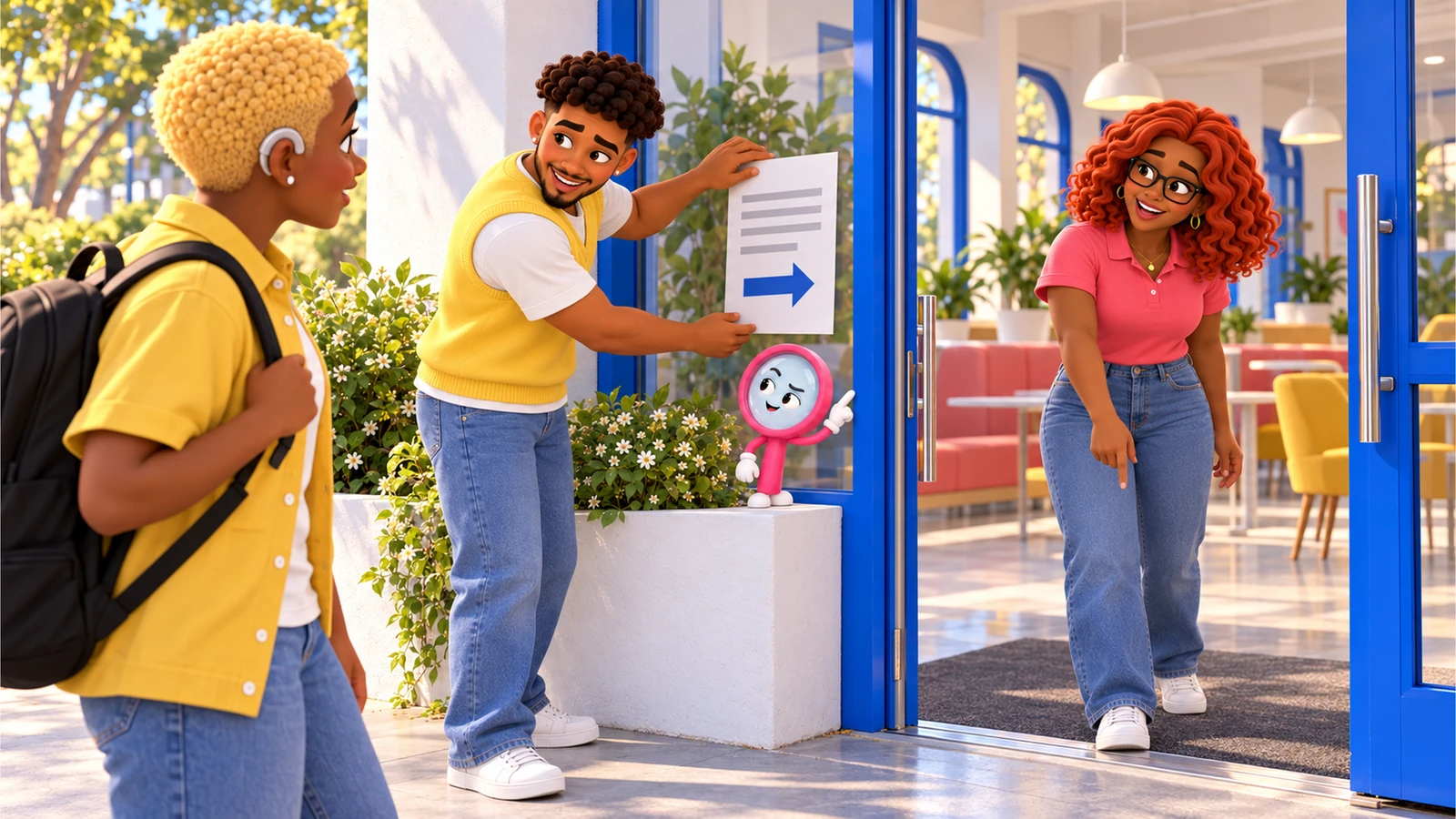
Overview
Students read a story in which Jordy and Gia work the same Saturday event. Jordy is paid $16.50 an hour, and Gia is paid $18.00. They compare the pay statements and the crew schedule, which lists Gia as shift lead, with federal pages on pay discrimination and on discussing wages. They then draft Jordy’s message to the supervisor asking how the rates were set.
Key terms
- Compensation
Compensation is all the pay and benefits a worker receives, including hourly rates, bonuses and overtime. En español: compensación
In this case: Jordy’s statement shows eight hours at $16.50 an hour, and Gia’s shows $18.00. The statements show the rates but not how they were set.
- Equal Pay Act
The Equal Pay Act is a federal law from 1963 that requires equal pay for men and women who do equal work. En español: Ley de Igualdad Salarial
In this case: The Equal Pay Act covers pay differences based on sex, not every difference. Different job duties, such as a real shift-lead role, can be a lawful reason.
- Title VII
Title VII is part of the Civil Rights Act of 1964. It bans job discrimination based on race, color, religion, sex or national origin. En español: Título VII
In this case: Title VII covers pay decisions based on race, color, religion, sex or national origin. No document shows how Jordy’s rate was set.
Where this example applies
Federal laws have coverage requirements and different standards. The soccer settlement was an agreement between the parties, not a court finding, and it decides nothing about Jordy’s employer.
Grade levels, subjects and time
- Grade levels
- 6–12, plus college and community groups.
- Subjects
- English language arts; also law.
- Time
- 45 minutes for the lesson steps on this page. The student page takes 20 to 30 minutes.
Learning objectives
Students will be able to:
- compare two workers’ duties, hours and titles before explaining a pay difference;
- explain what the Equal Pay Act, Title VII and the right to discuss wages cover;
- write a specific question to a supervisor about a pay difference without making an accusation.
What students should already be able to do
The student edition for each grade band assumes students can already:
- Grades 6–8
- find a number or a word in a short document; tell what a document says from what they guess; write a complete question.
- Grades 9–10
- summarize what a short document shows; tell a fact from an assumption; write a short message for a named reader.
- Grades 11–12
- summarize an official agency web page accurately; weigh the costs and benefits of a policy for different groups; write a memo with headings for a named reader.
- College and community
- read a pay statement and a work schedule; summarize an official agency web page accurately; plan a conversation with a supervisor.
Skills, terms and roles
New skill
Compare two cases on the same terms
Line up the same facts for both people, such as hours, duties and title, before you call a difference unfair.
Key terms
- New in this case
- Compensation, Equal Pay Act, Title VII
- From earlier cases
- Gross pay (Lesson 5)
Character spotlight
Jordy leads. Jordy ran the caption and audio check on top of setup and close, so they know what their shift included. They choose to ask before they post.
- Gia: She knows what she did as shift lead, but not whether it explains the higher rate.
The student’s role
You’re the one who lines up both shifts side by side before Jordy writes to Dana.
Materials
- The student page for Lesson 11: Why are Jordy and Gia paid different rates?. Students read the case, look at the evidence and write their response there.
- The evidence handout below: 3 documents, one copy per pair.
- The student edition for your grade band, printed or on screen. See printable pages by grade band.
Evidence handout
Evidence A Pay statement
Jordy’s pay statement
Event crew, Saturday. Hours: 8.0 at $16.50. Gross pay for the event: $132.00.
What it shows: Jordy worked eight hours at the Saturday event for $16.50 an hour.
What it leaves out: How the company set Jordy’s rate, and what other crew members earned.
Ask: Multiply the hours by the rate. Does it match the gross pay?
Evidence B Work schedule
The crew schedule
Saturday event, 3:00–11:00 p.m. Crew: Gia (shift lead), Jordy and two other crew members. Setup, 3:00–5:00: all crew. Caption and audio check: Jordy. Closing, 10:00–11:00: all crew.
What it shows: The schedule lists Gia as shift lead. All crew did setup and closing, and Jordy ran the caption and audio check.
What it leaves out: What a shift lead does, and whether the title comes with a higher rate.
Ask: Circle “shift lead.” Does the schedule say what that job includes?
Evidence C Text messages
Jordy and Gia compare notes
Sunday, 1:15 p.m. Gia: I’m fine with you knowing my rate. I just don’t want my statement posted anywhere. Jordy: Got it. Did you do anything different as shift lead? Gia: I opened up and handled one guest issue. Honestly, I don’t know if that’s why. Let’s ask Dana.
What it shows: Gia lets Jordy know her rate. As shift lead, she opened up and handled one guest issue.
What it leaves out: Whether that lead work explains the higher rate, and whether Gia wants Dana to see her rate.
Ask: What does Gia agree to share, and what does she ask Jordy not to do?
Printable pages by grade band
Each grade band has its own student pages and educator pages for this case. The educator pages show every student page with sample answers. See every printable page for this case, including the course editions.
| Grade band | Educator pages | Student pages |
|---|---|---|
| Grades 6–8 | Open on screen Print this case Download PDF, 568 KB | Open on screen Print this case Download fillable PDF, 447 KB |
| Grades 9–10 | Open on screen Print this case Download PDF, 478 KB | Open on screen Print this case Download fillable PDF, 357 KB |
| Grades 11–12 | Open on screen Print this case Download PDF, 499 KB | Open on screen Print this case Download fillable PDF, 476 KB |
| College and community | Open on screen Print this case Download PDF, 617 KB | Open on screen Print this case Download fillable PDF, 474 KB |
Real news and research for this case
These news stories and studies are real. Each link opens the original in a new tab.
Real source News PBS NewsHour (Associated Press) September 6, 2022
U.S. men's and women's soccer teams formally sign equal pay agreements
Shows the follow-through: the pay change was written into contracts, not just announced.
Read on pbs.org (opens in a new tab)Real source Video PBS NewsHour (YouTube) February 22, 2022
U.S. women soccer players reach $24 million settlement in fight for equal pay
An interview on how the players built their case, useful for separating a claim from a finding.
Watch on YouTube (opens in a new tab)More news and research (2)
Real source News NPR January 3, 2023
The impact that new salary transparency laws could have
New laws put pay ranges in job ads, making it easier to spot and ask about pay differences.
Read on npr.org (opens in a new tab)Real source Research Pew Research Center March 4, 2025
Gender pay gap in U.S. has narrowed slightly over 2 decades
National data on the pay gap, including a smaller gap for workers ages 25 to 34.
Read on pewresearch.org (opens in a new tab)Links checked September 24, 2026.
Professional standards
Many professions publish a code of ethics. These parts of real codes apply to this case.
Real source Society for Human Resource Management (SHRM) 2023
SHRM Code of Ethics: Fairness and Justice
Develop, administer, and advocate policies and procedures that foster fair, consistent and equitable treatment for all.
In plain words: HR professionals who belong to SHRM agree to use workplace policies that treat workers fairly and consistently.
Ask: The schedule lists Gia as shift lead. What written policy would show whether that title explains the higher rate?
Sample answers
- Grades 6–8
- Jordy would need a written job description that says what a shift lead does and what it pays.
- Grades 9–10
- A written policy that shows what shift lead includes and what it pays would answer this, because the schedule gives only the title.
- Grades 11–12
- The policy would need to state the shift-lead duties, how someone qualifies and each role’s rate, so that one rule applies to the whole crew.
Real source Society for Human Resource Management (SHRM) 2023
SHRM Code of Ethics: Use of Information
Take appropriate steps to ensure the accuracy and completeness of all communicated information about HR policies and practices.
In plain words: SHRM members also agree to explain workplace policies accurately and completely.
Ask: When Jordy asks Dana how event-crew rates are set, what should a complete answer include?
Sample answers
- Grades 6–8
- A complete answer would tell Jordy how rates are set and what a shift lead does.
- Grades 9–10
- A complete answer would include how event-crew rates are set, what shift lead involves and how someone qualifies for it.
- Grades 11–12
- A complete answer would include the criteria for each rate and what shift lead requires, and it would also say how Jordy could qualify.
Real source International Association of Business Communicators (IABC)
IABC Code of Ethics for Professional Communicators: “I protect confidential information”
I protect confidential information while acting within the law.
In plain words: IABC members agree to keep confidential information private, within what the law allows.
Ask: Gia is fine with Jordy knowing her rate, not with posting her statement. What should Jordy’s message to Dana include?
Read the full code on the IABC website (opens in a new tab)Share, schedule or open in your apps
Reading passage by grade band
Each grade band has its own longer reading passage built from this case’s story and its real sources. Real news, laws and research are cited in the text with their dates. Three “Stop and think” questions sit inside each passage. Open a band to read it, or print that band on its own.
Grades 6–8: Same event, different rate
448 words
Same event, different rate
The story: Comparing pay statements
Jordy and Gia work event shifts for the same company. Last Saturday, they both worked an event from 3 to 11 p.m. Both helped set up and close. Jordy also ran the caption and audio check.
On Sunday afternoon, they compare pay statements. Jordy’s says eight hours at $16.50 an hour. Gia’s says $18.00 an hour for the same event. “Wait what,” Gia texts. “Is it because I’m shift lead?”
The crew schedule does list Gia as “shift lead.” But it never says what that job includes. That day, Gia opened up and handled one guest issue. She honestly does not know if that explains the $1.50 difference.
Jordy wants to ask Dana, the supervisor, how rates are set. Jordy will not post anything before Dana answers. Your role is to line up both shifts side by side before Jordy writes to Dana.
Lining up the facts
In Lesson 5, you read a pay statement line by line. You learned that gross pay is the money you earn before any taxes or other deductions are taken out. Jordy’s gross pay for the event is $132.00, which is 8 hours times $16.50.
Now compare the two jobs on the same terms. The hours match. Setup and closing match. Jordy did the caption and audio check. Gia had the shift lead title, opened up and handled one guest issue. Compensation is all the pay and benefits a worker receives, including hourly rates, bonuses and overtime. A job title, extra duties or more experience can explain a pay difference. So can a mistake. The statements show the rates. They do not show how the rates were set.
In Lesson 10, you learned to take a question to the office responsible. Here, that is Dana. Jordy’s message can say what Jordy knows for sure: the hours, the duties and Jordy’s own rate. Then it can ask one clear question: what does “shift lead” include, and how are rates set?
Gia is fine with Jordy knowing her rate. But she does not want her statement posted anywhere. That choice belongs to Gia, and posting Jordy’s own pay is Jordy’s choice.
The laws and a famous pay fight
Two federal laws limit how employers set pay. The Equal Pay Act is a federal law from 1963 that requires equal pay for men and women who do equal work. Title VII is part of the Civil Rights Act of 1964. It bans job discrimination based on race, color, religion, sex or national origin.
In 2022, the U.S. women’s national soccer team won a $24 million settlement in its equal pay fight (NPR, February 22, 2022). The whole fight turned on what to compare. Jordy’s question starts the same way.
Key terms in this passage
- Compensation
- Compensation is all the pay and benefits a worker receives, including hourly rates, bonuses and overtime.
- Equal Pay Act
- The Equal Pay Act is a federal law from 1963 that requires equal pay for men and women who do equal work.
- Title VII
- Title VII is part of the Civil Rights Act of 1964. It bans job discrimination based on race, color, religion, sex or national origin.
- Gross pay
- Gross pay is the money you earn before any taxes or other deductions are taken out.
Real sources cited
- NPR, “The U.S. national women’s soccer team wins $24 million in equal pay settlement,” February 22, 2022. Open the source (opens in a new tab)
Grades 9–10: What does shift lead pay for?
624 words
What does shift lead pay for?
The story: A $1.50 surprise
Jordy and Gia work event shifts for the same company. On Saturday, they worked the same event, 3 to 11 p.m. Both did setup and closing. Jordy also ran the caption and audio check, a job Jordy takes seriously because Jordy is hard of hearing and knows when captions miss a line. They were paid the following Friday.
On Sunday afternoon, Jordy sends Gia a screenshot: $16.50 an hour. Gia’s reply comes fast. Hers says $18.00. Then she asks the question neither of them can answer: is it because she is shift lead?
The crew schedule lists Gia as “shift lead” and says nothing else about it. Gia remembers opening up and handling one guest issue. Gia only learned she makes more because Jordy showed her their statement. Nobody ever told her what the title pays for.
Jordy’s next message sets the course. Same event, same hours, and Jordy is asking Dana, the supervisor, before this goes anywhere. Your role in this case is to line up both shifts side by side before Jordy writes to Dana.
Comparing like with like
Lesson 5 gave you the habit of reading a pay statement line by line. Jordy’s shows 8.0 hours at $16.50, for gross pay of $132.00. Gross pay is the money you earn before any taxes or other deductions are taken out. At $18.00, the same eight hours would come to $144.00.
The new skill is comparing two cases on the same terms. Line up every fact the documents give you. Hours: the same. Setup from 3 to 5: all crew. Closing from 10 to 11: all crew. Caption and audio check: Jordy. Title: Gia is shift lead. Lead duties, according to Gia: opening up and one guest issue. What the title pays: unknown.
Compensation is all the pay and benefits a worker receives, including hourly rates, bonuses and overtime. A job title, extra duties or more experience can explain a pay difference. So can a mistake. The comparison narrows the question without answering it. If shift lead carries real extra duties and a set rate, the title may explain the $1.50. If it does not, Jordy has a specific question to ask.
Lesson 10 taught you to bring a question to the office responsible. Dana sets rates, so Dana gets the message. It should state what Jordy knows for sure: the hours, the duties and Jordy’s own rate. It should ask one clear question: what does “shift lead” include, and how are rates set? It does not need Gia’s statement. Gia is fine with Jordy knowing her rate, but she does not want her statement posted anywhere. Jordy, for their part, will decide what to do if Dana’s answer does not make sense. It is Jordy’s paycheck.
The law, and a comparison that shaped a lawsuit
The Equal Pay Act is a federal law from 1963 that requires equal pay for men and women who do equal work. Title VII is part of the Civil Rights Act of 1964. It bans job discrimination based on race, color, religion, sex or national origin. Talking about pay is protected too. The National Labor Relations Board says most private-sector workers have a right to discuss pay with coworkers, with or without a union (NLRB, no date listed).
The U.S. women’s national soccer team shows why the comparison matters. In 2020, a federal judge dismissed their equal pay claim, pointing to differences in how the teams’ contracts were structured (NPR, May 2, 2020). The players appealed, saying he had not looked at rates of pay. In 2022, they reached a $24 million settlement with a promise of equal pay rates (NPR, February 22, 2022). A settlement is an agreement, not a court finding, and it decides nothing about Jordy’s employer.
Key terms in this passage
- Compensation
- Compensation is all the pay and benefits a worker receives, including hourly rates, bonuses and overtime.
- Equal Pay Act
- The Equal Pay Act is a federal law from 1963 that requires equal pay for men and women who do equal work.
- Title VII
- Title VII is part of the Civil Rights Act of 1964. It bans job discrimination based on race, color, religion, sex or national origin.
- Gross pay
- Gross pay is the money you earn before any taxes or other deductions are taken out.
Real sources cited
- National Labor Relations Board (NLRB), “Your Right to Discuss Wages,” No date listed. Open the source (opens in a new tab)
- NPR, “Federal Judge Dismisses U.S. Women’s Soccer Team’s Equal Pay Claim,” May 2, 2020. Open the source (opens in a new tab)
- NPR, “The U.S. national women’s soccer team wins $24 million in equal pay settlement,” February 22, 2022. Open the source (opens in a new tab)
Grades 11–12: A pay gap is a question, not a finding
730 words
A pay gap is a question, not a finding
The story: Two statements on a Sunday
Jordy is Black, nonbinary and hard of hearing, studies part time and works event shifts. Gia studies communication and works café shifts, and she also picks up event work for the same company as Jordy. On Saturday, they both worked a 3 to 11 p.m. event. The crew schedule shows the division of labor. Everyone did setup from 3 to 5 and closing from 10 to 11. Jordy ran the caption and audio check. Gia is listed as “shift lead,” with no description of what that means.
On Sunday, Jordy shares a pay statement with Gia: eight hours at $16.50. Gia’s says $18.00. Her first reaction is a guess, that the difference must be the shift lead title. Her second is honesty. She opened up and handled one guest issue, and she does not know whether that is why she is paid $1.50 more. Gia only found out because Jordy showed her.
The friends agree on the facts and on a boundary. Gia is fine with Jordy knowing her rate but does not want her statement posted. Jordy will not post anything before asking Dana, the supervisor, how rates are set. Asked whether this is discrimination, Gia says she does not know yet. Maybe shift lead pays more. Ask Dana what it covers first.
Your role is to line up both shifts side by side before Jordy writes to Dana.
Comparing on the same terms
The skill in this case is comparing two situations on the same terms before calling a difference unfair. It builds on Lesson 5, where you read a pay statement line by line. Jordy’s statement shows 8.0 hours at $16.50 and gross pay of $132.00, the money earned before any taxes or other deductions are taken out.
A fair comparison lists every dimension the evidence covers. Hours, setup and closing are identical. Jordy had a technical duty, the caption and audio check. Gia had a title and two tasks attached to it. The documents leave three things unknown: what “shift lead” formally includes, whether it carries a set rate and how rates are set in general. Compensation is all the pay and benefits a worker receives, including hourly rates, bonuses and overtime. A job title, extra duties or more experience can lawfully explain a difference. So can a mistake. The comparison does not reveal which.
That is why the case turns on a question rather than a verdict. Lesson 10’s skill, reporting to the office responsible, points to Dana, who sets rates. Jordy’s message can state the observation, list what Jordy knows for sure and ask what shift lead includes and how rates are set. It does not need to name Gia’s rate. Jordy keeps the next decision too. If the answer does not make sense, Jordy decides what to do.
The legal frame and the soccer comparison
Two federal laws limit the reasons employers can use to set pay. The Equal Pay Act is a federal law from 1963 that requires equal pay for men and women who do equal work. Title VII is part of the Civil Rights Act of 1964. It bans job discrimination based on race, color, religion, sex or national origin. The EEOC enforces both. Its youth pages list the kinds of compensation the laws cover and the ban on retaliation (EEOC, no date listed). The NLRB adds that most private-sector workers may discuss pay with coworkers, with or without a union (NLRB, no date listed). That right does not make Gia’s statement Jordy’s to share.
The U.S. women’s national soccer team’s case shows how much depends on the comparison. In 2020, a federal judge dismissed their equal pay claim, pointing to differences in contract structure (NPR, May 2, 2020). The players appealed, arguing that he had not compared rates of pay. In February 2022, they settled for $24 million with a promise of equal pay rates (NPR, February 22, 2022), and the new terms were later written into signed contracts (PBS NewsHour, September 6, 2022). The settlement was an agreement between the parties, not a court finding.
Policy is moving toward more visible pay. New salary transparency laws put pay ranges in job ads, which makes differences easier to notice and ask about (NPR, January 3, 2023). HR professionals have their own standard. The SHRM code asks members to “foster fair, consistent and equitable treatment for all” (SHRM Code of Ethics, April 24, 2023).
Key terms in this passage
- Compensation
- Compensation is all the pay and benefits a worker receives, including hourly rates, bonuses and overtime.
- Equal Pay Act
- The Equal Pay Act is a federal law from 1963 that requires equal pay for men and women who do equal work.
- Title VII
- Title VII is part of the Civil Rights Act of 1964. It bans job discrimination based on race, color, religion, sex or national origin.
- Gross pay
- Gross pay is the money you earn before any taxes or other deductions are taken out.
Real sources cited
- U.S. Equal Employment Opportunity Commission (EEOC), “Pay Discrimination,” No date listed. Open the source (opens in a new tab)
- National Labor Relations Board (NLRB), “Your Right to Discuss Wages,” No date listed. Open the source (opens in a new tab)
- NPR, “Federal Judge Dismisses U.S. Women’s Soccer Team’s Equal Pay Claim,” May 2, 2020. Open the source (opens in a new tab)
- NPR, “The U.S. national women’s soccer team wins $24 million in equal pay settlement,” February 22, 2022. Open the source (opens in a new tab)
- PBS NewsHour (Associated Press), “U.S. men's and women's soccer teams formally sign equal pay agreements,” September 6, 2022. Open the source (opens in a new tab)
- NPR, “The impact that new salary transparency laws could have,” January 3, 2023. Open the source (opens in a new tab)
- Society for Human Resource Management (SHRM), “SHRM Code of Ethics,” 2023. Open the source (opens in a new tab)
College and community: Pay equity, comparators and the right to ask
753 words
Pay equity, comparators and the right to ask
The story: Discovering a differential
Jordy and Gia work event shifts for the same company. On a Saturday, both worked from 3 to 11 p.m. and shared setup and closing. Jordy also ran the caption and audio check. The schedule named Gia “shift lead” without defining the role. On Sunday, comparing statements, they find a $1.50 hourly difference: $16.50 for Jordy and $18.00 for Gia.
The case models how most workers actually discover pay differences, which is informally, through a coworker. Gia learns she is paid more only because Jordy shows her. Neither of them knows the policy behind the rates. Gia can describe what she did as lead, opening up and handling one guest issue, but not whether the company values that at $1.50 an hour.
What follows is a careful sequence. The friends agree on the facts: same event, same hours, two rates. Gia consents to Jordy knowing her rate and withholds consent to posting her statement. Jordy chooses to ask Dana, the supervisor, how rates are set before posting anything, and keeps the decision about what to do next. Asked whether the gap is discrimination, Gia says she does not know. Maybe shift lead pays more. The first step is to ask what it covers.
Your role is to line up both shifts side by side before Jordy writes to Dana.
Constructing a fair comparison
The new skill is comparing two cases on the same terms before drawing a conclusion. It extends Lesson 5’s line-by-line reading. Jordy’s statement shows 8.0 hours at $16.50, or $132.00 in gross pay, the money earned before any taxes or other deductions are taken out.
In employment law, the person you compare yourself to is often called a comparator, and the choice of comparator shapes the result. Here the natural comparator is Gia, but the comparison only holds if the jobs are defined. Compensation is all the pay and benefits a worker receives, including hourly rates, bonuses and overtime. The evidence establishes identical hours and shared tasks. It also shows one technical task for Jordy and one title with modest added tasks for Gia. It leaves open what the title formally requires and how the employer sets rates. Legitimate explanations such as duties, title and experience are plausible. So is error. The documents cannot distinguish among them.
Lesson 10’s skill, reporting to the office responsible, determines the next move. Dana sets rates, so Dana is asked. A strong message states the observation, lists the verified facts and asks one precise question about what shift lead includes and how rates are determined. It does not rely on Gia’s statement, which respects her boundary and keeps the question about Jordy’s pay.
Law, litigation and professional standards
Federal law constrains pay-setting. The Equal Pay Act is a federal law from 1963 that requires equal pay for men and women who do equal work. Title VII is part of the Civil Rights Act of 1964. It bans job discrimination based on race, color, religion, sex or national origin. The EEOC enforces both and describes retaliation protections (EEOC, no date listed). Separately, the NLRB explains that most private-sector employees may discuss wages with coworkers, with or without a union (NLRB, no date listed). A right to discuss one’s own pay is not a license to publish a colleague’s records.
The women’s national soccer team litigation illustrates the comparator problem at scale. In 2020, a federal judge dismissed the equal pay claim, emphasizing structural differences between the men’s and women’s contracts (NPR, May 2, 2020). The players appealed, arguing that rates of pay were the relevant comparison. The 2022 settlement, $24 million with a commitment to equal pay rates, resolved the dispute without a finding (NPR, February 22, 2022). The terms were later formalized in signed agreements (PBS NewsHour, September 6, 2022).
Broader trends frame the stakes. Pew reports that the gender pay gap has narrowed only slightly over two decades and is smaller for workers ages 25 to 34 (Pew Research Center, March 4, 2025). Salary transparency laws that require posted ranges may make comparisons easier to start (NPR, January 3, 2023).
Professional codes describe the employer’s side of the conversation Jordy is starting. SHRM members commit to “take appropriate steps to ensure the accuracy and completeness of all communicated information about HR policies and practices” (SHRM Code of Ethics, April 24, 2023). IABC members pledge, “I protect confidential information while acting within the law” (IABC Code of Ethics, no date listed). Dana’s answer should meet the first standard, and Jordy’s message already meets the second.
Key terms in this passage
- Compensation
- Compensation is all the pay and benefits a worker receives, including hourly rates, bonuses and overtime.
- Equal Pay Act
- The Equal Pay Act is a federal law from 1963 that requires equal pay for men and women who do equal work.
- Title VII
- Title VII is part of the Civil Rights Act of 1964. It bans job discrimination based on race, color, religion, sex or national origin.
- Gross pay
- Gross pay is the money you earn before any taxes or other deductions are taken out.
Real sources cited
- U.S. Equal Employment Opportunity Commission (EEOC), “Pay Discrimination,” No date listed. Open the source (opens in a new tab)
- National Labor Relations Board (NLRB), “Your Right to Discuss Wages,” No date listed. Open the source (opens in a new tab)
- NPR, “Federal Judge Dismisses U.S. Women’s Soccer Team’s Equal Pay Claim,” May 2, 2020. Open the source (opens in a new tab)
- NPR, “The U.S. national women’s soccer team wins $24 million in equal pay settlement,” February 22, 2022. Open the source (opens in a new tab)
- PBS NewsHour (Associated Press), “U.S. men's and women's soccer teams formally sign equal pay agreements,” September 6, 2022. Open the source (opens in a new tab)
- Pew Research Center, “Gender pay gap in U.S. has narrowed slightly over 2 decades,” March 4, 2025. Open the source (opens in a new tab)
- NPR, “The impact that new salary transparency laws could have,” January 3, 2023. Open the source (opens in a new tab)
- Society for Human Resource Management (SHRM), “SHRM Code of Ethics,” 2023. Open the source (opens in a new tab)
- International Association of Business Communicators (IABC), “IABC Code of Ethics for Professional Communicators,” No date listed. Open the source (opens in a new tab)
Pacing options
10-minute bellringer
10 minutes
One piece of evidence and one question. Use it to open the case or to review it the next day.
One class period
45 minutes
Teach the lesson steps on this page in four parts.
The student edition also has a one-period plan for each grade band:
- Grades 6–8: 45 minutes
- Grades 9–10: 50 minutes
- Grades 11–12: 60 minutes
- College and community: 75 minutes
Full chapter
71 to 94 minutes
Teach every page of the student edition chapter. The educator edition has notes and sample answers beside each page.
- Grades 6–8: 71 minutes
- Grades 9–10: 78 minutes
- Grades 11–12: 94 minutes
- College and community: 94 minutes
Minutes for each page
How long each student edition page takes, and what to cut when you have one class period.
Open your grade band.
Grades 6–8: full chapter 71 minutes, one period 45 minutes
| Page | Full chapter | One period | How to cut |
|---|---|---|---|
| Opener | 5 min | 5 min | |
| Key terms | 6 min | 3 min | Read the key terms aloud. Skip Who is involved. |
| Look at the evidence | 10 min | 10 min | |
| Look at the evidence, continued | 5 min | 5 min | |
| Key idea | 6 min | 2 min | Read the first paragraph of the key idea aloud. Skip the code of ethics. |
| Sort the evidence | 8 min | 3 min | Do the first row together and stop. |
| Practice | 6 min | Skip | Skip this page. |
| Your task | 12 min | 12 min | |
| Check your work | 5 min | Skip | Skip this page. Score the questions yourself with the rubric. |
| Questions to discuss | 8 min | 5 min | Use question 2 as an exit ticket. |
| Talk about this case at home | At home | At home |
Grades 9–10: full chapter 78 minutes, one period 50 minutes
| Page | Full chapter | One period | How to cut |
|---|---|---|---|
| Opener | 5 min | 5 min | |
| Key terms | 5 min | Skip | Skip this page. Define compensation and Title VII aloud in one minute. |
| Look at the evidence | 8 min | 8 min | |
| Look at the evidence, continued | 4 min | 4 min | |
| Key idea | 8 min | 3 min | Read the second paragraph of the key idea aloud. Skip In the news. |
| Sort the evidence | 6 min | Skip | Skip this page. |
| Practice | 6 min | 4 min | Do the choice only. Skip Improve a draft. |
| Your task | 20 min | 20 min | |
| Check your work | 6 min | 3 min | Students answer the Check your work questions only. Score the rubric yourself. |
| Questions to discuss | 10 min | 3 min | Use question 2 as an exit ticket. |
| Talk about this case at home | At home | At home |
Grades 11–12: full chapter 94 minutes, one period 60 minutes
| Page | Full chapter | One period | How to cut |
|---|---|---|---|
| Opener | 5 min | 5 min | |
| Key terms | 5 min | Skip | Skip this page. |
| Look at the evidence | 8 min | 8 min | |
| Look at the evidence, continued | 4 min | 4 min | |
| Key idea | 10 min | 6 min | Read the key idea. Skip the code of ethics and In the news. |
| Sort the evidence | 6 min | Skip | Skip this page. |
| Practice | 5 min | Skip | Skip this page. |
| Your task | 10 min | 10 min | |
| Your draft | 25 min | 25 min | |
| Check your work | 6 min | Skip | Collect drafts and score them with the rubric yourself. |
| Questions to discuss | 10 min | 2 min | Use question 3 as an exit ticket. |
| Talk about this case at home | At home | At home |
College and community: full chapter 94 minutes, one period 75 minutes
| Page | Full chapter | One period | How to cut |
|---|---|---|---|
| Opener | 5 min | 5 min | |
| Key terms | 5 min | Skip | Skip this page. |
| Look at the evidence | 8 min | 8 min | |
| Look at the evidence, continued | 4 min | 4 min | |
| Key idea | 10 min | 8 min | Skip In the news. |
| Sort the evidence | 6 min | Skip | Skip this page. The record sheet covers the same comparison. |
| Practice | 5 min | Skip | Skip this page. |
| Your task | 10 min | 10 min | |
| Your draft | 25 min | 25 min | |
| Check your work | 6 min | 5 min | Students answer the Check your work questions only. |
| Questions to discuss | 10 min | 10 min | |
| Talk about this case at home | At home | At home |
Minutes for each page are in the educator edition for each grade band.
10-minute bellringer
- 1 min Project Evidence A as students come in.
- 5 min Students read it on their own. Each student writes a one-sentence answer to the question.
- 4 min Take two or three answers. Then ask the follow-up questions.
Evidence A Pay statement
Jordy’s pay statement
Event crew, Saturday. Hours: 8.0 at $16.50. Gross pay for the event: $132.00.
Question What hourly rate and how many hours does this statement show?
Follow-up questions
- Check the math: does 8 hours at $16.50 come to $132.00?
- What does this statement not tell you about how the rate was set?
Listen for: Students confirm the $132.00 total and say that the statement shows the rate but not the reason for it.
This is the same bellringer as on the bellringers page, which has one for every case.
Lesson steps
This plan takes 45 minutes in four parts. Each step says what you do, what students do and how to check.
Warm-up 5 minutes
1 Two statements 5 min
- You
- Show statements: Jordy $16.50/hr, Gia $18.00/hr, same event, same hours.
- Students
- Write three possible explanations.
- Check
- Lists include legitimate and illegitimate reasons.
Read and discuss 25 minutes
2 Compare the work 8 min
- You
- Hand out the event schedule and job titles.
- Students
- Build a table: duties, hours, title, rate.
- Check
- Students notice Gia’s “shift lead” title and ask what it involved.
3 What the law covers 10 min
- You
- Summarize the EEOC youth page: Equal Pay Act, Title VII, legitimate factors.
- Students
- Match each explanation to “could be lawful,” “could be unlawful” or “need facts.”
- Check
- Most land in “need facts.”
4 Talking about pay 7 min
- You
- Explain that federal labor law protects most private-sector workers who discuss pay.
- Students
- Discuss: whose choice is it to go public?
- Check
- Students say Jordy decides.
Questions for the people in the case
- Jordy: What could explain the $1.50? Check next: Put duties, hours, title and rate side by side. Ask what “shift lead” means on this schedule.
- Jordy: Would you post about it? Check next: Ask the supervisor first. Jordy decides whether their pay goes public.
- Gia: Did you do lead work? Check next: Ask for the written duties for “shift lead” before comparing what each person did.
- Gia: So is this discrimination? Check next: Separate the observed gap, a possible explanation and a legal violation.
Task 12 minutes
5 Write the question 12 min
- You
- Model: “We compared these duties and hours. Can you explain the rate?”
- Students
- Draft Jordy’s message to the supervisor.
- Check
- Message names duties and hours and asks for the criteria.
Wrap-up 3 minutes
6 Exit 3 min
- You
- Frame: “An explanation that would satisfy me is __. One that wouldn’t is __.”
- Students
- Complete it.
- Check
- Answers distinguish legitimate factors.
Educator notes by page
These notes follow the pages of the student edition chapter. The educator edition prints the same notes beside each page. Heat check tells you how likely a page is to bring up strong feelings: low, medium or high. Medium and high pages come with a cool-down. Open a page to see what to say, what to watch for and how to support students.
Opener
Heat check: Medium
Why: Students may connect the gap to Jordy’s identity or share a family member’s pay. Cool-down: Say: “We only know what the documents show.” Nobody needs to share their own pay or a family member’s.
Say this
- “Two friends, same event, same hours, different pay. What is your first reaction?” Hear three answers. Write them on the board without judging them.
Watch for
- Misconception:
- Students decide the gap proves discrimination.
- Listen for:
- “That’s illegal.”
- Then:
- Ask what else could explain $1.50. Add “shift lead” to the board.
Support
- Read What happened aloud. Pause after each pay rate so students can underline it.
Key terms
Heat check: Low
Say this
- “Compensation is more than the hourly rate. What else could count?” Listen for overtime, bonuses and benefits.
Watch for
- Misconception:
- Students think the Equal Pay Act covers every pay difference.
- Listen for:
- “Any pay gap breaks the Equal Pay Act.”
- Then:
- Reread the definition. The law is about men and women doing substantially equal work.
Support
- Preteach “rate” and “gross pay” with Jordy’s statement: 8 hours × $16.50 = $132.00.
Look at the evidence
Heat check: Low
Say this
- “Put your finger on ‘shift lead.’ What would you need to know about that title?” Wait for “what the job includes” and “whether it pays more.”
Watch for
- Misconception:
- Students treat Gia’s pay statement as Jordy’s to share.
- Listen for:
- “Jordy can show everyone Gia’s statement.”
- Then:
- Point to Evidence C. Gia agreed to let Jordy know her rate, not to post her statement.
Support
- Give students a four-column table: duties, hours, title, rate.
- Read the text messages aloud with two voices.
Stretch
Ask which duty on the schedule belongs only to Jordy, and whether it could matter as much as shift lead.
Key idea
Heat check: Low
Say this
- “The Equal Pay Act and Title VII limit the reasons for a pay gap. Which reason could be lawful here?” Wait for “different job duties.”
- “The SHRM code asks for fair, consistent policies. What written policy would help Jordy?” Accept “a job description” or “a pay chart.”
Watch for
- Misconception:
- Students treat the SHRM code as a law.
- Listen for:
- “The company broke the SHRM code, so it’s illegal.”
- Then:
- Say: “SHRM’s code binds its members, who are HR professionals. The laws here are the Equal Pay Act and Title VII.”
Support
- Read the code quotation aloud. Point out its label: a quotation from a real source.
Stretch
Use the second SHRM card: what should a complete answer from Dana include?
Sort the evidence
Heat check: Low
Say this
- “Line up Jordy’s record, Gia’s account and the schedule. Where do they agree?” Model the first link together: both worked setup and closing.
Watch for
- Misconception:
- Students mark the title as proof that the pay is fair.
- Listen for:
- “She’s shift lead, so it’s fine.”
- Then:
- Ask what the schedule says shift lead includes. It says nothing. The title leaves the question open.
Support
- Let students write A (agrees), D (differs) or ? (leaves open) before writing sentences.
Practice
Heat check: Medium
Why: Students may share their own pay or a boss’s treatment. Cool-down: Return to Jordy: “What does Jordy know for sure?” No one needs to describe their own job.
Say this
- “Jordy has just seen Gia’s rate. What should Jordy do first?” Hold a quick vote before any discussion.
Watch for
- Misconception:
- Students choose C because employers can pay what they want.
- Listen for:
- “It’s their company, they decide.”
- Then:
- Ask what the key idea says. Employers set rates, but federal laws limit the reasons.
Support
- Read the options aloud before students choose.
Your task and draft
4 grade bands
The task is different in each grade band. Open yours.
Grades 6–8
Your task
Say this
- “Before you write, tell a partner one way their work was the same and one way it was different.” Partner talk first. Then students fill in the chart.
Watch for
- Misconception:
- Questions accuse the company.
- Listen for:
- “Why are you paying me less because of who I am?”
- Then:
- Ask which document shows the reason. None does. Ask for the reason instead.
Support
- Frame: “Both ___. But ___. I want to ask ___.”
Grades 9–10
Your task
Say this
- “Dana has never seen your sheet. Which three facts does Dana need to answer you?” Listen for hours, duties and Jordy’s own rate.
Watch for
- Misconception:
- Messages name Gia and her rate.
- Listen for:
- “Gia gets $18.00, so I should too.”
- Then:
- Point to Evidence C. Gia agreed to tell Jordy, not Dana. Try “another worker on the same shift.”
Support
- Frame: “I worked ___. My statement shows ___. Could you explain ___?”
Grades 11–12
Your task
Say this
- “Jordy asked one question. Your memo answers it for the whole crew. Which practice would have made the question unnecessary?” Hear two answers before students fill in the matrix.
Watch for
- Misconception:
- Memos state that the company broke the law.
- Listen for:
- “They violated the Equal Pay Act.”
- Then:
- Ask what facts a finding would need. The case gives a rate difference and a title, and no reason.
Support
- Memo headings: To, From, Purpose, Recommendations, Costs and limits.
Your draft
Say this
- “Your reader runs a small company. Which sentence answers their first worry?” Ask each student to underline it.
Watch for
- Misconception:
- State and local rules are stated as if they apply everywhere.
- Listen for:
- “The law requires pay ranges in every job ad.”
- Then:
- Some states and cities require them. Ask students where their article’s rule applies.
Support
- The overprinted sample holds the two key sections that fit this page. Full memos run 400 to 500 words.
College and community
Your task
Say this
- “Before Jordy writes to Dana, which records should Jordy have in hand?” List hours, duties, title and rate on the board.
Watch for
- Misconception:
- Students plan to lead with Gia’s pay statement.
- Listen for:
- “Jordy should show Dana Gia’s statement.”
- Then:
- Point to Evidence C. Gia agreed to tell Jordy her rate. She did not agree to share her statement.
Support
- The plan is about Jordy’s next steps. Nobody needs to describe their own job or pay.
Your draft
Say this
- “Read each branch of your plan aloud. Does Jordy know what to do next in every case?” Partners test each other’s plans.
Watch for
- Misconception:
- The plan starts with a legal complaint.
- Listen for:
- “Jordy should file with the EEOC right away.”
- Then:
- Ask what Jordy knows so far: a rate difference and a title. The first step is asking Dana.
Check your work
Heat check: Low
Say this
- “Read your message as Dana. Could you answer it in one reply?” Partners swap and underline the question.
Watch for
- Misconception:
- Students revise tone only.
- Listen for:
- “I made it nicer.”
- Then:
- Point to the Revision row. Ask them to replace a conclusion with a question.
Questions to discuss
Say this
- “Answer with a detail from a document, not a guess about the company.” Hear one answer per question, then ask who disagrees.
Stretch
Draft the pay-policy page the company could share: each role, its duties, its rate and how to qualify.
Talk about this case at home
Say this
- “Bring this page home or read it with someone you trust.” Nobody needs to share their own pay or a family member’s pay.
Sample response
Worked example, grades 9–10
Prompt: Build a private comparison sheet and draft Jordy’s message to the supervisor.
Student response
Comparison sheet: Jordy worked the Saturday event, 3 to 11 p.m.: setup, the caption and audio check, and closing, at $16.50 an hour. Gia worked the same event and hours, setup and closing, at $18.00. The schedule lists Gia as “shift lead.”
Message: Hi Dana, I have a question about my rate for Saturday’s event. 1 I worked 3 to 11 p.m., did setup and closing, and ran the caption and audio check. 2 My statement shows $16.50 an hour, 3 and I know Gia was paid $18.00 for the same shift. Could you explain how rates are set for event crew, and 4 what the shift-lead role involves? Thanks, Jordy
- Evidence. Precise hours and duties: the facts the supervisor needs to compare roles.
- Audience. Good: Jordy states their own record, which is theirs to share.
- Revise. This names a coworker and her pay without her permission. Jordy can raise the question without exposing Gia’s information.
- Strength. Strong: the question targets the one legitimate factor that might explain the difference.
Before: My statement shows $16.50 an hour, and I know Gia was paid $18.00 for the same shift.
After: My statement shows $16.50 an hour, and I understand another worker on the same shift was paid a higher rate.
Why: The revision keeps the question specific while respecting that Gia’s pay is hers to share, which also keeps the conversation about criteria rather than about a coworker.
Educator commentary: The sheet is accurate, and the message is specific, respectful and focused on the one legitimate factor that could explain the gap. Naming Gia and her rate without her permission is the one serious miss, because the case makes clear her information is hers to share. With that line revised, the message reaches Advanced on Audience and Proficient on Evidence.
Task answers by grade band
What a strong student in each grade band writes in the student edition task.
Open your grade band.
Grades 6–8
Make a side-by-side chart of Jordy’s and Gia’s work, then write one question Jordy could ask.
Students make: Chart plus a one-sentence question.
Steps students follow
- Read Jordy’s pay statement in Evidence A. Circle the hours and the rate.
- Read the schedule in Evidence B. Underline each person’s job title and duties.
- Fill in the chart for Jordy and for Gia: duties, hours, title and rate.
- Circle the row where Jordy and Gia are different.
- Write one question for Dana in the Your draft box. Do not guess the reason.
Sample answers for the task boxes
- What is the same for Jordy and Gia
- Both worked 3 to 11 p.m. and did setup and closing.
- What is different
- But Gia is shift lead at $18.00. Jordy gets $16.50.
Sample draft: Jordy’s question for Dana
Sample answer Grades 6–8
I want to ask Dana 1 how pay rates are set for event crew and 2 what a shift lead does.
- Asks for the reason instead of guessing it.
- Targets the title on the schedule, the most likely explanation.
Check your work questions
- Does your chart show the hours, duties, title and rate for each person?
- Does your question ask for the reason instead of guessing it?
- Does your question keep Gia’s pay statement private?
- One change I made
- I changed my question about Gia’s pay to a question about how rates are set, because Gia’s pay is hers to share.
My take: sample answers
- I think Jordy should ___ because ___.
- I think Jordy should ask Dana what a shift lead does because the schedule doesn’t say.
- The evidence that changed my first guess is ___.
- The text messages changed my guess. Gia only opened up and handled one guest issue.
- One question I still have is ___.
- One question I still have is what the two other crew members are paid.
Grades 9–10
Build a private comparison sheet and draft Jordy’s message to the supervisor.
Students make: Sheet plus a message of 80–120 words.
Steps students follow
- Reread Evidence A and B. Underline the hours, the duties and the title “shift lead.”
- Fill in the comparison sheet: what Jordy knows for sure and what Gia shared privately.
- Circle what Gia shared privately. Keep it out of the message.
- Write Jordy’s message to Dana, 80 to 120 words, in the Your draft box.
- Ask one clear question about what shift lead includes and how rates are set.
- Check your message with the questions on the Check your work page.
Sample answers for the task boxes
- What Jordy knows for sure
- Jordy worked 3 to 11 p.m., did setup, the caption and audio check and closing, at $16.50.
- What Gia shared privately
- Her $18.00 rate, and that she opened up and handled one guest issue.
- What Jordy is asking
- Jordy wants to know what shift lead includes and how event-crew rates are set.
Sample draft: Jordy’s message to Dana, 80 to 120 words
Sample answer Grades 9–10
Hi Dana, I have a question about my pay rate for the Saturday event. 1 I worked from 3 to 11 p.m., did setup and closing, and ran the caption and audio check. My statement shows $16.50 an hour. I understand 2 another worker on the same shift was paid a higher rate. Could you explain how rates are set for event crew, including 3 what the shift-lead role involves and how someone qualifies? 4 I’d appreciate a reply this week. Thanks, Jordy
- States Jordy’s own hours and duties, the facts Dana needs to compare roles.
- Raises the difference without naming Gia or sharing her rate.
- Targets the one factor that might explain the difference.
- Asks for a reply by a set time, without a threat.
Check your work questions
- Does your message say what Jordy knows and what Jordy is asking?
- Does it keep Gia’s name and rate out of the message?
- Is the tone polite and specific?
- Does it avoid saying the pay difference proves discrimination?
- One change I made after feedback
- I took out Gia’s name and her $18.00 rate, because Gia didn’t agree to share her rate with Dana.
My take: sample answers
- My claim: ___.
- Jordy should ask Dana how rates are set before deciding the difference is unfair.
- The best evidence is ___, because ___.
- The schedule, because it lists Gia as shift lead but never says what that job includes.
- Someone who disagrees might say ___.
- The difference is clear, so Jordy should report it right away.
- I would change my mind if ___.
- Dana refused to explain how rates are set.
Grades 11–12
Write a policy memo for the event company recommending pay-transparency practices.
Students make: Memo, 400–500 words.
Steps students follow
- Reread the key idea. List what the Equal Pay Act and Title VII each cover.
- Read your teacher’s article on pay-range posting laws. Note one requirement and where it applies.
- Fill in the options matrix: two practices, with a benefit and a cost for each.
- Write the recommendation and cost paragraphs on the Your draft page, about 180 words.
- Write the rest of your 400- to 500-word memo on lined paper or in the online workspace.
- Check your memo with the questions on the Check your work page.
Sample answers for the task boxes
- What federal law protects
- Equal Pay Act: equal pay for men and women doing substantially equal work. Title VII: no pay discrimination based on race, color, religion, sex or national origin.
- Practice 1, with a benefit and a cost
- Publish each role’s duties and rate. Benefit: clear criteria. Cost: time to write them.
- Practice 2, with a benefit and a cost
- Answer pay questions in writing. Benefit: complete answers. Cost: a manager’s time.
- State and local rules
- Some states and cities require pay ranges in job postings, so the company must check its location.
Sample draft: Recommendations, 100 to 130 words
Sample answer Grades 11–12
We recommend two practices. First, the company should write a short description of each event-crew role, 1 including shift lead, with its duties and its hourly rate. It should share that description with every worker. Right now the schedule lists a title but no duties, so workers cannot tell whether a rate difference reflects different work. Second, managers should answer pay questions in writing, naming the criteria behind each rate and how someone qualifies for a higher one. These steps help the company show that pay follows job duties, 2 which federal law allows. Pay based on a protected trait is what the Equal Pay Act and Title VII forbid.
- Turns Jordy’s one question into a practice for the whole crew.
- Describes the federal protections accurately without declaring a violation.
Sample draft: Costs and limits, 50 to 70 words
Sample answer Grades 11–12
These practices have costs. Writing role descriptions uses a manager’s time, and 1 a small company may worry that posted rates will lead to more questions. 2 Some states and cities also require pay ranges in job postings, so the company must check the rules where it operates. The descriptions should be reviewed whenever a role changes.
- Weighs a concern the employer would raise.
- Notes state and local variation.
Check your work questions
- Does your memo describe the Equal Pay Act and Title VII accurately?
- Does it note that pay-range rules vary by state and city?
- Does it weigh at least one concern a small employer would have?
- Are your recommendations specific enough for the company to act on?
- One change I made after feedback
- I replaced my claim that pay transparency is always good with two practices and their costs. The memo has to work for a small employer.
My take: sample answers
- My claim: ___.
- Jordy should ask Dana for the criteria behind both rates and keep Gia’s statement out of it.
- The best evidence is ___, because ___.
- The schedule, because it shows a title difference but no duties, so the title may or may not explain the gap.
- Someone who disagrees might say ___.
- Asking first delays a formal complaint, and deadlines apply to formal complaints.
- The limit of the evidence is ___.
- We have one statement and one schedule. We don’t know the other crew members’ rates or any pay policy.
- I would change my mind if ___.
- Dana could not name any criteria, or a written policy showed shift lead pays the same as crew.
College and community
Write Jordy’s message to the supervisor and a one-page plan for the conversation. The plan lists the record Jordy brings, what Gia agreed to share, the questions to ask and Jordy’s options after each kind of answer.
Students make: Message, 80–120 words, plus a one-page conversation plan.
Steps students follow
- Fill in the record sheet from Evidence A and B: date, hours, duties, title and rate.
- Mark what Gia agreed to share in Evidence C, and with whom.
- Write Jordy’s message to Dana, 80 to 120 words, on the Your draft page.
- Write the conversation plan: Jordy’s next step after each kind of answer.
- Note that formal complaints have deadlines. Say when Jordy should ask a qualified adviser.
- Check your work with the questions on the Check your work page.
Sample answers for the task boxes
- Record sheet: date, hours, duties, title, rate
- Saturday event, 3:00–11:00 p.m.; setup, caption and audio check, closing; crew; $16.50 an hour.
- What Gia agreed to share
- Gia’s rate, with Jordy only. Gia does not want her statement posted.
- Questions to ask Dana
- What does shift lead include? How are event-crew rates set? How does someone qualify for a higher rate?
Sample draft: Jordy’s message to Dana, 80 to 120 words
Sample answer College and community
Hi Dana, 1 I’d like to understand how pay rates are set for event crew. For the Saturday event, I worked from 3:00 to 11:00 p.m., did setup and closing, and ran the caption and audio check. My statement shows $16.50 an hour. I understand 2 another worker on the same shift was paid a higher rate. Could you tell me what the shift-lead role includes, how rates are set and how someone qualifies for a higher one? Thanks for your help. Jordy
- Opens with a question, not an accusation.
- Uses Gia’s information without naming her or her rate.
Sample draft: Conversation plan: Jordy’s next step after each kind of answer
Sample answer College and community
If Dana explains the criteria and they match the duties, Jordy asks how to qualify for shift lead. 1 If Dana gives a vague answer, Jordy asks for the criteria in writing and keeps a record of hours and duties. If the answer suggests a protected trait played a role, Jordy reads the EEOC page. Jordy also 2 asks a qualified adviser early, because formal complaints have deadlines.
- Plans for a need for more facts, not only a yes or a no.
- Covers the possible legal issue and its deadlines.
Check your work questions
- Does your record match the documents exactly?
- Does your message use Gia’s rate only as she agreed?
- Does it ask what shift lead includes and how rates are set, without claiming discrimination?
- Does your plan separate a satisfying answer, a need for more facts and a possible legal issue?
- One change I made after feedback
- I added a line about deadlines to my plan, because formal complaints have deadlines and Jordy should ask an adviser early.
My take: sample answers
- My claim: ___.
- Jordy should ask Dana for the criteria in writing and keep a personal record of hours and duties.
- The best evidence is ___, because ___.
- The text messages, because they show what Gia did as shift lead and what she agreed to share.
- Someone who disagrees might say ___.
- Asking Dana first gives the company time, and deadlines apply to formal complaints.
- The limit of the evidence is ___.
- We have one pay statement and one schedule. No document shows how the company sets rates.
- I would change my mind if ___.
- Dana named criteria that match Gia’s lead duties and showed how Jordy could qualify.
Sample task answers for each grade band are in the educator edition for that band.
Evidence answers
Sample answers for the two boxes under each document in the student edition. Grades 6–8 students write one question they still have instead of what the document leaves out.
Evidence A Jordy’s pay statement
Look closely: Multiply the hours by the rate. Does it match the gross pay?
| Grade band | What it shows | What it leaves out |
|---|---|---|
| Grades 6–8 | Jordy worked 8 hours at $16.50 an hour and earned $132.00. | One question: How did the company decide Jordy’s rate? |
| Grades 9–10 | Jordy worked 8 hours at $16.50 an hour, for $132.00 in gross pay. | How the rate was set, and what other crew members earned. |
| Grades 11–12 | Jordy’s own record: 8.0 hours at $16.50, and $132.00 gross, which adds up. | The criteria behind the rate, and any comparison with other crew members. |
| College and community | Jordy’s own record: 8.0 hours at $16.50, $132.00 gross. It is Jordy’s to share. | How the rate was set, and whether the company has a written pay policy. |
Evidence B The crew schedule
Look closely: Circle “shift lead.” Does the schedule say what that job includes?
| Grade band | What it shows | What it leaves out |
|---|---|---|
| Grades 6–8 | Gia is shift lead. All crew did setup and closing. Jordy did the caption and audio check. | One question: What does a shift lead do? |
| Grades 9–10 | Gia is listed as shift lead. All crew did setup and closing. | What a shift lead does, and whether the title comes with a higher rate. |
| Grades 11–12 | A title difference (shift lead) and shared duties (setup, closing) at one event. | A job description for shift lead, and any written link between title and pay. |
| College and community | Gia is shift lead; all crew did setup and closing; Jordy ran the caption and audio check. | A job description for shift lead, and whether the title carries its own rate. |
Evidence C Jordy and Gia compare notes
Look closely: What does Gia agree to share, and what does she ask Jordy not to do?
| Grade band | What it shows | What it leaves out |
|---|---|---|
| Grades 6–8 | Gia is fine with Jordy knowing her rate. She opened up and handled a guest issue. | One question: Does opening up and one guest issue explain the $1.50? |
| Grades 9–10 | Gia lets Jordy know her rate but not post her statement. She did some lead work. | Whether her lead work explains the $1.50, and whether Gia wants Dana to see her rate. |
| Grades 11–12 | Consent with limits: Jordy may know Gia’s rate, but her statement stays unposted. | Whether one opening and one guest issue explain the rate, and what Dana may see. |
| College and community | Gia shares her rate with Jordy but asks that her statement not be posted anywhere. | Whether her lead work explains the rate, and whether Dana may be told her rate. |
Practice answers
The feedback students see for each choice on the student page.
Jordy’s statement shows $16.50 an hour. Gia’s shows $18.00 for the same Saturday event, and the schedule lists her as “shift lead.” What should Jordy do first?
Why the best answer is best, by grade band
- Grades 6–8
- B. Jordy finds out what “shift lead” means before blaming anyone. It also keeps Gia’s statement private.
- Grades 9–10
- B. It tests the most likely explanation, the shift-lead title, first. A treats the work as the same and ignores Gia’s request. C ignores the limits the law puts on pay.
- Grades 11–12
- B. A treats an unexplained difference as a finding and exposes Gia’s pay. C assumes employers face no limits, which the EEOC and NLRB pages contradict. B gathers the facts first.
- College and community
- B. It tests the likeliest lawful explanation first and keeps Gia’s statement private. A exposes a coworker’s pay, and C ignores the limits federal law sets.
Whose perspective is missing?
Prompt: Whose view is missing from these documents? What would you ask them?
- Grades 6–8
- Dana’s view is missing. I would ask Dana what a shift lead does and how pay is set.
- Grades 9–10
- Dana’s view is missing, because Dana knows how rates are set. I would ask what the shift-lead role involves and how someone qualifies.
- Grades 11–12
- The two other crew members on the schedule are missing. Their rates could show the usual crew rate, but they choose whether to share.
- College and community
- The person who sets event-crew rates is missing, and we don’t know if that is Dana. I would ask how each rate is decided and whether it is written down.
Discussion answers
The numbers match the questions to discuss on the student page. Each sample answer is what a strong student in that grade band might say.
What information could explain the $1.50 difference, and what might challenge that explanation?
Heat check: MediumWhy: Students may guess that Jordy’s race or gender explains the gap, or bring up a family member’s pay. Cool-down: Ask which document shows the reason. None does. Sort the ideas into “could be lawful,” “could be unlawful” and “need facts.”
- Grades 6–8
- The shift-lead title could explain it. But the schedule doesn’t say what a shift lead does, and Gia only opened up and handled one guest issue.
- Grades 9–10
- Lead duties could explain it if the role has written criteria. Gia’s account challenges that, because one opening and one guest issue may be little extra work.
- Grades 11–12
- Lead duties or more experience could be a legitimate factor, and a mistake is possible too. The explanation weakens if shift lead has no written duties, or if other crew earn more without the title.
- College and community
- Lead duties, experience or a payroll mistake could explain it. The explanation weakens if shift lead has no written duties, or if other crew earn more without the title.
Whose choice is it to make Jordy’s pay public, and why?
Heat check: Low- Grades 6–8
- It is Jordy’s choice, because it is Jordy’s own pay. Gia’s pay is Gia’s choice.
- Grades 9–10
- It is Jordy’s choice. Most private-sector workers have a right to discuss pay, and the pay is Jordy’s. That right does not cover posting Gia’s statement.
- Grades 11–12
- It is Jordy’s choice, because the NLRB says most private-sector workers may discuss their own pay. Gia agreed to share her rate with Jordy, not to have her statement posted.
- College and community
- Jordy’s. The NLRB says most private-sector workers may discuss their own pay, with or without a union. That right does not cover posting Gia’s statement, which she asked Jordy not to post.
What answer from Dana would satisfy Jordy, and what answer would not?
Heat check: Low- Grades 6–8
- A clear reason, such as a list of what a shift lead does, would help. An answer with no reason would not.
- Grades 9–10
- A written explanation of what shift lead involves and how someone qualifies would satisfy Jordy. A vague answer that names no criteria would not.
- Grades 11–12
- An answer that names specific criteria and applies them to both roles. An answer that cites “experience” with no detail, or refuses to explain, leaves Jordy’s question open.
- College and community
- Criteria for each rate, applied to both roles, would satisfy Jordy. A vague appeal to experience, or no explanation at all, would leave the question open.
In the soccer case, the judge looked at contract structures, and the players wanted him to compare rates of pay. Why does that choice matter?
Heat check: Low- Grades 9–10
- What you compare can change the answer. The judge focused on how the contracts were structured, and the players said he had not looked at rates of pay.
- Grades 11–12
- The comparison shapes the answer. Contract structure and totals can make pay look fair while rates differ. The settlement did not decide which comparison was right.
- College and community
- The comparison decides what counts as unequal. Contract structure and totals can make pay look fair while rates differ, and the 2022 settlement did not decide which comparison was right.
Sample explanation
One way a student could explain the case in plain words:
The difference deserves a closer look. I want to understand the duties, criteria and evidence before claiming I know the reason.
En español: La diferencia merece revisarse. Quiero entender las funciones, los criterios y la evidencia antes de afirmar que conozco la razón.
Annotated student draft
Prompt: Write Jordy’s message to the supervisor about the pay difference.
First draft
Hi, I found out Gia makes more than me and 1 we did the exact same work so 2 this is discrimination. I know it’s because of who I am. 5 I want the same rate as her starting now or 4 I’m going to post about it everywhere so people know how this company treats workers. 3 I have her pay stub as proof. I’ve worked here longer than some people and I always show up on time. Let me know by tomorrow. Jordy
- Evidence. Did you? Gia was listed as shift lead. Compare duties first.
- Revise. That’s a finding. You have a question so far.
- Audience. Gia’s pay is hers to share. Ask her before using it.
- Revise. Threats end conversations. Ask for the criteria first.
- Strength. Clear goal. Pair it with a request for the reason.
Revised draft
Hi Dana, I have a question about my pay rate for the Saturday event. I worked setup and closing, from 3 to 11 p.m., and ran the caption and audio check. My statement shows $16.50 an hour. I understand another worker on the same shift was paid a higher rate. Could you explain how rates are set for event crew, including what the shift-lead role involves and how someone qualifies? If there are criteria I haven’t met, I’d like to know what they are. I’d appreciate a reply this week. Thanks, Jordy
Rubric
Score each row. Proficient is the target for most students.
| Criterion | Beginning | Developing | Proficient | Advanced |
|---|---|---|---|---|
| Evidence | Relies on assumption. | Mentions the gap only. | Cites duties, hours and rate. | Cites records and acknowledges what isn’t known. |
| Reasoning | Declares discrimination. | Assumes the reason. | Asks for criteria before concluding. | Identifies possible legitimate factors to test. |
| Audience & purpose | Threatens or exposes coworkers. | Polite but vague. | Specific question to the right person. | Specific question that protects coworkers’ privacy. |
| Revision | No change. | Tone only. | Replaces conclusion with a question. | Explains how changes protect Jordy and get an answer. |
Support and challenge
Support
- Provide a pre-built comparison table
- Read the EEOC page aloud with visuals
- Spanish vocabulary: salario, tarifa, discriminación, criterios
- Allow oral message drafting
- Reduce to comparing duties and rates
Supports written for each grade band:
Grades 6–8
- Comparison table
- Frames: “Both __. But __. I want to ask __.”
- Vocabulary: rate, duties, fair, reason
- Partner talk first
Grades 9–10
- Comparison-sheet template
- Model message
Grades 11–12
- Memo template
- Options matrix
College and community
- Record sheet: date, hours, duties, title, rate
- Message frame from the workshop: “We compared these duties and hours. Can you explain the rate?”
- Next-step chart: an explanation that answers the question, a need for more facts, a possible legal issue
Challenge
- Find your state labor department’s page on pay equity
- Research the EEOC’s filing deadlines and how they vary by state
- Grades 6–8
- Name one reason for the difference that would be fair and one that wouldn’t.
- Grades 9–10
- Separate what Jordy knows from what Gia has chosen to share.
- Grades 11–12
- Explain that some states and cities require pay ranges in job postings, and weigh costs and benefits for a small employer.
- College and community
- Explain which facts would make the difference a legitimate factor, such as lead duties. Say when a worker would turn to the EEOC’s information, and cite the EEOC page accurately.
More extension prompts
These activities are not on the student page. Use them for students who finish early or want a different angle.
- Trace it to the source Journalism
- Separate job comparisons, compensation information and assumptions; protect personal details.
- Compare the options Public policy
- What does a proposed pay-transparency measure address, and what other parts of the pay process need examination?
- Reflect on your thinking Learning
- What additional evidence would strengthen or change your initial explanation?
Try it at your school
Know how pay decisions are made where you work.
- Ask for your pay rate and how it’s set in writing when you start a job
- Keep your own record of hours and duties
- Talk with a trusted adult or counselor if something seems off
- Look up your state labor department’s pay-equity page
Who to ask Supervisor or HR, school counselor, state labor department, the EEOC’s public information line
Stay safe Don’t share coworkers’ pay information without their permission. Deadlines apply to formal complaints, so ask a qualified adviser early if you think there’s a legal issue.
Classroom resources
Free outside resources we checked for this case. Watch, Try and Read items work for students. Teach items are for you and stay off the student pages. Preview a link before you use it with a class.
Try
Games, simulations and tools students use themselves.
Students and educators U.S. Bureau of Labor Statistics
Occupational Outlook Handbook
Compare pay, duties and training for jobs side by side on the same terms.
- Grades 6–8
- Grades 9–12
- Ages 16–24
U.S. government work; public domain.
Also on the student page, under Explore more.
Open on bls.gov (opens in a new tab)Read
Articles, official pages and case records.
For students U.S. Equal Employment Opportunity Commission
Pay Discrimination (Youth@Work)
Read, in plain language for young workers, which pay differences the law forbids and your right to complain.
- Grades 6–8
- Grades 9–12
- Ages 16–24
U.S. government work; public domain.
Also on the student page, under Explore more.
Open on eeoc.gov (opens in a new tab)Students and educators U.S. Equal Employment Opportunity Commission
Equal Pay/Compensation Discrimination
See the legal test for comparing two jobs and what reasons can lawfully explain a pay gap.
- Grades 9–12
- Ages 16–24
U.S. government work; public domain.
Also on the student page, under Explore more.
Open on eeoc.gov (opens in a new tab)Links checked September 25, 2026.
Standards
Common Core codes come from our standards map for this case. Each code links to the official standard. The C3 row names what students do for each code. The College and community row names the AAC&U VALUE rubrics and ACRL Framework frames the task practices. AAC&U says VALUE rubrics are for reviewing learning across a college, not for grading, so score the task with the case rubric.
| Grade | What students do | Standards |
|---|---|---|
| Grade 6 | Make a side-by-side chart of Jordy’s and Gia’s work, then write one question Jordy could ask. Students make: Chart plus a one-sentence question. | RI.6.1 (opens in a new tab) W.6.2 (opens in a new tab) W.6.5 (opens in a new tab) SL.6.1.c (opens in a new tab) SL.6.1.d (opens in a new tab) |
| Grade 7 | RI.7.1 (opens in a new tab) W.7.2 (opens in a new tab) W.7.5 (opens in a new tab) SL.7.1.c (opens in a new tab) SL.7.1.d (opens in a new tab) | |
| Grade 8 | RI.8.1 (opens in a new tab) W.8.2 (opens in a new tab) W.8.5 (opens in a new tab) SL.8.1.c (opens in a new tab) SL.8.1.d (opens in a new tab) | |
| Grades 9–10 | Build a private comparison sheet and draft Jordy’s message to the supervisor. Students make: Sheet plus a message of 80–120 words. | RI.9-10.1 (opens in a new tab) W.9-10.2 (opens in a new tab) W.9-10.5 (opens in a new tab) SL.9-10.1.c (opens in a new tab) SL.9-10.1.d (opens in a new tab) |
| Grades 11–12 | Write a policy memo for the event company recommending pay-transparency practices. Students make: Memo, 400–500 words. | RI.11-12.1 (opens in a new tab) W.11-12.2 (opens in a new tab) W.11-12.5 (opens in a new tab) SL.11-12.1.c (opens in a new tab) SL.11-12.1.d (opens in a new tab) |
| College and community | Write Jordy’s message to the supervisor and a one-page plan for the conversation. The plan lists the record Jordy brings, what Gia agreed to share, the questions to ask and Jordy’s options after each kind of answer. Students make: Message, 80–120 words, plus a one-page conversation plan. |
|
| Social studies (C3) |
| D2.Civ.12.9-12 (opens in a new tab) D2.Civ.14.9-12 (opens in a new tab) D2.His.1.9-12 (opens in a new tab) |
What each standard means
RI.6.1- Use evidence from the text to support what it says directly and what you can infer from it.
W.6.2- Write an informative text that explains a topic by choosing, organizing and analyzing relevant information.
W.6.5- With help from peers and adults, strengthen writing by planning, revising, editing or rewriting.
SL.6.1.c- Ask and answer specific questions with details that add to the discussion.
SL.6.1.d- Review the main ideas of a discussion and show you understand other views by reflecting and paraphrasing.
RI.7.1- Use several pieces of evidence from the text to support what it says directly and what you can infer.
W.7.2- Write an informative text that explains a topic by choosing, organizing and analyzing relevant information.
W.7.5- With help from peers and adults, strengthen writing by planning and revising, focusing on purpose and audience.
SL.7.1.c- Ask questions that draw out more detail, and respond with relevant ideas that bring the discussion back on topic.
SL.7.1.d- Take in new information from others and change your view when the evidence calls for it.
RI.8.1- Use the evidence that most strongly supports your analysis of what a text says and implies.
W.8.2- Write an informative text that explains a topic by choosing, organizing and analyzing relevant information.
W.8.5- With help from peers and adults, strengthen writing by planning and revising, focusing on purpose and audience.
SL.8.1.c- Ask questions that connect several speakers’ ideas, and respond with relevant evidence and observations.
SL.8.1.d- Take in new information from others and qualify or defend your view based on the evidence.
RI.9-10.1- Support an analysis with solid, complete evidence from the text, both for what it states and for what it implies.
W.9-10.2- Write an explanatory text that presents complex ideas and information clearly and accurately.
W.9-10.5- Strengthen writing by planning, revising, editing or rewriting, focusing on what matters most for the purpose and audience.
SL.9-10.1.c- Move a discussion forward with questions that connect it to larger ideas, bring others in and test ideas and conclusions.
SL.9-10.1.d- Respond to different views, sum up where people agree and disagree, and adjust your view when the evidence calls for it.
RI.11-12.1- Back up an analysis with the strongest evidence from the text, including where the text leaves things uncertain.
W.11-12.2- Write an explanatory text that conveys complex ideas clearly and accurately.
W.11-12.5- Strengthen writing by planning, revising, editing or rewriting, focusing on what matters most for the purpose and audience.
SL.11-12.1.c- Keep a discussion moving with questions that probe reasoning and evidence, and make sure the full range of views is heard.
SL.11-12.1.d- Respond to different views, pull together what each side says, resolve conflicts where possible and name what still needs research.
D2.Civ.12.9-12- Analyze how people use and challenge laws at different levels to address public issues.
D2.Civ.14.9-12- Analyze past, present and emerging ways of changing society, promoting the common good and protecting rights.
D2.His.1.9-12- Evaluate how events were shaped by their time and place and by the wider historical context.
Ethical Reasoning VALUE Rubric- AAC&U’s rubric for recognizing ethical issues and applying and weighing different ethical perspectives. In this case: Students decide how to use a coworker’s pay information that she agreed to share and keep her statement private.
Written Communication VALUE Rubric- AAC&U’s rubric for writing that fits its context and purpose, develops its content and uses sources and evidence. In this case: Students write a workplace message and a plan for the conversation.
Critical Thinking VALUE Rubric- AAC&U’s rubric for exploring issues, evidence and assumptions thoroughly before forming a conclusion. In this case: Students state the pay question and the facts it depends on before they draw any conclusion.
Information Has Value- Information has value, including as a means to influence people, so credit, access and privacy matter. In this case: Students explain the right to discuss wages that the NLRB page describes and how it applies to comparing pay statements.
Plain wording is our paraphrase. The official text is at each link.
Course versions
Each course version changes what students read, make and show. The names are the official course names.
Open your course to see its task.
Honors (set by your school)
Task: Connect the U.S. women’s soccer equal-pay case to present-day pay protections: what did each side compare, and why did it matter?
- Students make
- Essay, 600–700 words.
- Assess
- The essay is judged on accurate, sourced history, a clear distinction between the ruling, the appeal argument and the settlement and accurate present-day law, not on length.
Steps and sample answers
Steps students follow
- Read the two NPR reports. Note the date of each event they describe.
- Fill in the then/now chart: the 2020 ruling, the appeal argument, the 2022 settlement and today’s law.
- Write a thesis about how the choice of comparison shaped the dispute.
- Draft your two key paragraphs on the Your draft page, about 180 words.
- Finish your 600- to 700-word essay on lined paper or in the online workspace.
- Answer the strongest counterargument: the two teams bargained different contracts.
- Check your essay with the questions on the Check your work page.
Sample answers for the task boxes
- 2020 ruling
- A federal judge dismissed the equal-pay claim, pointing to how the contracts were structured.
- The players’ appeal argument
- The judge had not looked at rates of pay.
- 2022 settlement
- $24 million and a promise of equal pay rates. An agreement, not a court finding.
- Present-day law (EEOC)
- The Equal Pay Act and Title VII limit the reasons for pay differences at covered employers.
- Thesis
- The judge compared contract structures and the players compared rates of pay, so each side’s comparison decided what counted as fair.
Sample draft: Key paragraph: the three stages, about 100 words
Sample answer Honors (set by your school)
The soccer dispute moved through three stages, and each one turned on a comparison. In May 2020, a federal judge dismissed the players’ equal-pay claim. He pointed to differences in how the two teams’ contracts were structured. The players appealed, arguing that he had not looked at rates of pay. In February 2022, the two sides reached a $24 million settlement that included a promise of equal pay rates with the men’s team. 1 That settlement was an agreement between the parties, not a court finding. Because the case settled while the appeal was pending, 2 no appeals court decided whose comparison was right.
- Keeps the settlement distinct from a ruling.
- States what the record does not show.
Sample draft: Key paragraph: the counterargument and your answer, about 80 words
Sample answer Honors (set by your school)
1 The strongest objection is that the two teams bargained different contracts, so different pay reflected a choice, not discrimination. That point explains why the 2020 ruling looked at contract structure. It does not answer the players’ argument that the rates of pay were unequal. Jordy’s case raises the same question on a small scale. Compare duties, titles or rates, and the answer may change.
- States the other side’s best point fairly before answering it.
Check your work questions
- Does your essay keep the 2020 ruling, the appeal argument and the 2022 settlement separate?
- Does every claim about the soccer case cite the reporting?
- Does it describe present-day law accurately, using the EEOC page?
- Does it answer the strongest counterargument with evidence?
- One change I made after feedback
- I cut a sentence saying the court found the team was underpaid, because the two sides settled, and a settlement is not a court finding.
This case in the Honors (set by your school) educator edition
Open on screen Print this casePre-AP English 1 and Pre-AP English 2
Task: Closely compare Jordy’s and Gia’s statements and the crew schedule, and write an evidence-based paragraph on what could explain the rate difference.
- Students make
- Comparison grid plus paragraph (150–200 words).
- Assess
- The grid is checked for accuracy, and the paragraph is scored for considering several explanations, justifying the ranking with evidence and avoiding conclusions beyond it.
- Course skills
- Close observation and analysis, Higher-order questioning, Evidence-based writing.
Steps and sample answers
Steps students follow
- Fill in the comparison grid for Jordy and Gia: duties, hours, title and rate.
- Answer this question: what would “shift lead” need to mean for this to be fair?
- List three explanations for the $1.50 difference.
- Rank the explanations with a partner. Name the document behind each ranking.
- Write a paragraph of 150 to 200 words on the Your draft page.
- End your paragraph where the evidence ends. Do not name a cause the documents cannot show.
Sample answers for the task boxes
- Jordy: duties, hours, title, rate
- Setup, caption and audio check, closing; 3–11 p.m.; crew; $16.50.
- Gia: duties, hours, title, rate
- Setup, opening, one guest issue, closing; 3–11 p.m.; shift lead; $18.00.
- What “shift lead” would need to mean
- Shift lead would need real extra duties, set in writing, that come with a higher rate.
- My ranking, strongest first
- 1. The shift-lead title (Evidence B). 2. A mistake (no document yet). 3. Discrimination (no evidence yet).
Sample draft: Your paragraph, 150 to 200 words
Sample answer Pre-AP English 1 and Pre-AP English 2
The shift-lead title is the best-supported explanation for the $1.50 difference, 1 but the evidence does not prove it. The schedule lists Gia as “shift lead.” Both Gia and Jordy worked from 3 to 11 p.m., and both did setup and closing. Jordy also ran the caption and audio check, a task Gia did not have. Gia says she 2 “opened up and handled one guest issue.” For the title to justify the difference, “shift lead” would need extra duties that come with a higher rate in writing. 3 No document shows those duties or that rule. A mistake is possible, but nothing points to one. Discrimination would need evidence about how rates are set, and the documents show none. The next step is to ask Dana how event-crew rates are set.
- Qualifies the claim in the first sentence.
- Quotes Evidence C word for word.
- Stops where the evidence stops.
Check your work questions
- Does your grid match the documents exactly?
- Did you consider at least three explanations?
- Does each ranking name the document behind it?
- Does your paragraph avoid any conclusion the documents cannot support?
- One change I made after feedback
- I cut a sentence calling the company unfair, because no document shows how rates are set.
This case in the Pre-AP English 1 and Pre-AP English 2 educator edition
Open on screen Print this caseAP English Language and Composition
Task: Analyze how an employer’s pay explanation (educator-provided) persuades, then evaluate whether it answers Jordy’s question.
- Students make
- Analysis, about 500 words.
- Assess
- The analysis receives practice feedback on the three AP Lang scoring rows, with commentary judged on how precisely it names the missing evidence.
- Course skills
- Claims and Evidence (CLE), Rhetorical Situation (RHS), Style (STL).
Steps and sample answers
Steps students follow
- Read the employer reply your teacher gives you. Underline each reason it gives for the rates.
- Fill in the chart: each claim in the reply, and the evidence it offers.
- Circle any criterion, such as “experience,” that the reply never defines.
- Write a thesis about whether the reply answers Jordy’s question.
- Draft your analysis of about 500 words. Start on the Your draft page.
- Revise one paragraph so it names the evidence that would make “experience” credible.
Sample answers for the task boxes
- A claim in the reply
- Rates depend on “experience.”
- The evidence it offers
- None. It never says how much experience, or what kind, earns more.
- Evidence that would make it credible
- A measure of experience for each role, and a rule linking it to each rate.
- Thesis
- The reply sounds reasonable, but its appeal to “experience” gives Jordy no criteria to check, so it does not answer Jordy’s question.
Sample draft: Body paragraph, about 100 words
Sample answer AP English Language and Composition
The reply leans on the word “experience” to sound fair without committing to a standard Jordy can test. “Experience” is a respectable criterion, and 1 a reader may accept it at first because it suggests a lawful reason. But the reply never says how much experience, of what kind, or how it connects to the $1.50 difference. Jordy asked how event-crew rates are set and what the shift-lead role involves. 2 A vague criterion answers neither question. It also leaves Jordy unable to tell a legitimate factor from an excuse.
- Concedes what the reply does well before criticizing it.
- Commentary ties the choice to Jordy’s purpose.
Sample draft: Revised paragraph: the evidence that would make “experience” credible
Sample answer AP English Language and Composition
For “experience” to be credible, the reply would need to 1 name the measure, such as the number of events worked. It would also need to show that the same measure sets every crew member’s rate. Then Jordy could check the criterion against Jordy’s own record.
- Names the specific evidence that is missing.
Check your work questions
- Does your thesis judge whether the reply answers Jordy’s question?
- Do you analyze specific words from the reply, with quotations?
- Do you name the evidence that is missing?
- Does your commentary explain the effect of each choice on Jordy?
- One change I made after feedback
- I replaced a sentence calling the reply vague with one that names the missing measure, because commentary should say what evidence would fix it.
This case in the AP English Language and Composition educator edition
Open on screen Print this caseAP United States Government and Politics
Task: Concept application: explain how the Equal Pay Act (1963) and Title VII (1964) extended civil rights into the workplace, and how the EEOC enforces them. Apply the concepts to Jordy’s question.
- Students make
- Concept-application response, about 300 words.
- Assess
- Each part is checked in the style of the Concept Application question for accurate description of both laws, the EEOC’s role and an application that declares no violation.
- Course skills
- Unit 3: Civil Liberties and Civil Rights, Unit 2: Interactions Among Branches of Government, Concept Application.
Steps and sample answers
Steps students follow
- Fill in the timeline with the Equal Pay Act (1963) and Title VII (1964).
- Label the diagram: what Congress did, what the EEOC does and what employers must do.
- Write part A: describe what each law protects.
- Write part B: explain how the EEOC enforces these laws.
- Write part C: apply the laws to Jordy’s question without declaring a violation.
- Write about 300 words in all. Start on the Your draft page.
Sample answers for the task boxes
- 1963
- Equal Pay Act: equal pay for substantially equal work.
- 1964
- Title VII: bans job discrimination, including in pay.
- Congress, the EEOC, employers
- Congress passed the laws. The EEOC enforces them. Covered employers must follow them when they set pay.
Sample draft: Part A: the two laws
Sample answer AP United States Government and Politics
The Equal Pay Act of 1963 requires equal pay for men and women doing substantially equal work. Title VII of the Civil Rights Act of 1964 bans job discrimination, including in pay, based on race, color, religion, sex or national origin. 1 Together they extended civil rights into the workplace.
- Connects both laws to Unit 3 civil rights.
Sample draft: Part B: the EEOC’s role
Sample answer AP United States Government and Politics
Congress wrote the laws, and the Equal Employment Opportunity Commission (EEOC), 1 an executive agency, enforces them at covered employers. The EEOC explains the laws to the public. Workers can file complaints with it, and deadlines apply.
- Names the EEOC’s place in the executive branch.
Sample draft: Part C: apply the laws to Jordy
Sample answer AP United States Government and Politics
Jordy’s $16.50 rate and Gia’s $18.00 rate 1 show a difference, not a violation. The schedule lists Gia as shift lead, and different job duties can lawfully explain a pay difference. Before any finding, the facts that would matter are what shift lead involves, how rates are set and whether a protected trait played a role. Jordy should ask Dana first. 2 Deadlines apply to formal complaints, so Jordy should ask a qualified adviser early if a legal issue appears.
- Applies the laws without declaring a violation.
- Answers the challenge about deadlines.
Check your work questions
- Does part A describe both laws accurately?
- Does part B explain the EEOC’s role as an enforcement agency?
- Does part C apply the laws without declaring a violation?
- Do you use terms such as protected class and enforcement correctly?
- One change I made after feedback
- I replaced my claim that the company broke Title VII with the facts that would matter, because the case shows a difference, not a violation.
This case in the AP United States Government and Politics educator edition
Open on screen Print this caseAP Seminar
Task: Individual written argument on “Would pay transparency make workplaces fairer?”, using a stimulus packet.
- Students make
- Individual written argument, 1,200–1,500 words.
- Assess
- The argument is scored with an educator-adapted rubric modeled on the published Individual Written Argument expectations; it is practice, not a Performance Task 2 submission.
- Course skills
- Understand and Analyze, Evaluate Multiple Perspectives, Synthesize Ideas.
Steps and sample answers
Steps students follow
- Annotate each stimulus source for its claim, its evidence and its perspective.
- Fill in the perspective map: worker, employer and historical.
- Write your research question and a one-sentence thesis in the planner.
- Outline your argument, including the strongest counterargument.
- Draft your introduction and one body paragraph on the Your draft page.
- Write the full argument of 1,200 to 1,500 words in the online workspace or on paper.
- Check your argument with the questions on the Check your work page.
Sample answers for the task boxes
- Research question
- Would pay transparency make workplaces fairer for hourly workers like Jordy?
- Worker perspective
- Clear criteria let workers like Jordy check whether a gap reflects duties or bias.
- Employer perspective
- Publishing rates costs time and can limit flexibility in setting pay.
- Historical perspective
- The soccer dispute shows that what is compared, contract structure or rates of pay, can decide whether pay looks fair.
- Thesis
- Pay transparency makes workplaces fairer when it publishes criteria along with rates, because workers need to know what is compared.
Sample draft: Introduction, about 100 words
Sample answer AP Seminar
1 In a fictional case, an event worker named Jordy finds a $1.50 difference in pay for the same Saturday event. The only clue is a title on the schedule: “shift lead.” Questions like Jordy’s lead many people to ask whether pay transparency would make workplaces fairer. The EEOC explains that federal laws limit the reasons employers can use to set pay. The NLRB says most private-sector workers may discuss pay with coworkers. This argument claims that transparency makes workplaces fairer 2 only when employers publish the criteria behind each rate.
- Labels the dramatization before using it.
- States an original, qualified claim.
Sample draft: One body paragraph, about 100 words
Sample answer AP Seminar
The U.S. women’s soccer dispute shows why criteria matter. In May 2020, a federal judge dismissed the players’ equal-pay claim, pointing to differences in how the two teams’ contracts were structured. The players appealed, arguing that he had not looked at rates of pay. In February 2022, the two sides reached a $24 million settlement that included a promise of equal pay rates. 1 A settlement is an agreement, not a court finding. The dispute turned on what to compare, so publishing pay alone would not have settled it.
- Keeps the ruling, the argument and the settlement distinct.
Check your work questions
- Is your research question clear and focused?
- Do you represent the worker, employer and historical perspectives fairly?
- Do you keep the 2020 ruling, the players’ argument and the 2022 settlement separate?
- Do you label Jordy’s case as fictional and the soccer case as real?
- One change I made after feedback
- I added “in a fictional case” before Jordy’s story, because my argument mixes an invented example with real reporting.
This case in the AP Seminar educator edition
Open on screen Print this caseOfficial course framework: College Board, AP Seminar course page (opens in a new tab)
Pre-IB (a school pathway, not an IB program)
Task: Write a short perspectives analysis of the pay question from three positions (Jordy, Gia and the supervisor), identifying what each person can know from where they stand. Then give a two-minute reflection on the question: what can a worker know about a pay decision from their own position?
- Students make
- Perspectives analysis (400–500 words) plus a two-minute reflection.
- Assess
- The educator applies the school’s own pre-IB rubric for perspective analysis, accuracy and reflection; no IB criteria, marks or grades are assigned.
Steps and sample answers
Steps students follow
- Fill in the perspective grid for Jordy, Gia and Dana: knows, assumes, cannot see.
- Mark each entry with the document that supports it.
- Draft your analysis on the Your draft page, one paragraph per person.
- Finish your 400- to 500-word analysis on lined paper.
- Plan a two-minute reflection: what can a worker know about pay from their position?
- Give your reflection aloud to a partner or the class.
Sample answers for the task boxes
- Jordy: knows, assumes, cannot see
- Knows Jordy’s own hours, duties and $16.50 rate, and Gia’s rate. Assumes the work was equal. Cannot see how rates are set.
- Gia: knows, assumes, cannot see
- Knows her title, her $18.00 rate and what she did. Cannot see whether the title explains the rate.
- Dana: knows, assumes, cannot see
- Knows how rates are set, or can find out. Cannot see what Jordy and Gia said to each other unless they share it.
Sample draft: Your analysis, one paragraph per person, about 170 words
Sample answer Pre-IB (a school pathway, not an IB program)
Jordy knows the most about Jordy’s own work: eight hours, setup, the caption and audio check, closing and a rate of $16.50. Jordy also knows Gia’s rate, 1 but only because Gia chose to share it. At first Jordy assumes the work was the same, yet the schedule lists Gia as shift lead. Gia knows her title and her $18.00 rate, and she knows she opened up and handled one guest issue. She does not know whether that work explains the difference. 2 Dana holds the information neither worker can see: how rates are set and what shift lead requires. If shift lead involves different job duties, that could be a legitimate factor. The EEOC notes that 3 retaliation for complaining is prohibited, which matters because Jordy is asking a supervisor about pay.
- Separates what Jordy knows from how Jordy knows it.
- Answers the route’s challenge about the supervisor’s position.
- Uses legal vocabulary correctly, from the EEOC page.
Sample draft: Reflection notes for your two-minute talk
Sample answer Pre-IB (a school pathway, not an IB program)
A worker sees only their own record and what coworkers share. The criteria sit with the employer, so asking is how a worker learns them.
Check your work questions
- Do you represent each person’s view accurately and fairly?
- Do you separate what each person knows from what they assume?
- Do you use compensation, legitimate factor and retaliation correctly?
- Does your reflection connect position to knowledge?
- One change I made after feedback
- I replaced my guess that Dana is hiding something with what Dana can see that the workers cannot, because no document shows Dana’s intent.
This case in the Pre-IB (a school pathway, not an IB program) educator edition
Open on screen Print this caseIB Middle Years Programme (MYP)
Task: Investigate “Why do people doing similar work get paid differently?” and present findings.
- Students make
- Presentation plus reflection.
- Assess
- The educator uses Individuals and societies criteria A, C and D, applying the school’s own year-level descriptors.
- Course skills
- Individuals and Societies A: Knowing and understanding, Individuals and Societies D: Thinking critically, Individuals and Societies C: Communicating.
Steps and sample answers
Steps students follow
- Write your inquiry question about why people doing similar work get paid differently.
- List two legitimate explanations and one explanation the law forbids for Jordy’s pay gap.
- Use the EEOC page to explain which laws would cover the forbidden explanation.
- Plan your slides. Write speaker notes for your findings slide on the Your draft page.
- Present your findings to the class.
- Write a reflection of 100 to 150 words on the Your draft page. Use the statement of inquiry.
Sample answers for the task boxes
- My inquiry question
- Why do people doing similar work sometimes get paid differently, and when is that fair?
- Legitimate explanations
- Different job duties, such as a real shift-lead role, or more experience.
- An explanation the law forbids
- Paying Jordy less because of race, sex or another protected trait.
- Which laws would apply
- Title VII covers pay decisions based on race, color, religion, sex or national origin. The Equal Pay Act covers sex-based differences.
Sample draft: Speaker notes for your findings slide, 60 to 90 words
Sample answer IB Middle Years Programme (MYP)
Our evidence shows a title difference but no written duties. Jordy and Gia worked the same hours, and both did setup and closing. The schedule lists Gia as shift lead, and she opened up and handled one guest issue. That could be a legitimate factor. 1 We could not find out how the company sets rates, so we cannot say whether the difference is fair.
- Reports the limit of the findings honestly.
Sample draft: Reflection on fairness, 100 to 150 words
Sample answer IB Middle Years Programme (MYP)
Our statement of inquiry says pay systems can reflect fair criteria or hidden bias, so workers need clear information and protected ways to ask. This case changed how I think about fairness. 1 At first I thought equal hours meant equal pay. Now I see that duties matter too, and that a title alone does not tell you what the duties were. Jordy has a protected right to discuss pay, but Jordy still has to ask the company to explain its criteria. Gia’s choice to share her rate with Jordy, but not to post her statement, showed me that 2 fairness includes privacy too.
- Names what the student believed before the unit.
- Connects the case to the statement of inquiry in the student’s own words.
Check your work questions
- Is your inquiry question focused and answerable?
- Do your slides compare legitimate and discriminatory explanations fairly?
- Do you explain the Equal Pay Act and Title VII accurately?
- Does your reflection connect the case to the statement of inquiry?
- One change I made after feedback
- I changed my findings slide to say the title may explain the gap, not that Jordy is underpaid, because we found no written duties.
This case in the IB Middle Years Programme (MYP) educator edition
Open on screen Print this caseOfficial course framework: International Baccalaureate, MYP curriculum (opens in a new tab)
IB Diploma Programme: Global politics
Task: Compare the statement of equal pay for equal work in Article 23 of the Universal Declaration of Human Rights with how U.S. federal law (the Equal Pay Act and Title VII) and one state or city pay-transparency law approach it. Then evaluate whether transparency laws change the balance of power between employers and workers like Jordy.
- Students make
- Analytical response, 700–900 words.
- Assess
- The educator gives practice feedback on conceptual accuracy, use of evidence and evaluation of perspectives; no IB marks are predicted.
- Course skills
- Global politics — thematic study: Rights and justice.
Fit: partial. Equal pay for equal work is a recognized right in international instruments and a live political issue, but the case is one workplace question whose cause is unknown, so a Global Politics task must bring in comparative material and use the case only as an entry point.
Steps and sample answers
Steps students follow
- Read Article 23 and the EEOC page. Note who states each right and who enforces it.
- Fill in the rights-versus-law grid for Article 23, the two federal laws and your chosen law.
- Answer the power prompts: who holds pay information in Jordy’s case, and who can act on it?
- Draft your evaluation of the transparency law on the Your draft page.
- Write the full 700- to 900-word response on lined paper or in the online workspace.
- Evaluate at least two perspectives fairly: worker, employer or regulator.
Sample answers for the task boxes
- Article 23: who states the right
- An international statement of the right to equal pay for equal work.
- Equal Pay Act and Title VII: who enforces them
- U.S. federal laws for covered employers, enforced by the EEOC.
- Who holds pay information, and who can act on it
- The company holds the criteria. Jordy knows only Jordy’s own record and what Gia chose to share.
Sample draft: Evaluation: does the law change the balance of power? About 150 words
Sample answer IB Diploma Programme: Global politics
A pay-transparency law can shift some power toward workers, because 1 it pulls information out of the employer’s hands. In Jordy’s case, the company holds the criteria behind each rate. Jordy holds only Jordy’s own statement and what Gia chose to share. Article 23 states a right to equal pay for equal work. U.S. federal law gives that idea force through the Equal Pay Act, Title VII and the EEOC. 2 Yet a right is hard to use without information. A worker who cannot see how rates are set cannot tell a legitimate factor from discrimination. A law that requires pay ranges in job postings gives workers a starting point, but it does not explain a title such as shift lead. The balance changes most when employers must also state the criteria behind each rate.
- Analyzes information as a source of power.
- Answers the challenge: a recognized right can be hard for one worker to use.
Sample draft: A second perspective, about 40 words
Sample answer IB Diploma Programme: Global politics
From an employer’s perspective, publishing criteria costs time and limits flexibility. 1 That concern is fair, but it does not answer how a worker like Jordy could otherwise check a gap.
- Treats a second perspective fairly before answering it.
Check your work questions
- Do you explain Article 23 and U.S. federal law accurately?
- Do you analyze information as a source of power?
- Do you evaluate at least two perspectives fairly?
- Do you use power and legitimacy precisely?
- One change I made after feedback
- I stopped saying the law guarantees equal pay. Instead, I wrote that it limits the reasons for pay differences, which is what the federal laws do.
This case in the IB Diploma Programme: Global politics educator edition
Open on screen Print this caseSteps and sample answers for each course are in the educator edition for that course.
Not recommended for this case
- IB Diploma Programme: Language A: language and literature
- The case’s texts are pay statements, a schedule and a chat, which support workplace reasoning rather than analysis of language and form, and the U.S. women’s soccer connection is news reporting rather than a studied literary work.
Sources
Case sources
- NPR, “The U.S. national women’s soccer team wins $24 million in equal pay settlement (opens in a new tab).” February 22, 2022. The settlement, the promise of equal pay rates, and how the 2020 ruling and the appeal turned on what was compared.
- NPR, “Federal Judge Dismisses U.S. Women’s Soccer Team’s Equal Pay Claim (opens in a new tab).” May 2, 2020. The judge’s reasoning about the different contract structures, quoted from the ruling.
- U.S. Equal Employment Opportunity Commission (EEOC), “Pay Discrimination (opens in a new tab).” No date listed. Part of the EEOC’s Youth@Work pages. It lists the groups the laws protect, the kinds of compensation they cover and the ban on retaliation.
- National Labor Relations Board (NLRB), “Your Right to Discuss Wages (opens in a new tab).” No date listed. Explains that covered employees may discuss pay with coworkers, with or without a union.
Research behind the lesson
These are our teaching applications of the ideas below. For a rule or a fact, use the case sources.
- Cornell Legal Information Institute, No date listed. Authority and jurisdiction (opens in a new tab). Legal reference. Whether legal authority binds a decision-maker depends on the relevant jurisdiction and legal system. Keep in mind: This reference introduces a concept. The actual rule, jurisdiction, facts and current primary sources must be checked in each case.
- Jeong-Nam Kim and James E. Grunig, 2011. Situational theory of problem solving (opens in a new tab). Research article. How people recognize a problem, connect it to their lives and perceive barriers helps explain their communication about it. Keep in mind: A prompt for asking about people’s circumstances, not a way to infer someone’s beliefs from their identity.
Professional codes
- Society for Human Resource Management (SHRM), SHRM Code of Ethics (opens in a new tab). As amended April 24, 2023.
- International Association of Business Communicators (IABC), IABC Code of Ethics for Professional Communicators (opens in a new tab). No date shown on the page.
Standards and course frameworks
- Common Core State Standards Initiative, English Language Arts Standards, Reading: Informational Text: grade 6 (opens in a new tab), grade 7 (opens in a new tab), grade 8 (opens in a new tab), grades 9–10 (opens in a new tab), grades 11–12 (opens in a new tab). Checked September 24, 2026.
- Common Core State Standards Initiative, English Language Arts Standards, Writing: grade 6 (opens in a new tab), grade 7 (opens in a new tab), grade 8 (opens in a new tab), grades 9–10 (opens in a new tab), grades 11–12 (opens in a new tab). Checked September 24, 2026.
- Common Core State Standards Initiative, English Language Arts Standards, Speaking and Listening: grade 6 (opens in a new tab), grade 7 (opens in a new tab), grade 8 (opens in a new tab), grades 9–10 (opens in a new tab), grades 11–12 (opens in a new tab). Checked September 24, 2026.
- National Council for the Social Studies, “College, Career, and Civic Life (C3) Framework (opens in a new tab).” Checked September 25, 2026.
- College Board, Pre-AP shared principles and instructional practices (opens in a new tab). Checked September 25, 2026.
- College Board, AP English Language and Composition course page (opens in a new tab). Checked September 25, 2026.
- College Board, AP United States Government and Politics course page (opens in a new tab). Checked September 25, 2026.
- College Board, AP Seminar course page (opens in a new tab). Checked September 25, 2026.
- International Baccalaureate, MYP curriculum (opens in a new tab). Checked September 25, 2026.
- International Baccalaureate, Global politics course page (opens in a new tab). Checked September 25, 2026.
- American Association of Colleges and Universities (AAC&U), “VALUE Rubrics (opens in a new tab).” 2009. Checked September 25, 2026.
- Association of College and Research Libraries (ACRL), a division of the American Library Association, “Framework for Information Literacy for Higher Education (opens in a new tab).” 2016. Checked September 25, 2026.
Margin notes
- Evidence to check
- A question to ask
- A rule or process
- Who it affects
The companions are characters in the story. Their notes point to something to check or ask.
AP, Pre-AP and IB activities are practice designed by No, Pero Why?. They are not official College Board or IB materials. Honors expectations are set by your school. College tasks are practice designed by No, Pero Why?. They are not official materials from AAC&U, ACRL or any college, and no college has reviewed them. This guide gives general education, not legal advice.